Stay up-to-date with the antiques world

By subscribing, you are agreeing to the privacy policy. Unsubscribe anytime.

Barnebys

Barnebys HQ

Brahegatan 10
BOX 5038
114 37 Stockholm

Company

  • About Us
  • Join Barnebys
  • Our partners
  • Press
  • Career

Explore More

  • Barnepedia
  • Buying/Selling at auction
  • Auction Houses / Dealers / Galleries

Support

  • FAQ
  • Terms of Use
  • Privacy and Cookies policy
  • Contact us
  • Barnebys Group AB
  • Barnebys.se
  • Barnebys.com
  • Barnebys.co.uk
  • Barnebys.de
  • Barnebys.fr
  • Barnebys.es
  • Barnebys.it
  • Barnebys.hk
  • All auction items
  • Categories
  • Auction results
  • Magazine
  • Ancient Art
  • Arts & Graphics
  • Asian Art
  • Books, Maps & Manuscripts
  • Carpets, Rugs & Textile
  • Coins & Banknotes
  • Contemporary Art
  • Ethnographic
  • Fashion & Vintage
  • Folk Art
  • Furniture, Design & Mirrors
  • Glass
  • Jewelry & Gems
  • Lighting
  • Medals, Arms & Armor
  • Miscellaneous
  • Music & Musical Instruments
  • Nautica, Technica & Optic
  • Photographs
  • Porcelain & Pottery
  • Postcards & Stamps
  • Sculptures
  • Silver & Gold
  • Sports & Leisure
  • Tin & Metals
  • Toys & Collectibles
  • Vehicles
  • Watches & Clocks
  • Wine & Spirits
  • Works of art
  • All auction items
  • Auction results
  • Magazine
  • Get an appraisal
  • Auction system

Barnebys Magazine

LatestEditor's picksTopics
Magazine/Ancient Art/Migrating Objects: The Collection of Peggy Guggenheim

Migrating Objects: The Collection of Peggy Guggenheim

In 1959, Peggy Guggenheim bought what she later described as ‘twelve fantastic artifacts' from Africa, the Pacific and South America, which went on to form the basis of her extraordinary collection of non-Western art.

June 14, 2023Giulia Zileri Dal Verme
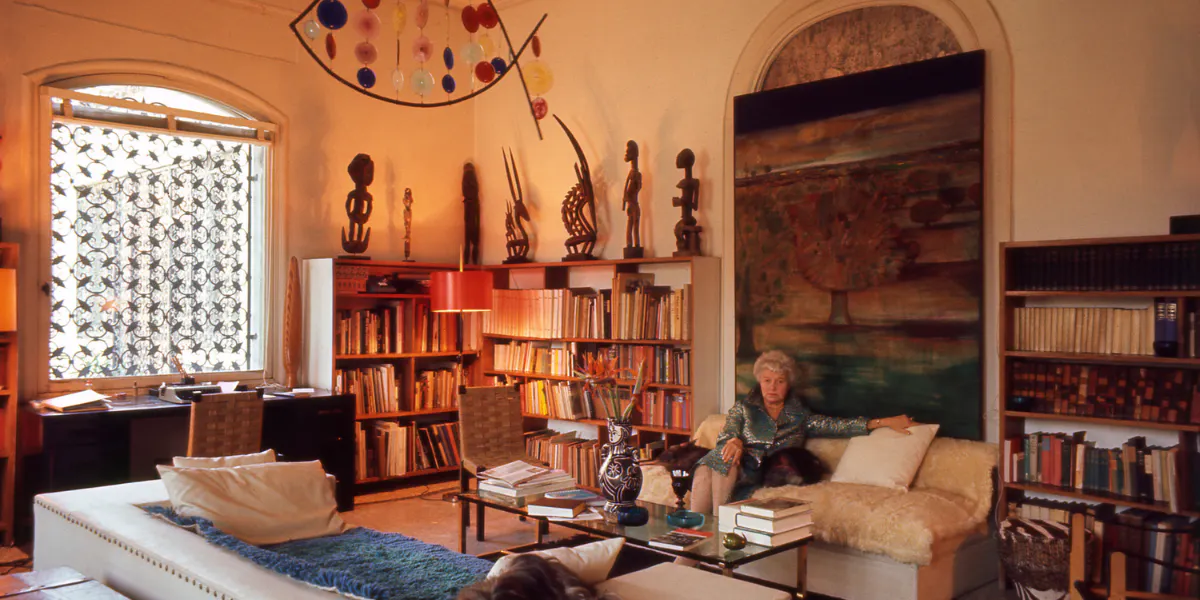
Peggy Guggenheim in the library, Palazzo Venier dei Leoni, Venice, 1975. On back bookcase, left to right: suspension hook, unrecorded Western latmul artist, early 19th - early 20th century, Papua New Guinea; male figure, unrecorded artist, early 20th century, Papua New Guinea. On back right-hand bookcase: female Ci Wara headdress, probably first half of 20th century, unrecorded Bamana artist, Segou region, Mali; male Ci Wara headdress, probably first half of 20th century, unrecorded Bamana artist, Segou region, Mali; male figure (pombia), probably mid-20th century, unrecorded Senufo artist, Côte d’Ivoire; seated male figure, probably first half of 20th century, unrecorded Dogon artist, N’duleri region, Mali. Solomon R. Guggenheim Foundation. Photo Ray Wilson. Purchase Peggy Guggenheim Collection, 2007 via the Peggy Guggenheim Collection (detail)

Peggy Guggenheim in the library, Palazzo Venier dei Leoni, Venice, 1975. On back bookcase, left to right: suspension hook, unrecorded Western latmul artist, early 19th - early 20th century, Papua New Guinea; male figure, unrecorded artist, early 20th century, Papua New Guinea. On back right-hand bookcase: female Ci Wara headdress, probably first half of 20th century, unrecorded Bamana artist, Segou region, Mali; male Ci Wara headdress, probably first half of 20th century, unrecorded Bamana artist, Segou region, Mali; male figure (pombia), probably mid-20th century, unrecorded Senufo artist, Côte d’Ivoire; seated male figure, probably first half of 20th century, unrecorded Dogon artist, N’duleri region, Mali. Solomon R. Guggenheim Foundation. Photo Ray Wilson. Purchase Peggy Guggenheim Collection, 2007 via the Peggy Guggenheim Collection (detail)

While Peggy Guggenheim is most known for her avant-garde collection of Modern art from Europe and the United States, a lesser-known, yet equally important, aspect of her collection concerns her fascination with the arts of Africa, Oceania, and the Americas. 

Related: Peggy Guggenheim: 7 Fascinating Facts
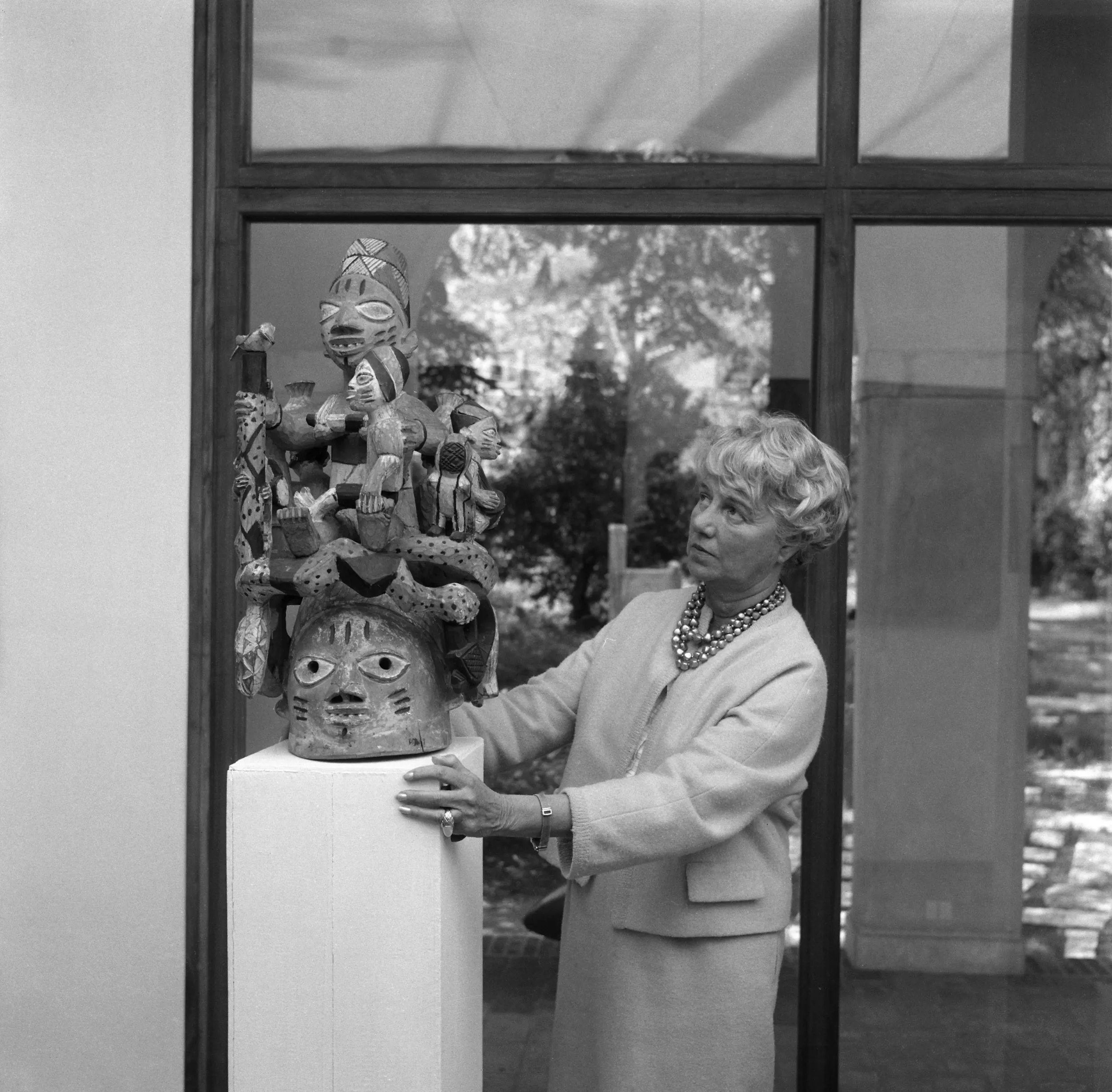
Peggy Guggenheim in the barchessa, Palazzo Venier dei Leoni, with headdress (Ago Egungun), probably first half of 20th century, workshop of Oniyide Adugbologe (ca. 1875-1949; Yoruba artist), Abeokuta, Nigeria; Venice, late 1960s. Photo Archivio Cameraphoto Epoche. The Solomon R. Guggenheim Foundation. Gift, Cassa di Risparmio di Venezia, 2005, via the Peggy Guggenheim Collection

Twelve Fantastic Artifacts

In 1959, Guggenheim purchased what she described as ‘twelve fantastic artifacts, consisting of masks and sculptures from New Guinea, the Belgian Congo, the French Sudan, Peru, Brazil, Mexico and New Ireland.' Those twelve objects would serve as the foundation of her collection of non-Western art, which she continued to expand on through the 1960s, eventually amassing around 50 works from various cultures around the world. In 2021, the Peggy Guggenheim Collection in Venice, housed in the Palazzo Venier dei Leoni (Peggy’s home and museum on the Grand Canal), displayed her collection of African, Oceanic and Pre-Columbian art in an exhibition titled Migrating Objects. The exhibition showcased the objects in their Venetian residence for the first time as a whole, juxtaposing them in conversation with other modernist works collected by Guggenheim by artists such as Alberto Giacometti, Pablo Picasso and Tancredi Parmeggiani. 
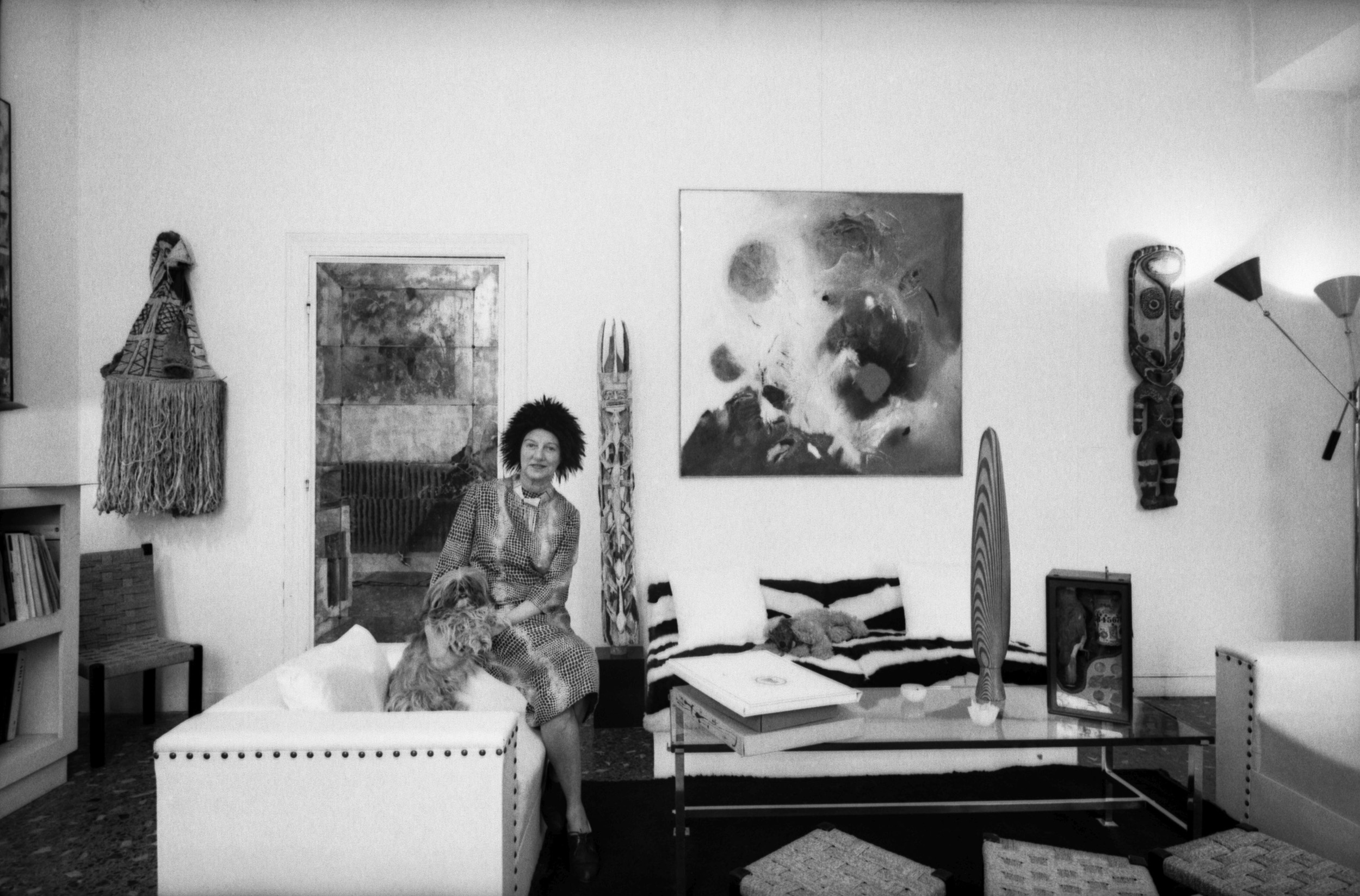
Peggy Guggenheim in the living room, Palazzo Venier dei Leoni, Venice, early 1960s. Back wall, left to right: unrecorded Cubeo artist, first half of the 20th century, Northern Amazon; funerary carving (malangan), unrecorded Mandara (or Tabar) artist, early 20th century, Northern New Ireland; Event #247, 1956, Edmondo Bacci; ancestor figure, unrecorded Sawos artist, Yamok Village, East Sepik Province, Papua New Guinea. The Solomon R. Guggenheim Foundation. Photo Archive Cameraphoto Epoche. Gift, Cassa di Risparmio di Venezia, 2005 via the Peggy Guggenheim Collection

Collecting non-Western art

Guggenheim’s collection reflected the increasing popularity of African, Oceanic and Pre-Columbian art available in the West from the 1950s. Indeed, though Guggenheim had been a pioneer in her patronage of certain European and American contemporary artists, her turn to non-Western art is thought to have been fairly mainstream. 

Related: Max Ernst: 5 Facts to Know

Max Ernst, the German-American surrealist painter to whom Guggenheim was briefly married, was for example an avid collector of Pre-Columbian and Oceanic art and likely influenced Guggenheim’s own journey. By 1959, when she acquired those first twelve artifacts, New York had become a center for the African art market in particular, with several galleries specializing in reselling artifacts to collectors and artists. But already beginning in the late 19th century objects from Africa, the Pacific and South America started to be brought to Europe through colonial trade and ethnographic expeditions. In the first decade of the 20th century, Western modernist artists such as Giacometti, Matisse and Picasso began collecting and somewhat appropriating African and Oceanic art aesthetics. These artists found ethnographic objects alluringly exotic, evoking a sense of unfamiliarity and authenticity untouched by modernity.
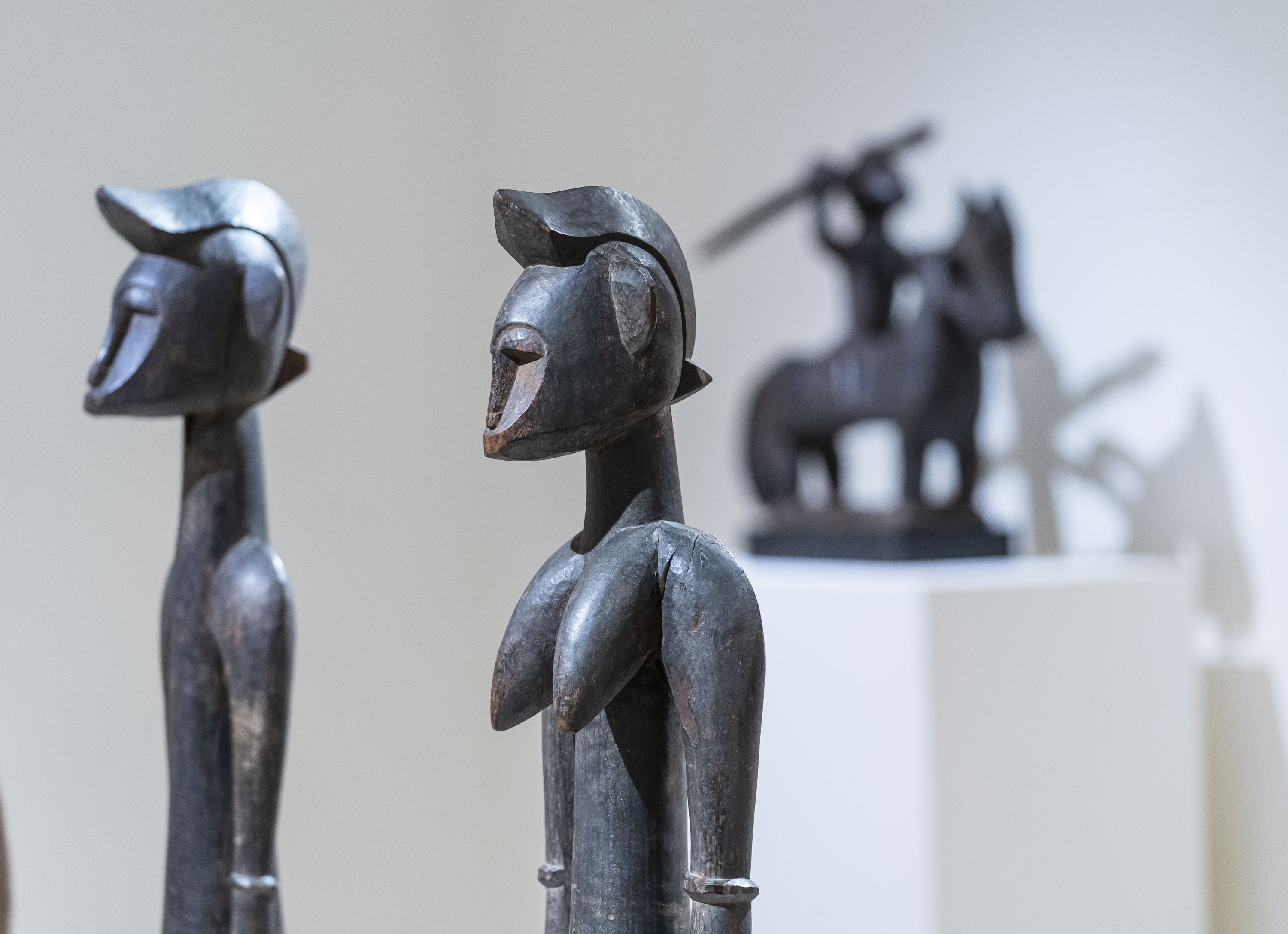
Migrating Objects: Arts of Africa, Oceania, and the Americas in the Peggy Guggenheim Collection. Curated by Christa Clarke, R. Tripp Evans, Ellen McBreen, Fanny Wonu Veys, with Vivien Green. Peggy Guggenheim Collection, February 15 - June 15, 2020. Photo © Matteo De Fina via the Peggy Guggenheim Collection

Their interest in these objects is now referred to as ‘modernist primitivism’: a fascination with objects and cultures from parts of the world that were improperly thought to be more primitive. Their engagement was mainly aesthetic: removed from their homelands, these works were de-contextualized, their origins obscured, and their intended purpose often ignored. Many of Guggenheim’s contemporaries even argued for the deliberate ignorance of the subject. English sculptor Henry Moore, for example, argued that to understand 'primitive' art, 'it is more important to look at it than to learn the history.' 

Related: Henry Moore: 8 Little Known Facts

Peggy Guggenheim and African art

Guggenheim's collection of African art reflects the prevailing aesthetic preferences of the 1950s and 1960s. It includes sculptures from West and Central Africa, originating from countries such as Guinea, Mali, Côte d'Ivoire, Nigeria, Gabon, the Democratic Republic of Congo, and Angola. The collection features celebrated types of objects favored by Western modernists, including a Baga D'mba headdress from Guinea and a Kota reliquary guardian figure from Gabon. There are several Senufo sculptures from Burkina Faso, Côte d'Ivoire, and some examples of Dogon sculptures from Mali. Most of the African works in her collection were created in the first half of the 20th century, making them contemporary to her Western works.

Related: How Dogon Art Inspired Western Artists
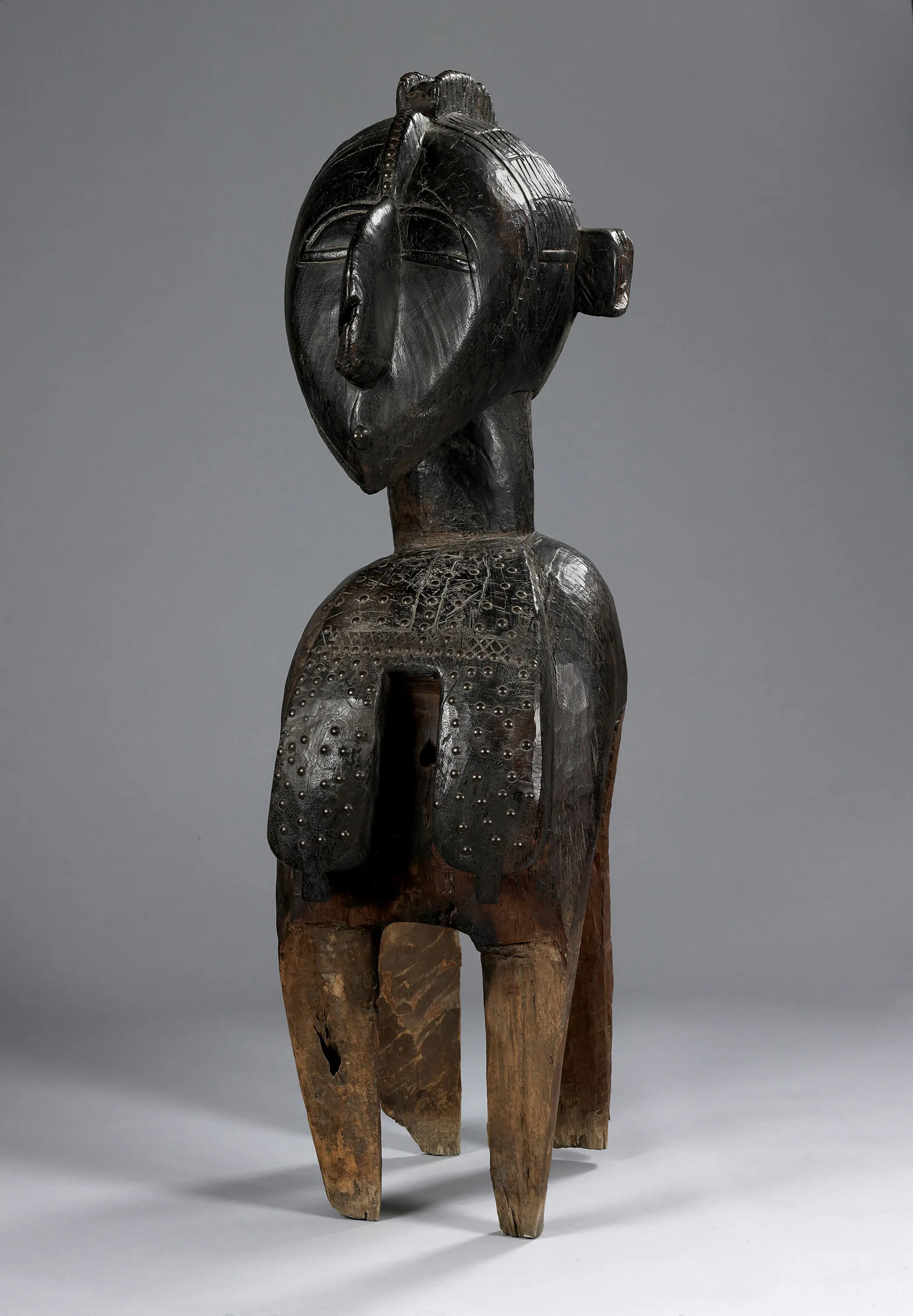
D'mba headdress, probably first half of 20th century. Unrecorded Baga artist, Guinea. Wood and brass tacks, 142 x 40 x 75 cm. Photo © manusardi.it via the Peggy Guggenheim Collection

Peggy Guggenheim and Oceanic art

Guggenheim's collection includes nine objects from the Pacific, predominantly from the part of Papua New Guinea that was under German occupation. Two malangan objects, one mask and one sculpture, from New Ireland, and one Chamber flute stopper from the Sepik River area in New Guinea are included. One of the most striking objects from the Indonesian province of Papua is an Asmat soul canoe, or wuramon, which Guggenheim bought in the 1960s. It portrays a group of supernatural creatures, each named for a specific recently deceased ancestor, whose spirit they embody. The center is dominated by a water spirit, and going down the hull there are figures that represent other spirits, with a bird on one end.

Related: Oceanic Art: a Beginner’s Guide
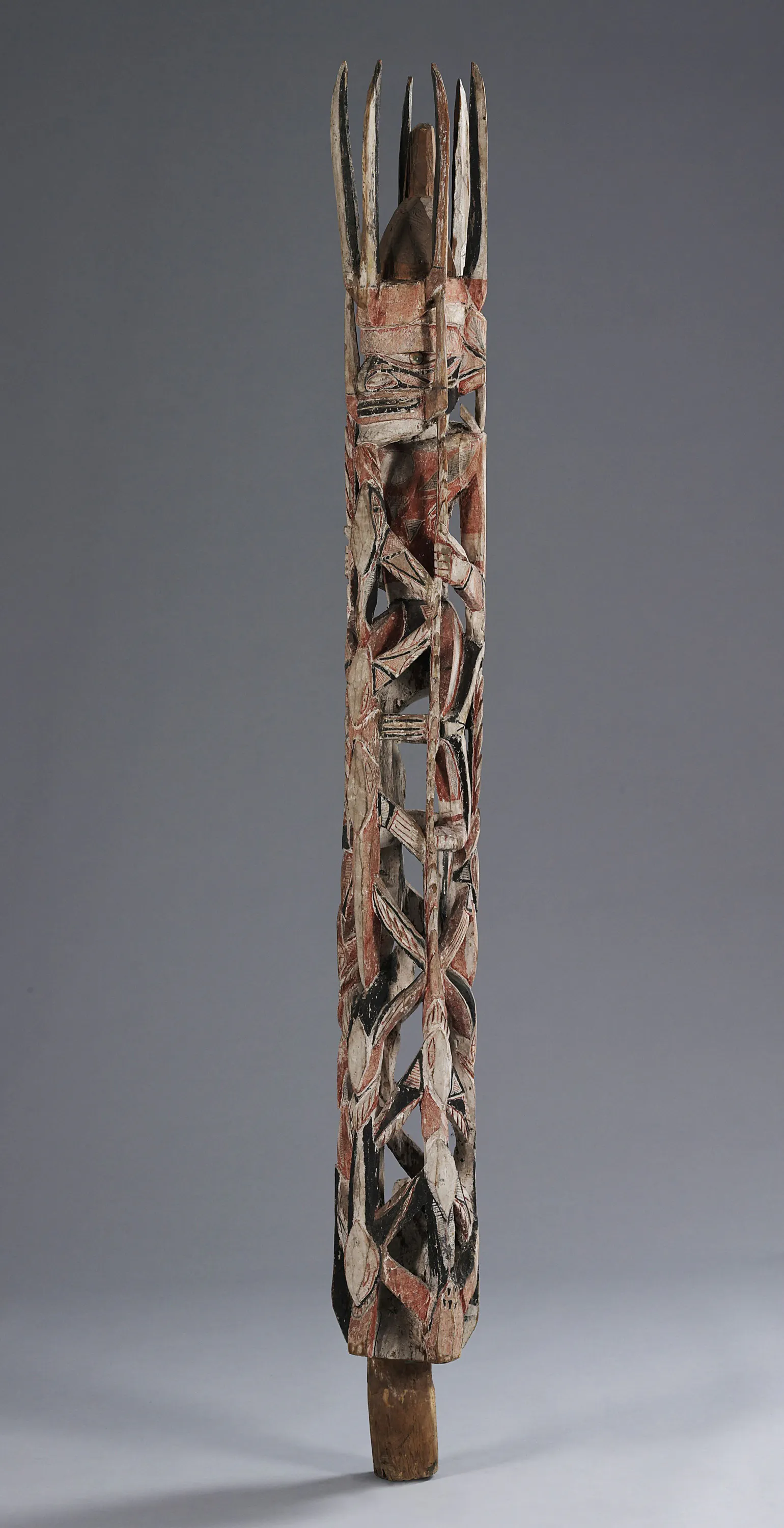
Funerary carving (malangan maramarua), early 20th century. Unrecorded Mandara (or Tabar) artist, Tabar Island, Northern New Ireland, Papua New Guinea. Wood, natural pigment, and sea snail opercula, 170 x 22 x 22 cm. Photo © manusardi.it via the Peggy Guggenheim Collection

Peggy Guggenheim and Pre-Columbian art

Guggenheim's interest in Pre-Columbian art was sparked by her husband Max Ernst, who introduced her to it after their trip to Mexico in 1959. While she had less firsthand knowledge of Andean and Amazonian art, her selection of South American works demonstrates somewhat of a genuine engagement. Among her collection, three works from ancient West Mexico stand out. Guggenheim's terracotta figures from Nayarit, two freestanding figures and one marriage pair with an infant, exemplify the small-scale sculpture of ancient West Mexico. Despite their cultural and geographical differences, these pieces all have a connection to funerary practices, serving as a form of remembrance for the deceased. Her Chimu works, a three-panel mummy mask and a feather poncho, were derived from elite burials and are excellent examples of Pre-Columbian art.

Related: The 5 Most Famous Civilizations of Pre-Columbian Art
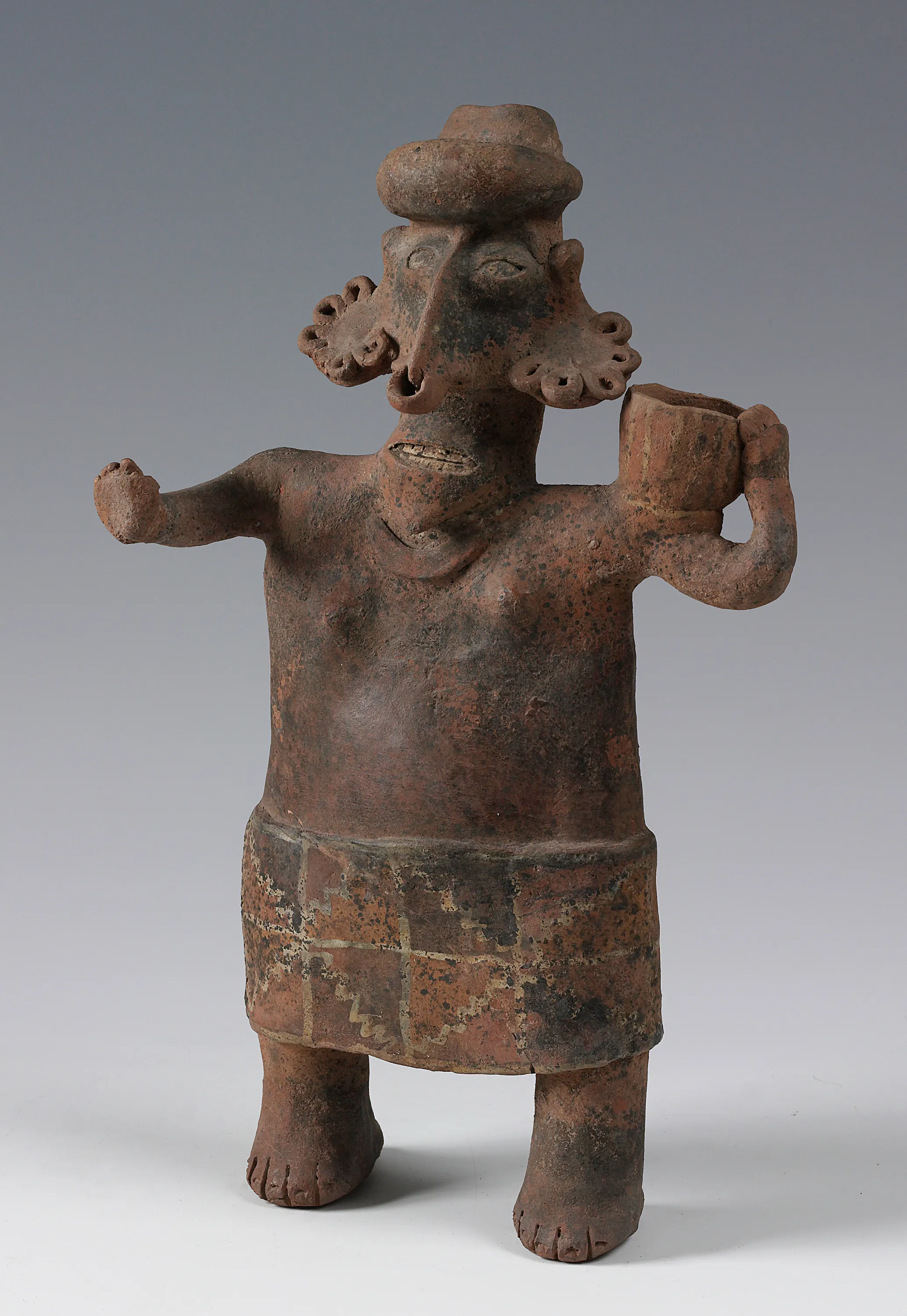
Female figure, 300 BCE-400 CE. Unrecorded Nayarit artist (Ixtlán del Río culture), ancient West Mexico. Slip-painted terracotta 42 x 24 x 13 cm. Photo © manusardi.it via Peggy Guggenheim Collection

The making of a museum

A survey of the original photographs taken while Peggy Guggenheim was living in the Palazzo Venier dei Leoni suggests a primarily aesthetic engagement with these objects. In many of her installations, Guggenheim essentially followed what scholars have termed the ‘affinity’ model’: juxtaposing Western art and ethnographic artifacts for visual impact, focusing only on the formal qualities, perhaps uncritically.
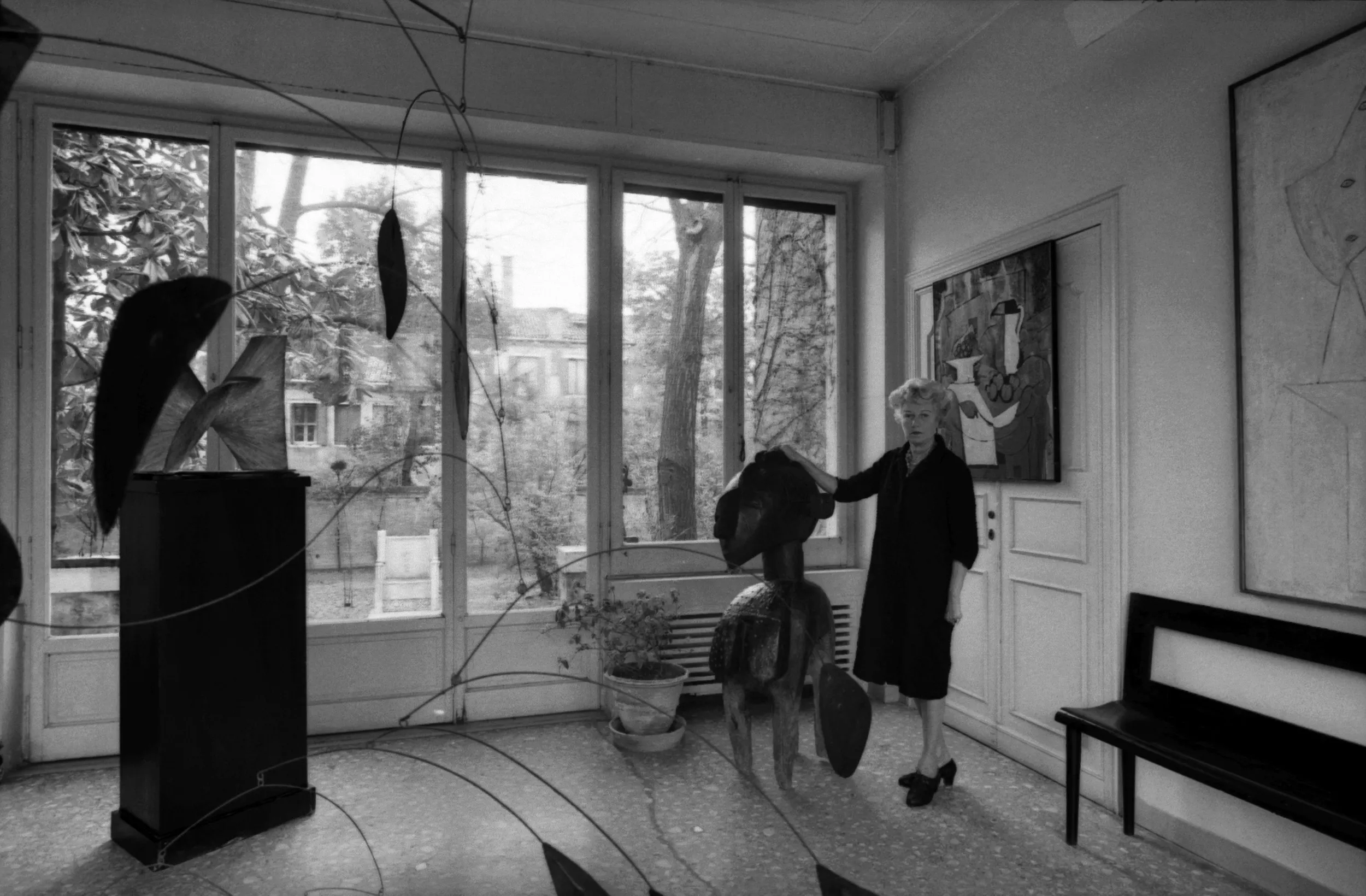
Peggy Guggenheim in the foyer of Palazzo Venier dei Leoni next to a D'mba headdress, probably first half of 20th century, unrecorded Baga artist, Guinea; Venice, 1960s. The Solomon R. Guggenheim Foundation. Photo Archivio Cameraphoto Epoche. Gift, Cassa di Risparmio di Venezia, 2005 via the Peggy Guggenheim Collection

In a 1966 photograph of the Palazzo, for example, a Dogon seated male figure from Mali stands in front of Picasso’s On The Beach from 1937. The juxtaposition emphasizes the visual overlaps between the two: the abstract forms, the flat surfaces and the contrasts between round and straight lines. In another instance, a D’mba sculpture made by a Baga artist from Guinea appears in front of Picasso’s The Studio (1928) for a similar visual impact. Similarly, her West Mexican standing figures are installed as to encourage visual resemblances and emphasize and reflect back onto the modernist works, whether they are seen flanking Picasso’s The Poet (1911) or Kandinsky’s Landscape with Red Spots No.2 (1913).

Want more articles like this delivered straight to your inbox? Subscribe to our free newsletter!
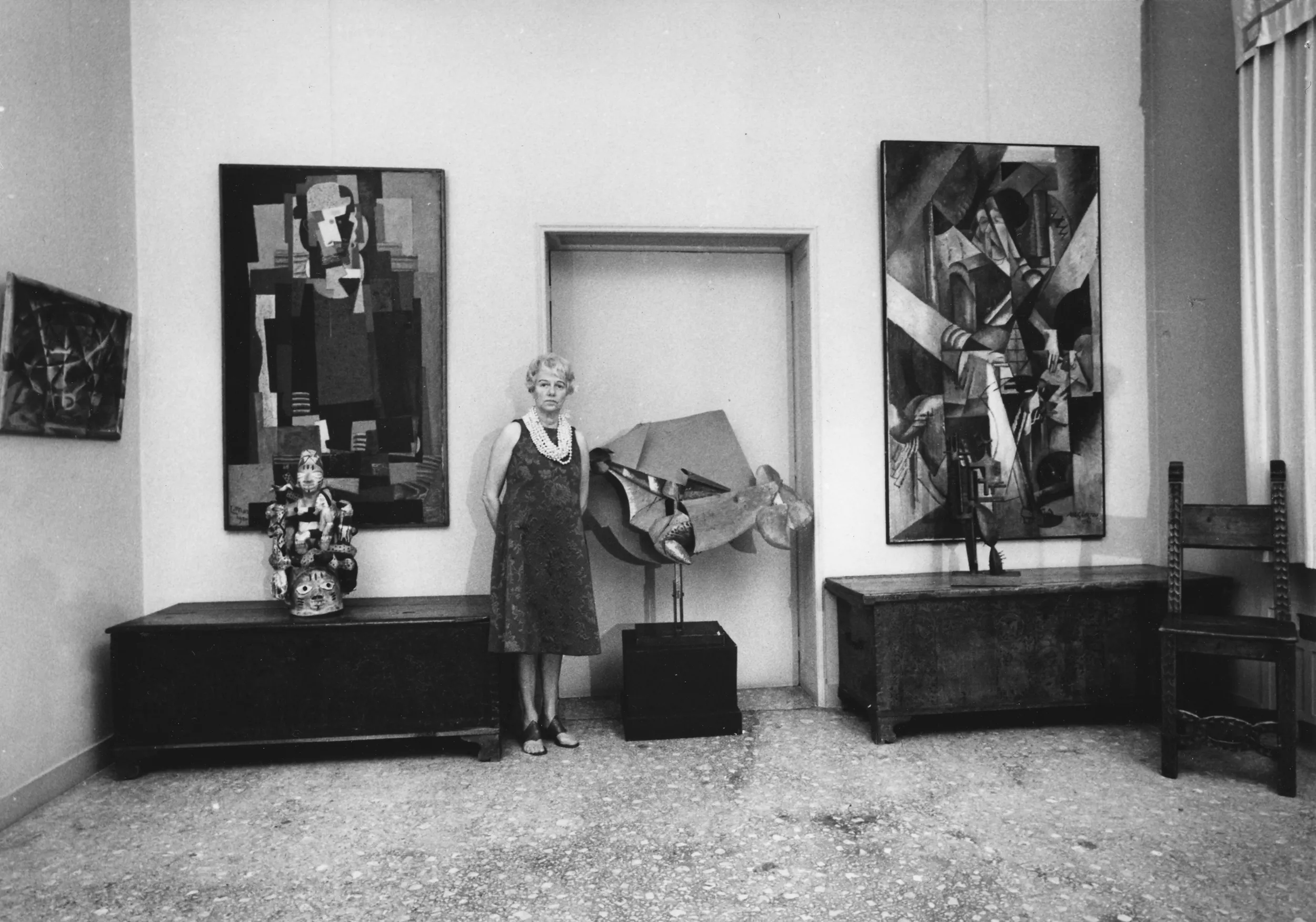
Peggy Guggenheim in the dining room of Palazzo Venier dei Leoni, Venice, late 1960s. Next to her, on the left, headdress (Ago Egungun), probably first half of 20th century, workshop of Oniyide Adugbologe (ca. 1875-1949; Yoruba artist), Abeokuta, Nigeria. Behind her, left to right: Abstract Speed + Sound (Velocità astratta + rumore) 1913-14, Giacomo Balla; The Regular, 1920, Louis Marcoussis; Dynamism of a Speeding Horse + Houses, 1914-15, Umberto Boccioni; Woman with Animals (Madame Raymond Duchamp-Villon), 1914, Albert Gleizes; Cactus Man I, 1939, Julio González. The Solomon R. Guggenheim Foundation. Photo Archivio Cameraphoto Epoche. Gift, Cassa di Risparmio di Venezia, 2005 via the Peggy Guggenheim Collection

Removed from their contexts, these objects are combined in various stagings to create new meanings. For some artists and intellectuals of the time, this was the very essence of art-making and curating. André Breton, for example, advocated for such de-contextualization. As one of the founders of Surrealism, he declared that ‘From the beginning, the course of Surrealism is inseparable from the power of seduction, of fascination, that Oceanic objects exerted over us’. Breton argued for the need to liberate objects from their contexts and origins in order to reach a collective visionary imagination. And so in Guggenheim’s collection, Oceanic objects such as a malanga carving from Papua New Guinea are often found facing surrealist painters, including the paintings of her husband Max Ernst.

Related: Surrealism and the Subconscious
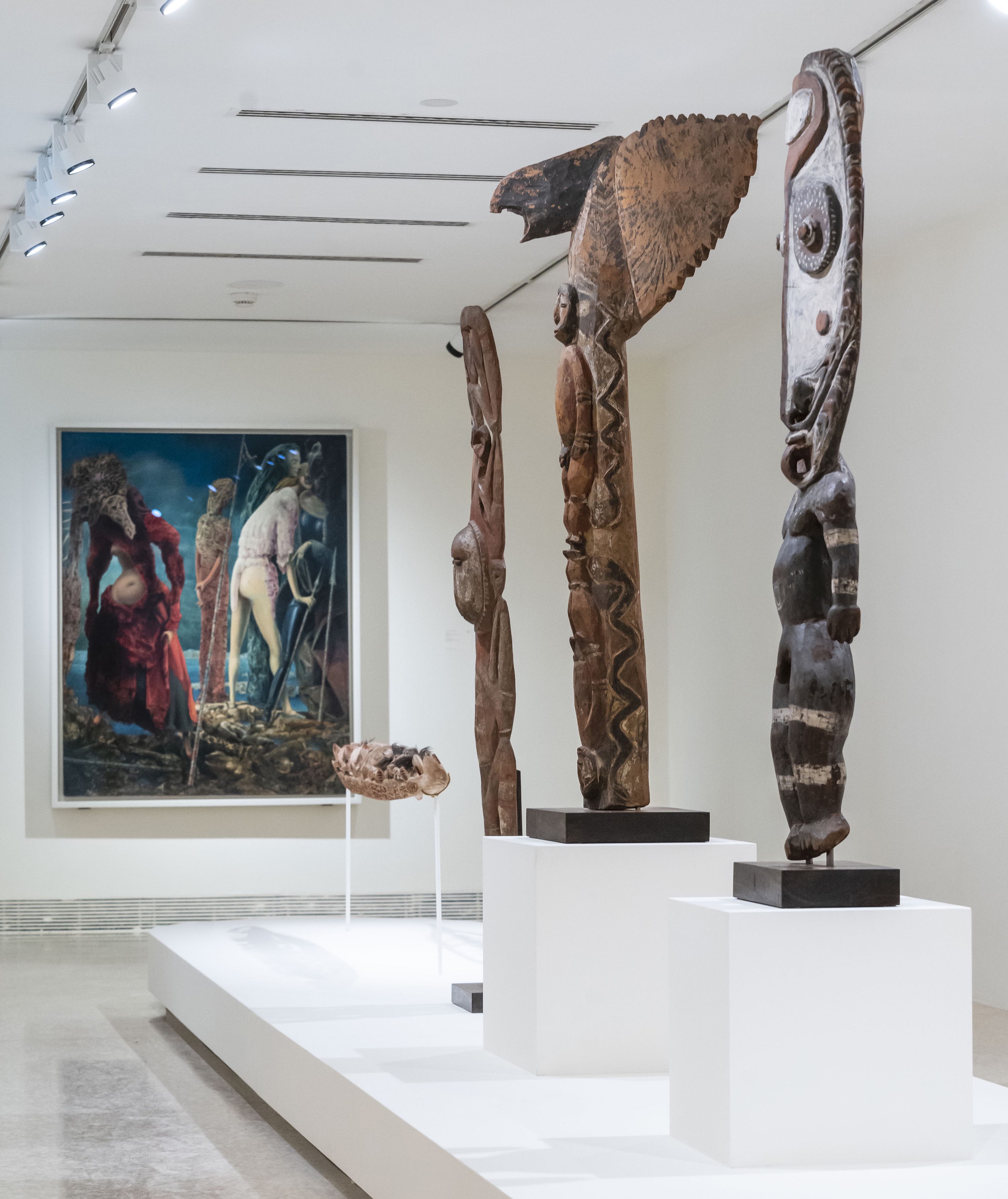
Migrating Objects: Arts of Africa, Oceania, and the Americas in the Peggy Guggenheim Collection. Curated by Christa Clarke, R. Tripp Evans, Ellen McBreen, Fanny Wonu Veys, with Vivien Green. Peggy Guggenheim Collection, February 15 - June 15, 2020. Photo © Matteo De Fina via the Peggy Guggenheim Collection

For the less sympathetic critics, Guggenheim's engagement with non-Western art presents as no more than refined decoration, in contrast to her modernist collecting, which seems more thoughtful. For others, however, the juxtapositions she created in her installations have the potential to stir viewers and perhaps reach into that collective imagination, as the Surrealists would have hoped.

Find more articles in Barnebys Magazine

Peggy GuggenheimMax ErnstAfrican artOceanic artPre-Columbian art

Join 200,000+ collectors reading Barnebys Magazine

By subscribing, you are agreeing to the privacy policy. Unsubscribe anytime.

About the author

Giulia Zileri Dal Verme

Giulia Zileri Dal Verme is the Global Senior Editor at Barnebys Magazine. She read Classics at Oxford University and studied Art Business at Sotheby’s Institute of Art. Her research focuses on the intersection between cultural practices and visual art, with a keen interest towards the ancient world. She is engaged in the auction market and particularly fascinated by London’s thriving art scene.

Read more from this author
Giulia Zileri Dal Verme

Explore related articles

Art Leven's 'First Nation Fine Art Auction' will take place on Tuesday 17th June 2025, featuring 82 works by First Nations artists of outstanding cultural and historical significance. Photo © Art Leven
Works of Art

Beyond the Sale: Art Leven on Stewardship, Legacy, and First Nations Art

Spectacular large shallow basket decorated with decoration of the Morning Eagle on interior, Yei Be Chei Corn People. Image © Thomaston Place Auction Galleries (detail)
Antiquities

Tribal Art and Antiquities in the Spotlight

John Akomfrah, Purple. Installation premiered in 2019 at the  ICA Watershed, US. Licence CC BY-SA 4.0 via Wikimedia Commons.
Works of Art

John Akomfrah Will Represent Britain at the 2024 Venice Biennale

Bring your auction to collectors worldwide!