Stay up-to-date with the antiques world

By subscribing, you are agreeing to the privacy policy. Unsubscribe anytime.

Barnebys

Barnebys HQ

Brahegatan 10
BOX 5038
114 37 Stockholm

Company

  • About Us
  • Join Barnebys
  • Our partners
  • Press
  • Career

Explore More

  • Barnepedia
  • Buying/Selling at auction
  • Auction Houses / Dealers / Galleries

Support

  • FAQ
  • Terms of Use
  • Privacy and Cookies policy
  • Contact us
  • Barnebys Group AB
  • Barnebys.se
  • Barnebys.com
  • Barnebys.co.uk
  • Barnebys.de
  • Barnebys.fr
  • Barnebys.es
  • Barnebys.it
  • Barnebys.hk
  • All auction items
  • Categories
  • Auction results
  • Magazine
  • Ancient Art
  • Arts & Graphics
  • Asian Art
  • Books, Maps & Manuscripts
  • Carpets, Rugs & Textile
  • Coins & Banknotes
  • Contemporary Art
  • Ethnographic
  • Fashion & Vintage
  • Folk Art
  • Furniture, Design & Mirrors
  • Glass
  • Jewelry & Gems
  • Lighting
  • Medals, Arms & Armor
  • Miscellaneous
  • Music & Musical Instruments
  • Nautica, Technica & Optic
  • Photographs
  • Porcelain & Pottery
  • Postcards & Stamps
  • Sculptures
  • Silver & Gold
  • Sports & Leisure
  • Tin & Metals
  • Toys & Collectibles
  • Vehicles
  • Watches & Clocks
  • Wine & Spirits
  • Works of art
  • All auction items
  • Auction results
  • Magazine
  • Get an appraisal
  • Auction system

Barnebys Magazine

LatestEditor's picksTopics
Magazine/Ancient Art/Restored Apollo Belvedere Returns to the Vatican Museums

Restored Apollo Belvedere Returns to the Vatican Museums

The ancient statue is among the most famous pieces of the papal collection.

October 21, 2024Gritta von Toll
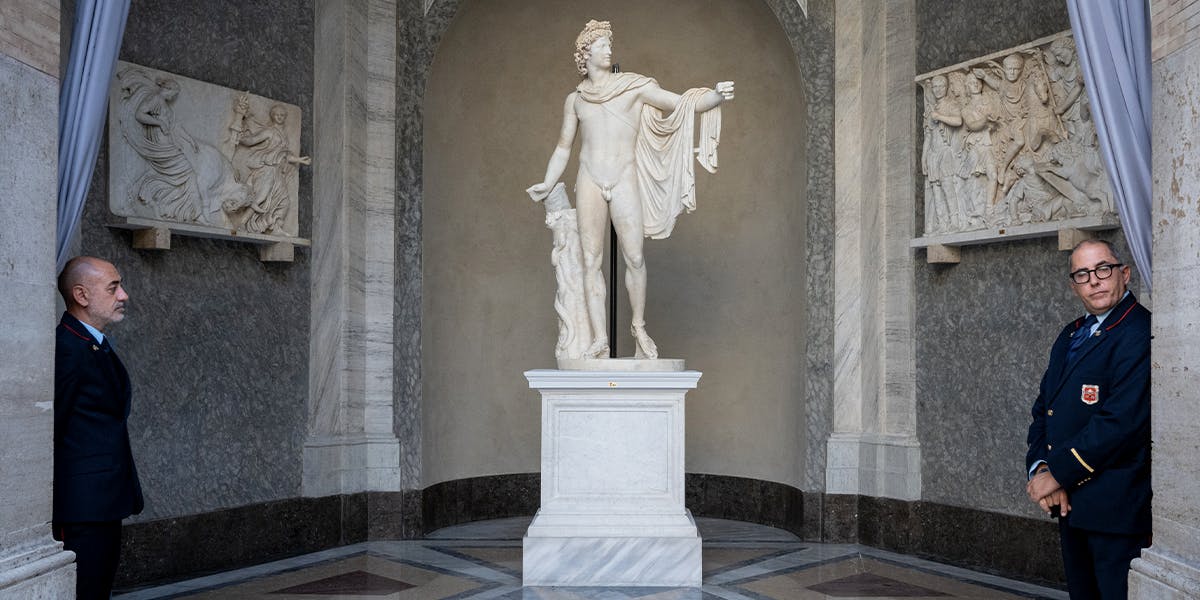
VATICAN CITY, VATICAN - 15. 10. 2024: The marble statue "Apollo Belvedere" returns to the display of the Vatican Museums after its restoration. The statue was discovered in 1489 on the Viminal Hill in Rome and brought to the Vatican between 1508 and 1509 at the behest of Pope Julius II. Pope Julius II had the statue courtyard in the Belvedere designed there with a complex iconographic program focusing on the mythical origins of ancient Rome. (Photo by Stefano Costantino/SOPA Images/LightRocket via Getty Images)(detail)

VATICAN CITY, VATICAN - 15. 10. 2024: The marble statue "Apollo Belvedere" returns to the display of the Vatican Museums after its restoration. The statue was discovered in 1489 on the Viminal Hill in Rome and brought to the Vatican between 1508 and 1509 at the behest of Pope Julius II. Pope Julius II had the statue courtyard in the Belvedere designed there with a complex iconographic program focusing on the mythical origins of ancient Rome. (Photo by Stefano Costantino/SOPA Images/LightRocket via Getty Images)(detail)

Even gods need a bit of pampering now and then: In 2019, the famous marble statue Apollo Belvedere was taken from its usual place in the Vatican's Belvedere Courtyard for an extensive restoration. Cracks had appeared on its legs and knees, which needed repairing. A laser cleaning was also performed, and a carbon fibre support was added to the back to improve its stability for the future.

See also: 5 Must-See Sculptures in Italy

The Apollo Belvedere is a Roman marble copy of a lost Greek bronze sculpture, created around 330 BC. It is attributed to the late Classical sculptor Leochares, who also worked for Alexander the Great and his father, Philip of Macedonia.

The 2.24-metre-high Roman copy, made from Carrara marble in the 2nd century, was rediscovered in the late 15th century. Shortly after, it was acquired by Cardinal Giuliano della Rovere, who, upon becoming Pope Julius II, had it placed in 1511 in the courtyard of the papal summer palace, Belvedere, in the Vatican. The Apollo Belvedere remains there to this day, housed since 1803 in a pavilion commissioned by Pope Pius VII. Its "neighbours" include the Laocoön Group, another famous piece from Julius II's collection.

See also: How an Ancient Sculpture Changed Renaissance Art

For a long time, the Apollo Belvedere was regarded as the most beautiful sculpture of antiquity, captivating admirers such as Goethe and the archaeologist Johann Joachim Winckelmann.

Want more articles like this delivered straight to your inbox? Subscribe to our free newsletter!

The Vatican Museums are among the most important in the world, housing an extensive collection of artworks spanning several millennia, from antiquity to the present day. The famous Sistine Chapel is also part of this vast complex and undoubtedly contributed to the Vatican Museums being ranked second on the list of the most visited museums in the world last year.

Find more articles in Barnebys Magazine

sculptureancient sculptureapollo belvederevatican museums

Join 200,000+ collectors reading Barnebys Magazine

By subscribing, you are agreeing to the privacy policy. Unsubscribe anytime.

About the author

Gritta von Toll

Gritta von Toll is the German Editor at Barnebys Magazine. She completed studies in pre- and early history and archaeology, and since 2015, after a short detour into the world of advertising, she has worked at Barnebys, where she immerses herself in art history in order to bring bygone epochs closer to today's readers.

Read more from this author
Gritta von Toll

Bring your auction to collectors worldwide!