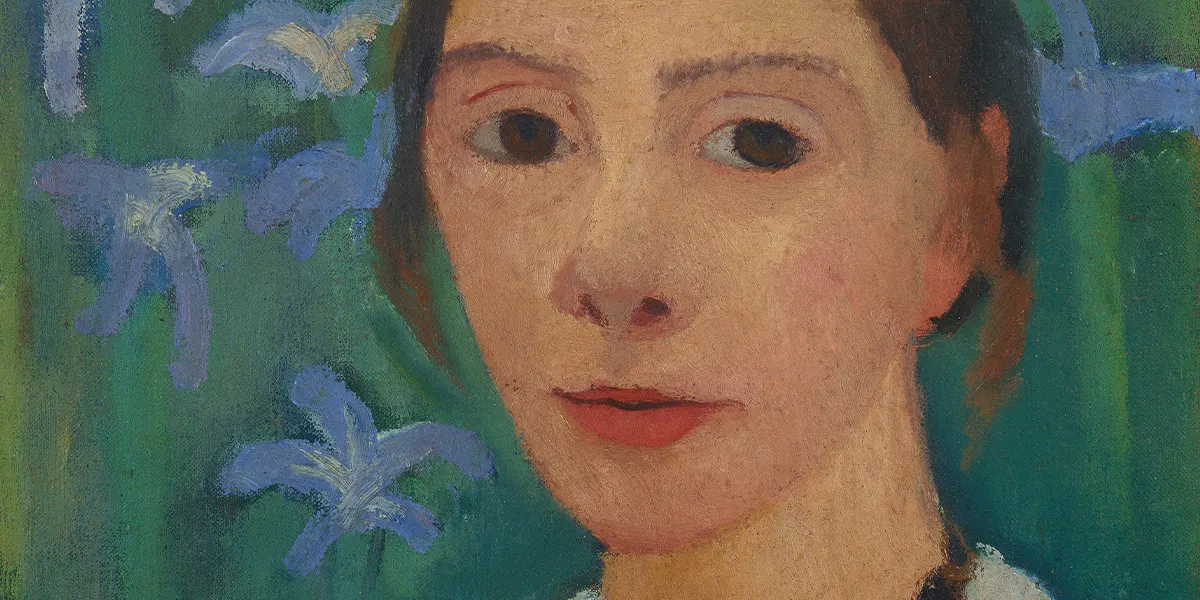
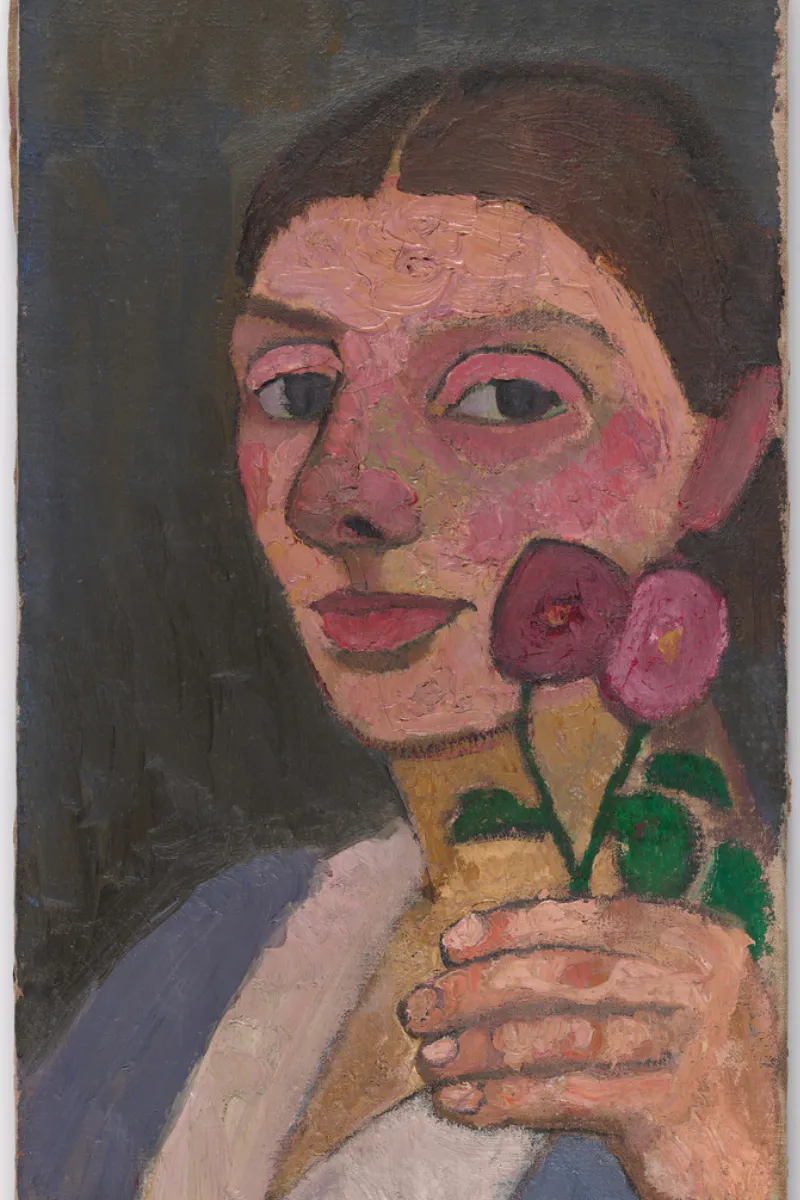
To mark the 150th anniversary of the birth of Paula Modersohn-Becker, an important pioneer of Expressionism, we look back at her remarkable but tragically short life through five key moments.
1. She was expected to become a governess
Minna Hermine Paula Becker was born on 8 February 1876 in Dresden into a family where art, music and literature played an important role. After the family moved to Bremen in 1888, she set up a small studio in the house and began drawing regularly.
Her parents supported her education but expected her to pursue a respectable profession. Teaching was considered appropriate for a middle-class woman, while a career as an artist was not. Paula therefore enrolled at a teacher training college in Bremen and completed her studies in September 1895.
In reality, however, she had little interest in becoming a teacher. Art had already become central to her life. The following year she moved to Berlin to study at the drawing and painting school of the Association of Berlin Women Artists and Art Lovers, where she remained until completing the programme in May 1898.
See also: 10 Artist Couples You Should Know
2. Worpswede became her place of inspiration
During these years Paula spent much of her time visiting exhibitions and museums. She admired Old Masters such as Rembrandt and Dürer, but she was equally interested in more recent artistic developments.
In April 1895 she encountered the painters of the Worpswede artists’ colony for the first time at an exhibition. The group had settled in the nearby village of Worpswede in the Teufelsmoor, where they sought to work independently of academic conventions, following the example of the Barbizon School.
Paula was immediately drawn to the idea and was particularly impressed by the paintings of Fritz Mackensen and Otto Modersohn, who would later become her husband. She first visited Worpswede in the summer of 1897 with her parents. A small inheritance and financial support from relatives eventually allowed her to move there in September 1898, where she studied under Mackensen. The landscape, the changing light and the lives of the local farming community soon became central subjects in her work.
See also: The Art of Plein Air Painting

3. Paris held a special fascination
Although Worpswede provided a supportive and inspiring environment, another city exerted an even stronger pull on Paula: Paris. At the turn of the century it was the centre of the European avant-garde, and she increasingly felt that the naturalistic approach of the Worpswede painters could not fully satisfy her artistic ambitions.
On New Year’s Eve 1900 she travelled to the French capital for the first time. During her stay she attended the Académie Colarossi, where she even won an internal semester competition, and took anatomy classes at the École des Beaux-Arts. She also spent long hours in the Louvre, sketching paintings and sculptures.
See also: 8 Patrons of the Parisian Avant-garde
A particularly important discovery came at the gallery of the art dealer Ambroise Vollard, where she encountered the work of Paul Cézanne. His approach to form and structure would leave a lasting impression on her.
Paula returned to Paris several times over the following years. During a second stay in the spring of 1903, by then married to Otto Modersohn, she became interested in Japanese woodblock prints and the late antique Fayum portraits on Egyptian sarcophagi. Two years later she travelled to the city once more, attending the Académie Julian and discovering the work of Gauguin and the Nabis, as well as Matisse and the Fauves. Each visit broadened her artistic horizon, and she carried these new influences back to Worpswede, where they gradually found their way into her own increasingly distinctive style.
See also: Paul Cézanne: 5 Things to Know
4. She shared a close friendship with Rilke
The social centre of the Worpswede artists’ colony was the Barkenhoff, the home of the painter Heinrich Vogeler and his wife Martha. Artists, writers and intellectuals gathered there regularly, and it was in this setting that Paula met the poet Rainer Maria Rilke in the autumn of 1900.
Vogeler had first met Rilke in Italy two years earlier and later invited him to visit Worpswede. Rilke soon became part of the circle and, in 1901, married Paula’s friend Clara Westhoff, a sculptor who also lived in the colony.
Paula and Rilke quickly developed a close intellectual friendship. Both shared a desire for a freer life beyond the expectations of bourgeois society, and both regarded Paris as an important point of reference for their work. Rilke himself spent time there working as secretary to the sculptor Auguste Rodin.
Although their personalities were quite different, Rilke admired Paula’s determination and the independence of her artistic path. He also recognised the originality of her work, which he compared to that of Vincent van Gogh.
See also: 8 Paintings that Vincent Van Gogh Copied

5. Her dream of independence remained unfulfilled
At the beginning of 1906 Paula became convinced that she wanted to live permanently in Paris, even if this meant separating from Otto Modersohn. During this period she met the sculptor Bernhard Hoetger, who was deeply impressed by her work. At the same time, however, he made her aware of how difficult it would be to achieve financial independence as an artist.
When Otto arrived in Paris in October, Paula ultimately abandoned her plan to remain there. Another wish had also remained unfulfilled: she longed to have a child of her own, although she was already a stepmother to Otto’s daughter from his first marriage.
Want more articles like this straight to your inbox? Subscribe to our free newsletter!
After the couple returned to Worpswede in March 1907, it soon became clear that Paula was pregnant. She was overjoyed, even though she regretted that her condition increasingly limited her ability to paint.
On 2 November her daughter Mathilde was born. Just eighteen days later, Paula Modersohn-Becker died of an embolism. She was thirty-one years old.