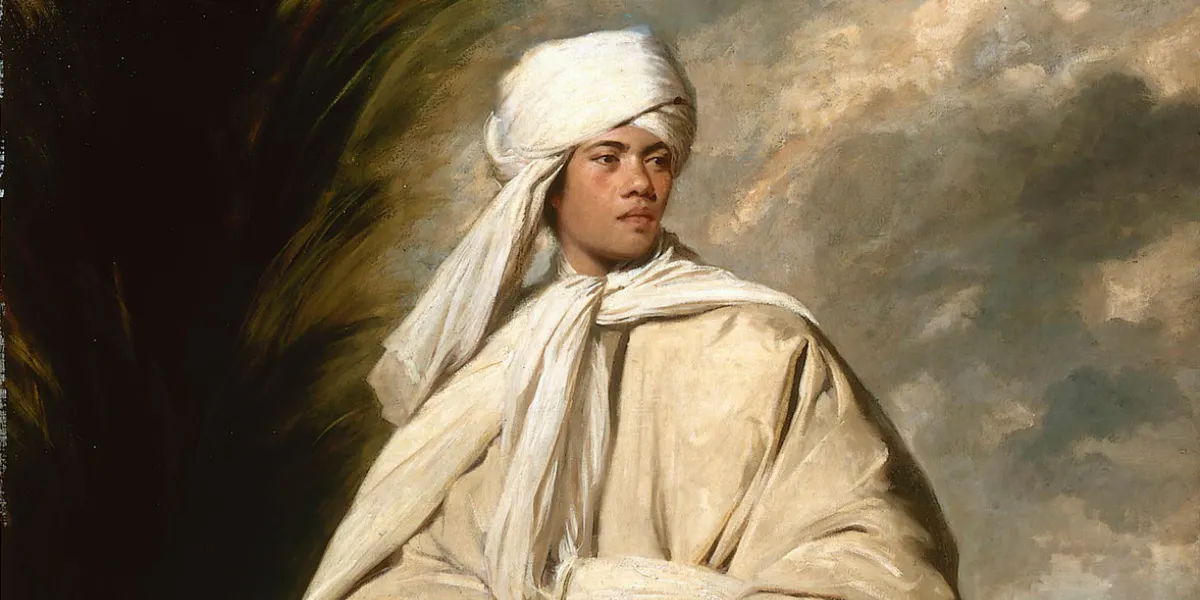
Known as ‘Omai’ in England, Mai (1753 - 1780) was a native of Raiatea, part of French Polynesia, who in his twenties had traveled from Tahiti to England with Captain James Cook on his second voyage into the Pacific. Arriving in London on the HMS Adventure in 1774, Mai caused a great stir of excitement and quickly became surrounded by luminaries such as the President of the Royal Society and the novelist Fanny Burney, even meeting King George III (for whom Joshua Reynolds was 'Principal Painter in Ordinary'). During the two years he spent in London, Mai became a kind of celebrity among the most important circles, eventually becoming immortalized in a majestic portrait by Joshua Reynolds.
Nearly eight feet high, Reynolds’ Portrait of Mai is considered to hold an important place in art history, depicting the first Polynesian to visit Britain. The imposing figure of Mai is portrayed barefoot in front of a rural Arcadian landscape, wearing a traditional tapa cloth, or a toga, and a headdress of Turkish or Indian inspiration. The pose is inspired by the Apollo Belvedere and emphasizes the tattoos on Mai’s hands.
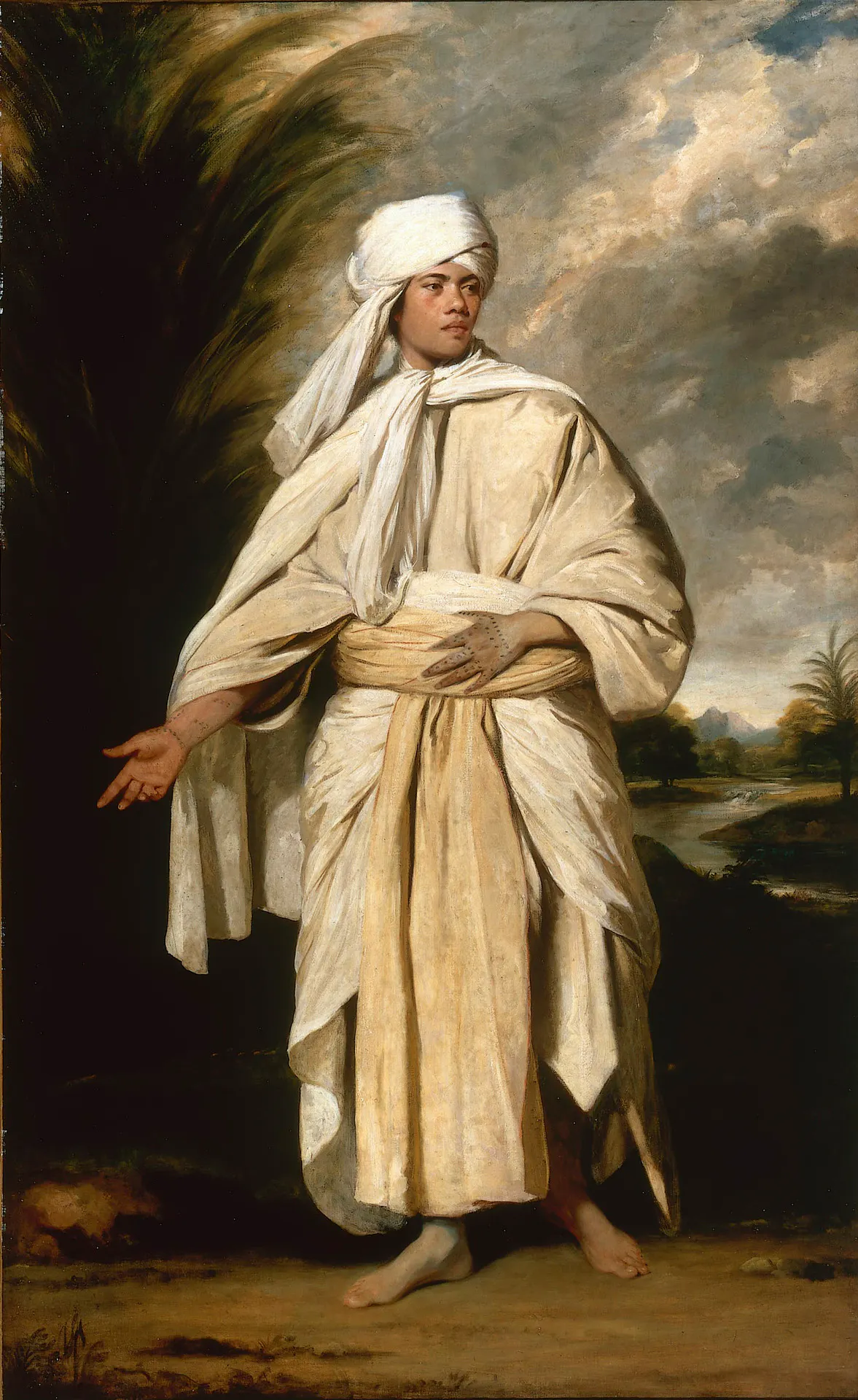
For some, Reynolds' depiction of Mai celebrates a progressive idea of globalism and cultural exchange; for others, the highly stylized rendition of Mai plays on colonialist notions of the 'noble savage' that have now been put into perspective. Most scholars, nonetheless, agree that it is one of the finest pictures painted by the artist, who captured this complex cultural encounter with dignity and authority.
Related: Thomas Gainsborough: Grand Portraits in Nature
Painted in 1776 at the peak of Reynolds’ artistic output, it was exhibited in the same year at the Royal Academy of Arts in London alongside 11 other portraits. Lacking a specific buyer, it remained in Reynolds' studio until his death in 1792.
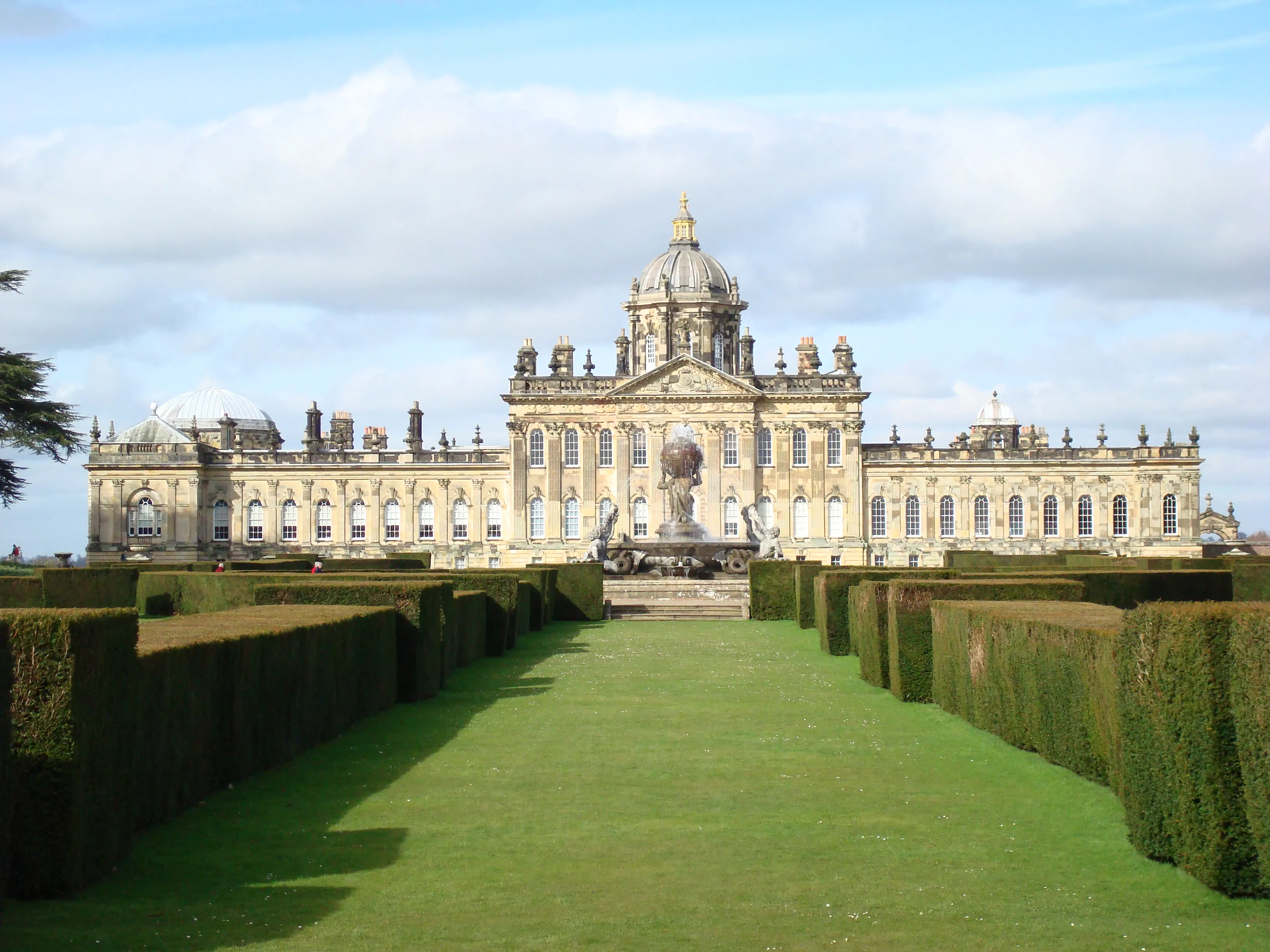
From then on, the painting has a complicated history of ownership. In 1796, it was auctioned and acquired by the art dealer Michael Bryan for 100 guineas, who then sold it to art collector Frederick Howard, who displayed it at Castle Howard for 200 years. Only in 1954 the public got to see it again, at an exhibition at the Royal Academy.
In 1984 it was put on sale by one of Howard’s descendants, but the Tate Gallery declined to pay £5.5 million for it. In 2001, it was auctioned at Sotheby’s and bought by art dealer Guy Morrison for a total price of £10.3 million, a record at the time for a work by Reynolds and the second-highest hammer price for a British artist.
Related: The 12 Most Expensive Paintings Ever Auctioned
Things got complicated when it was acquired by the Irish businessman John Magnier, who in 2002 applied to export the work to sell it at auction, but was refused so by the UK government. Tate Gallery tried to purchase the work again, this time for £12.5 million, but Magnier refused to sell.
The painting thus remained in storage at Christie’s until 2005, while the British government continued to refuse a permanent export license.
Last year, the painting got re-valued at £50 million while still on an extended export bar. Eager to retain the portrait in Britain, the National Portrait Gallery organized a funding campaign to purchase the painting, but various art funds and private donors were only able to raise half of the money needed. That’s when conversations with the Getty Museum in Los Angeles began.
Want more articles like this straight to your inbox? Subscribe to our free newsletter!
On March 31, 2023, the NPG and the Getty announced a plan to jointly acquire and share ownership of the masterpiece. This means that the portrait will stay in England, at least half of the time, as it will be exhibited between London and Los Angeles. Mai is due to be exhibited at the National Portrait Gallery upon its reopening on June 22, after major works to renovate the building will be completed. Then, it is expected to be displayed at the Getty during the 2028 Olympic Games in Los Angeles.
Related: The Most Visited Museums In The World in 2022
“The portrait is unique in both British and world culture and yet has never been in a museum collection: now it has the potential to be in two, one facing the Pacific from where Mai came, and the other only yards from Reynolds’ studio, where it was painted," commented Nicholas Cullinan, Director of the National Portrait Gallery.
Timothy Potts, Director of the J. Paul Getty Museum, added: “Reynolds’ Portrait of Mai is both an icon of British portraiture and a uniquely noble representation of a person of color from the Pacific islands — a region that was in Mai’s day being colonized by Britain and other European nations. Reynolds depicts his subject in a pose at once beneficent and commanding, modeled loosely on some famous ancient Roman sculptures.”