In March 1974, Queen II, the second studio album by the British rock band Queen, was released. Although it was not a designated concept album, it can certainly be considered one. The partially overlapping tracks take the listener on a journey into a musical fantasy world where side 1 (Side White) and side 2 (Side Black) seem to be fighting the eternal battle between good and evil.
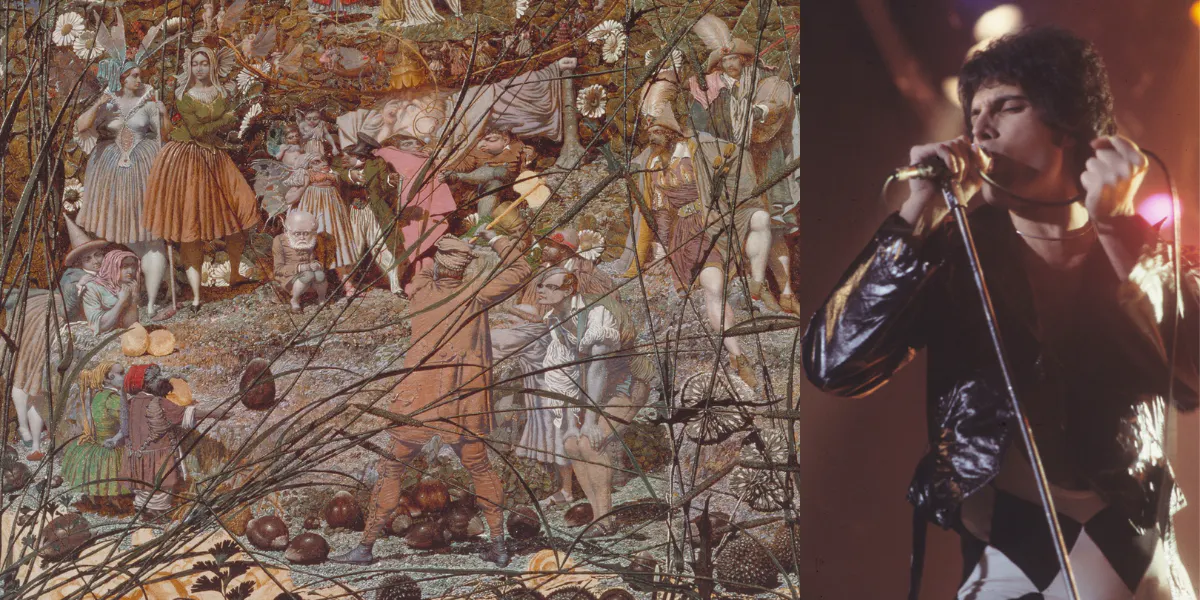
All the tracks on side two were written by Freddie Mercury, including the closing track "Seven Seas of Rhye," which had already been released as a shorter instrumental version on the previous album and now became the sole single from Queen II. The second song on side two is titled "The Fairy Feller's Master-Stroke." The lyrics describe a gathering of fantastical creatures watching the fairy woodcutter split hazelnuts. Mercury drew inspiration from the painting of the same name by the Victorian painter Richard Dadd.
See also: The Epic Freddie Mercury Auction Nets $50.4 Million
Richard Dadd (1817-1886) was recognized as exceptionally talented from an early age and was accepted into the Royal Academy Art School at the age of 20. In 1842, he was invited by the Welsh politician and businessman Sir Thomas Phillips to accompany him as his personal draftsman on a tour of Near East. While the group traveled down the Nile by boat, Dadd began to hallucinate. What was initially thought to be heatstroke eventually turned out to be a serious mental illness. Richard Dadd spent the rest of his days in the psychiatric hospitals of Bethlem ("Bedlam") and Broadmore. There, the doctors encouraged him to continue painting.
See also: Art Brut: Art Outside the Box

This period saw the creation of Dadd's most famous paintings, many of which transport viewers to worlds populated by fairies, elves, and other fantastical creatures. One such example is Dadd's masterpiece, The Fairy Feller's Master-Stroke, a multi-figure oil painting whose meticulous execution took nine years, from 1855 to 1864. To accompany the painting, Dadd wrote the poem Elimination of a Picture & Its Subject, in which he described the depicted figures. Among them are characters from Shakespearean plays: Oberon, King of the Fairies; Titania, Queen of the Fairies; and Puck, the mischievous sprite from A Midsummer Night's Dream, as well as Queen Mab, a fairy queen mentioned as the bringer of dreams in Romeo and Juliet. In his monologue in Act 1, Romeo's best friend Mercutio refers to an empty hazelnut shell as Queen Mab's vehicle, which explains the significance of the elf woodcutter's task in the painting.
See also: Shakespeare's First Folio Turns 400
The Fairy Feller's Master-Stroke has been part of the collection of the Tate Britain since 1963. It is very likely that Freddie Mercury, who studied graphic design at Ealing Art College in London from 1966 to 1969, saw the painting in the museum and was inspired by it.
The painting is not currently on display at the Tate Britain. Instead, it is currently featured as a central work in the current exhibition “Richard Dadd: Beyond Bedlam” at the Royal Academy – a comprehensive retrospective dedicated to the tragic painter on display through October 25, 2026.