![Andy Warhol (1928-1987), American, REBEL WITHOUT A CAUSE (JAMES DEAN), FROM "ADS," 1985 [F&S II. 355], screenprint in colors on Lenox museum board, the full sheet. Image © Waddington's (detail)](https://images.prismic.io/barnebys/eac0e6a7-09a4-4fc6-be84-f6ce6be52684_Andy+Warhol+edition.jpg?auto=format,compress)
From June 24 to June 29, Waddington's will host their Editions auction, featuring over 130 lots. Emphasizing the diversity and long history of printmaking, this auction begins during the 17th century with a suite of seven botanical prints by Johann Wilhelm Weinmann, “Phyathoza Icongraphia.” Highlights include Andy Warhol’s “Rebel without a Cause (James Dean),” Christopher Pratt’s “Labrador Current,” and Kenojuak Ashevak’s “Summer Owl.” Other artists featured include Kaws, Jean Paul Riopelle, Alex Katz, David Hockney, Takao Tanabe, Yayoi Kusama, Rita Letendre, Sam Francis, Zhang Xiaogang, Joan Miró, Salvador Dalí, Pablo Picasso and Georges Braque.
Here are a few top lots to know more about:
Alex Katz, White Roses, 2014
Alex Katz’s great genius lies in his ability to simplify, removing the inessential while never losing either elegance or rigor. The critic John Russell, in his review of Katz’s 1986 retrospective at the Whitney Museum, wrote that “the paintings look easy, the way Fred Astaire made dancing look easy and Cole Porter made words and music sound easy, but don't let's be fooled. When it comes to the art that conceals art, Katz is right in there with those two great exemplars.”
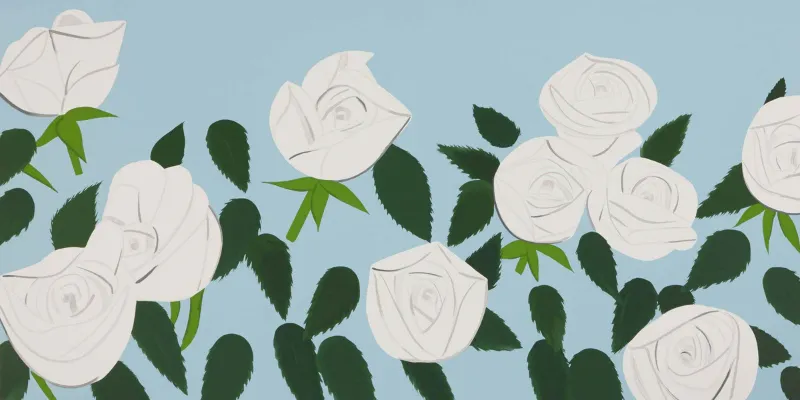
Robert Storr, Dean of the School of Art at Yale University and curator of the exhibition “Katz X Katz” explains that Katz’s flower paintings date back to the 1950s and harken back to his first encounters working en plein air in 1949 while studying at the Skowhegan School of Painting & Sculpture: “He was painting them full-scale like this from the beginning of his career,” noting that Warhol’s large flower portraits actually came after Katz’s. Katz himself says that his work seeks to create a record of “quick things passing.” Though often thought of as a portraitist, Katz has long been interested in the landscape and the natural world. Critic Calvin Tomkins explains that Katz “make us see the world the way he sees it, clear and up close, with all but the most essential details pared away.”
Andy Warhol, Rebel Without a Cause (James Dean), from "ADS", 1985 [F&S II. 355]
In 1985, Andy Warhol created a portfolio of ten works based on advertisements, known as the Ad Series. Warhol based these screenprints on well-known publicity images from the 1950s-1970s, one of which was the poster for the Japanese release of James Dean’s Rebel Without a Cause.
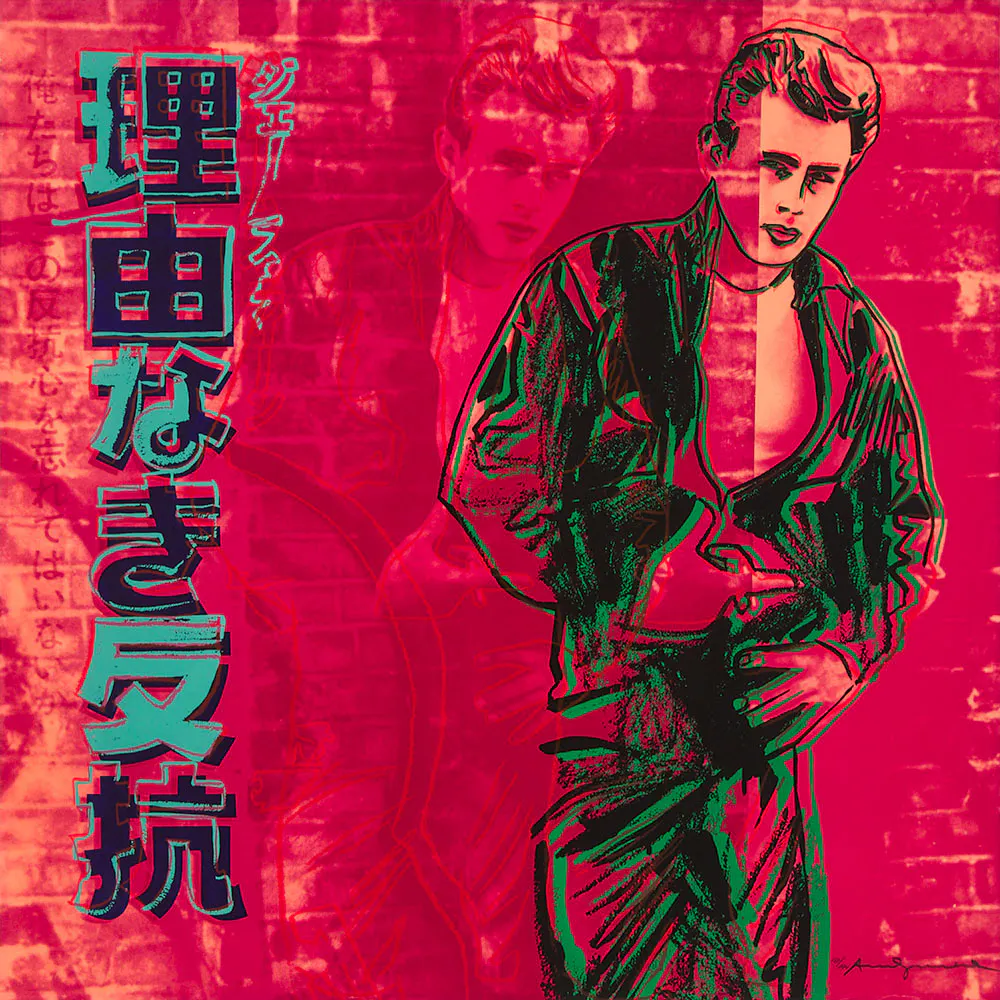
Warhol viewed Dean as an original figure of teenage fantasy, a figure which he uses to deconstruct the idea of fantasy itself. As with the other images in this series, Warhol used Dean to comment on the seductive and illusory nature of advertising, which he understood to be an influential form of visual culture in its own right. Warhol’s great talent lay in distilling and reflecting specific cultural moments, often through the lens of celebrity and consumerism. The majority of Warhol’s work focuses on American imagery, and so his use of this Japanese version of an American classic might be viewed as a comment on the universality of mass-media and the global creep of an increasingly hegemonic visual culture.
David Hockney, My Second Drawing of Beuvron-En-Auge, 2021
David Hockney found his sanctuary in the Pays d'Auge in Normandy in 2019. He purchased property in a small village located very close to Beuvron-en-Auge, known as one of the most beautiful villages in France. Of the move, Hockney explained: “I came to Normandy because there are more flowers here.” His house, garden and surrounding countryside became the focus of his work, specifically his iPad drawings, which the artist had been working with for over ten years.
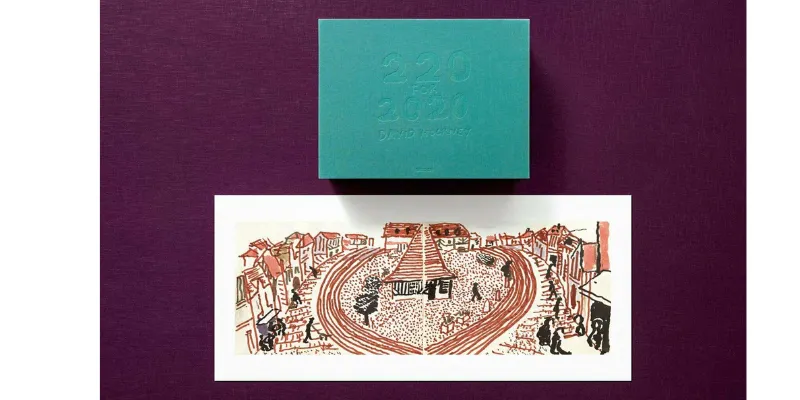
The setting provided him with great inspiration, launching a project known as “A Year in Normandy.” Inspired by the Bayeux Tapestry, Hockney set out to capture the arrival of spring in Normandy through 100 images rendered on his iPad. Despite a global lockdown in March 2020, Hockney continued to make his drawings of the Pays d'Auge. The works he created are Impressionistic, capturing light and line with great assuredness.
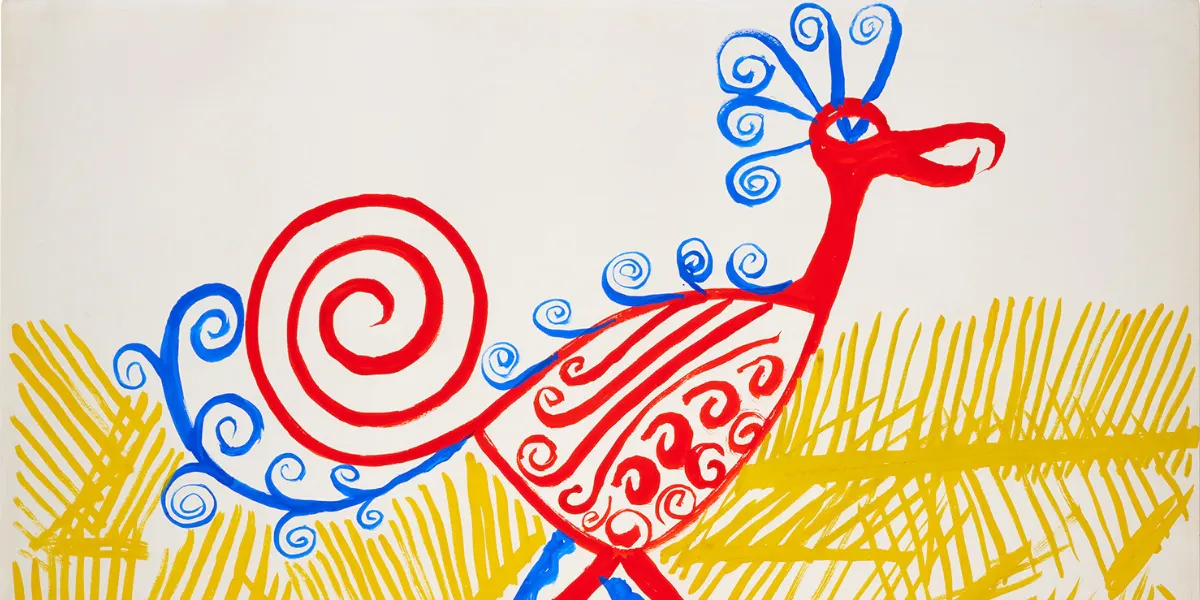
Kenojuak Ashevak, Summer Owl, 1979
Renowned for her images of birds, it is the owl for which Kenojuak is best known. Her celebrated “Enchanted Owl” has been the most famous and recognizable image in the Inuit art canon for decades, also holding the distinction of being the most expensive Inuit print ever sold at auction.
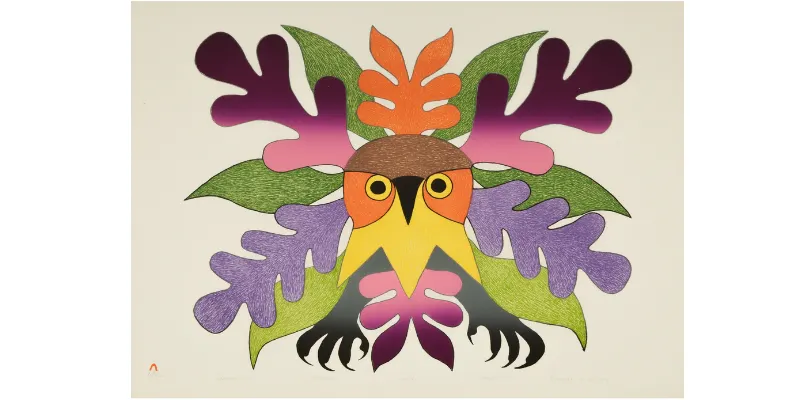
Owls never ceased to interest Kenojuak, who used them as a subject for over 100 different prints as well as original drawings. Her fantastical owls could be audacious, festive, preening, and often surrounded by brightly-hued plumage. Beginning in the early 1960s, Kenojuak introduced foliage to enhance her avian images, as seen here. In “Summer Owl,” the artist’s signature symmetrical composition is on display, both energetic and harmonious. For Kenojuak, form always took precedence, though she often explained that her main objective as an artist was to inspire happiness in her viewers—mission accomplished with this radiant print.
Yue Minjun, Birds of Peace, from the "Snatched Ecstasy" Portfolio, 2009
Yue Minjun’s grinning self-portrait may well be the most recognizable image in contemporary Chinese art. The repetition of his pink face with its toothy, double-wide smile allows Yue to play with ideas of mass production and mechanical reproduction in the present consumerist culture, while also self-examining through a lens of cynicism and cartoonish exaggeration. Yue is known for manipulating images from the Western canon as well as well-known works of Chinese visual culture, ranging from socialist propaganda to commercial art. Yue’s work has been subject to many interpretations, and the artist himself has said that “a smile doesn’t necessarily mean happiness, it could be something else.”
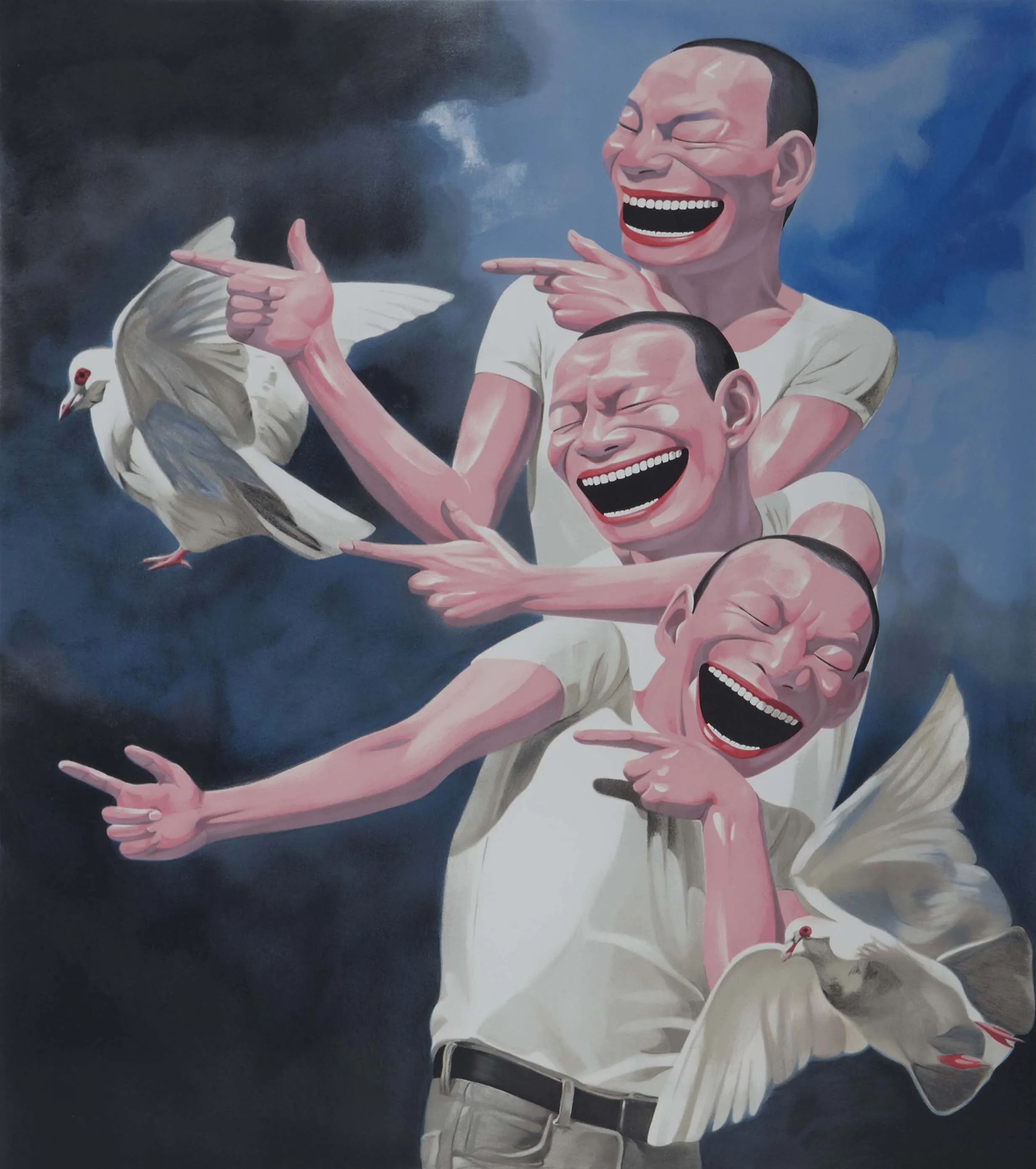
The “Snatched Ecstasy” portfolio is set of 20 lithographs, six of which are on offer in Waddington’s Editions auctions. Each work is accompanied by a poem by Fernando Arrabal.
Christopher Pratt, Launching Greyling, 1992
For Christopher Pratt, “boats symbolized the essence of Newfoundland and Labrador.” Though enraptured with boats from a young age, Pratt’s vessels are rarely depicted at ease in the water. The artist prefers to ground, hang, or overwinter them, removing them from of their natural surrounding and instead rendering them as abandoned, trapped or in waiting. Simultaneously serene and tense, “Launching Greyling” is quite literally in suspended animation, waiting to be launched.
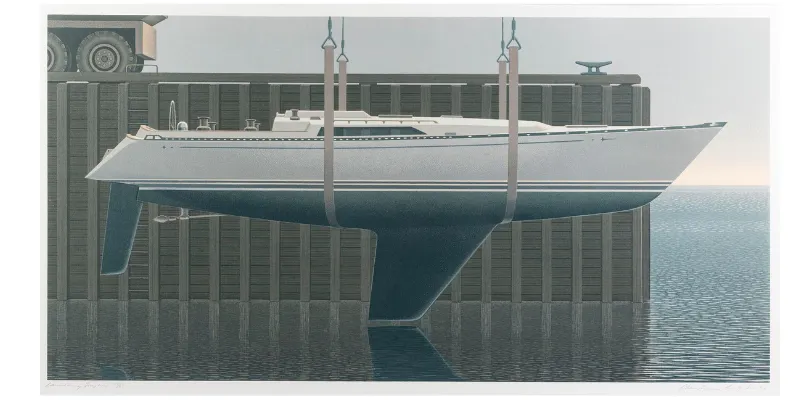
Writing about a similar composition, Pratt explained that images like this “have less to do with sailing than with the boat itself: a sculpture, sleek and efficient, shark-like, hanging in straps being lowered into the water, suspended between the abstracts of conception, the mathematics of construction and reality at sea.”