
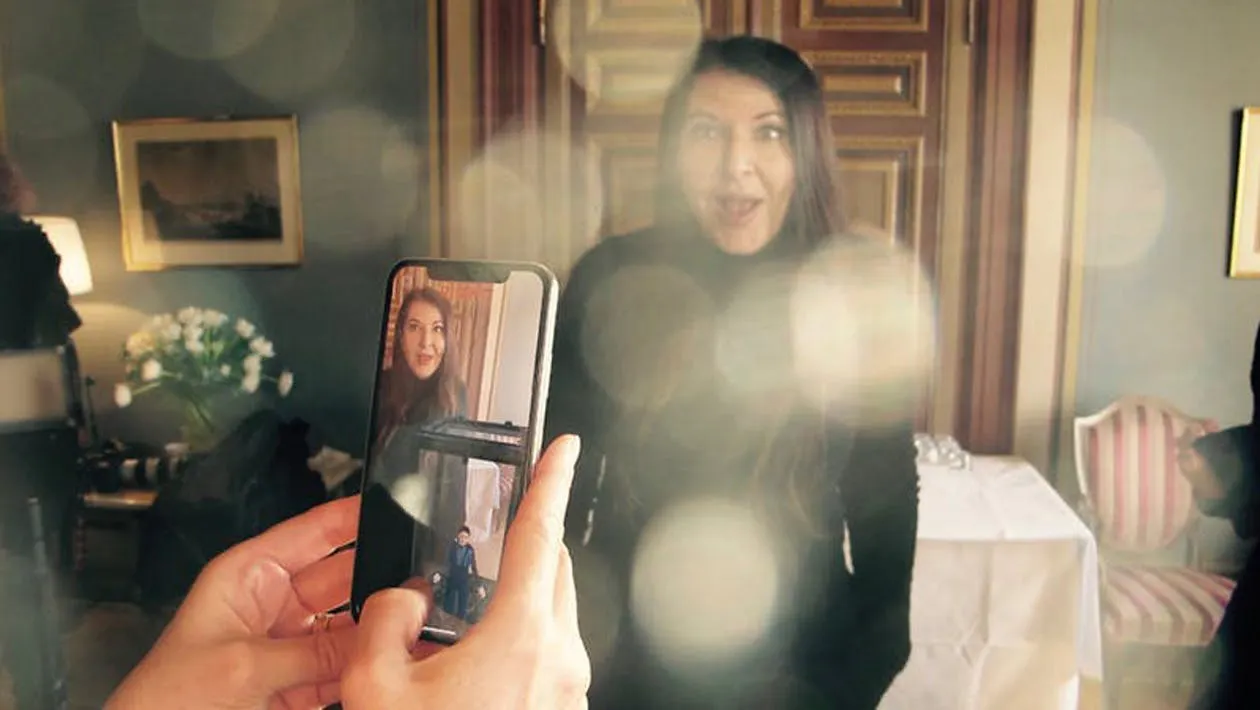
Barnebys recently had the great pleasure of taking part in Stockholm's Nobel Week Dialogue, a day conference aimed at reconciling science and society and which several Nobel Prize winners participate annually. After the conference, Barnebys attended an interview with Marina Abramović, the famous Serbian performance artist, who provided insight into her project Rising as well as the future of performance art.
Someone said ‘I hate your work’ because it always makes me cry.
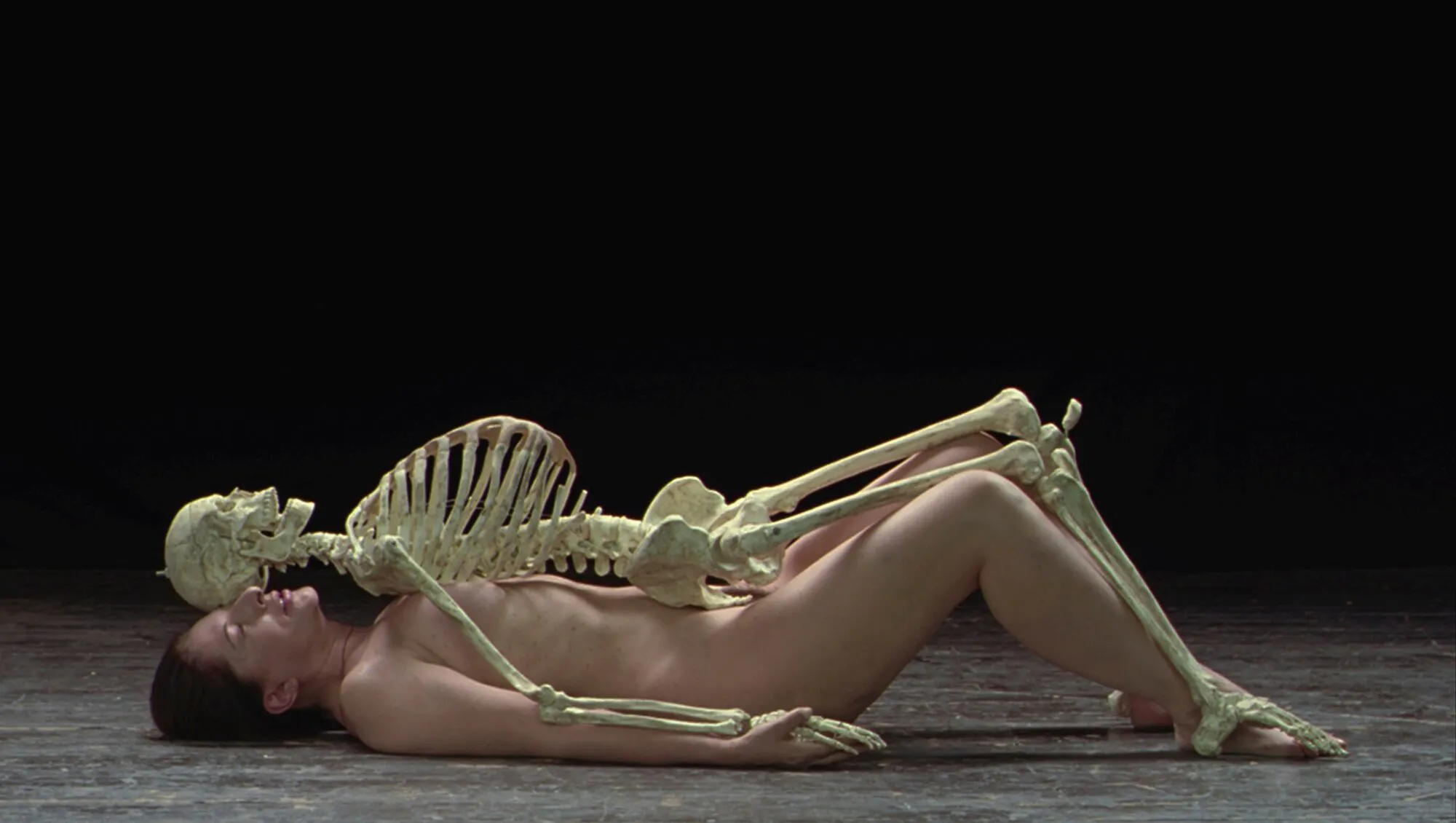
Abramović opened the conference by talking about her ongoing art project, Rising, which involves many forms, including an app, a video game that was exhibited at Art Basel Hong Kong, and a performance lecture. Developed to bring awareness to rising sea levels and environmental degradation, Rising shows Abramović in a huge water tank in augmented reality as the water levels rise around her. In collaboration with Acute Art, her new work urges the public to reduce waste, reuse and recycle, and to save on natural resources like water and energy.
Nature talks to us, we just stopped listening.
The event that served as an eye-opener for Abramović's engagement with the environment was a visit to the Maldives twenty years ago. There, on the beach were hermit crabs which had begun to live in plastic instead of their shells, as a result of people picking up the shells from the island. Abramović bought shells sold on the market and laid them out on the beach to give the crabs their homes back, but found that the crabs had gotten used to the plastic and preferred it to their natural habitat.
The beginning of the conference began unusually. The audience members were told to not drink from the glass of water that sat before each listener. When Abramović went up on stage, she asked each audience member to be quiet, uncross their legs and then take twelve deep breaths together. At the end, she urged everyone to slowly bring the glass to their mouth and feel the cold when it touched their lips. After a few seconds, everyone in the audience was allowed to start drinking the water very slowly. The whole time, Abramović instructed with her calm and meditative voice; the audience became an organism acting unanimously to the great artist's instructions.
“What you project is what fills the glass of water,” said Abramović.
The purpose of the exercise echoed the mission of Rising and drew attention to the importance and the life-giving nature of water and how it is imperative that this vital resource be conserved.
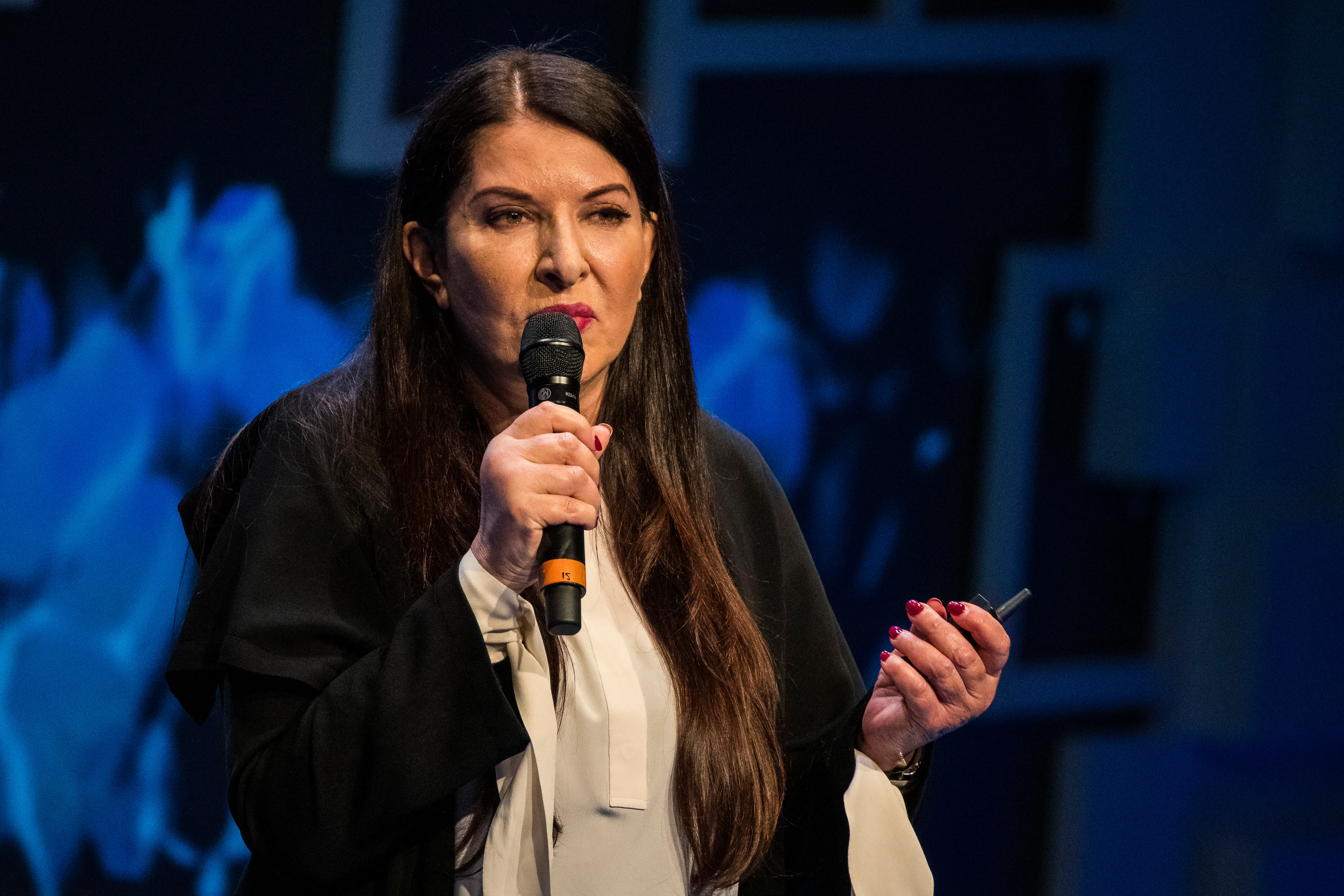
On Monday, Barnebys went to the Grand Hotel in Stockholm to listen to a conversation between Abramović and Daniel Birnbaum, the current director of Stockholm's Moderna Museet as they discussed the relationship between science and art.
"Scientists and artists both have a gut feeling and intuition and the urge to research,” said Abramović. “At the same time, scientists have to come out with physical proof that something works which artists don't. Some things science cannot explain, but they exist.”
It’s easy to believe that the scientific sphere is completely new to Abramović, but this is not the case: in 1989, Abramović participated in a meeting in Amsterdam with the purpose of bringing together leading scientific researchers with artists and spiritual leaders in a talk about technology development and the future. Among the participants were the Dalai Lama and Robert Rauschenberg. Abramović described the meeting as very rewarding. She believes that artists should be involved in social issues to a much greater extent because art has a lot to contribute. "It was a revolutionary meeting," she said. "This time I'm the only artist here and it's very lonely."
At this point, she talked about her project Rising and the future of art in the age of technology.
See also: The 15 Most Expensive Female Artists
Barnebys: You talked about involving very new, visual technologies in your art. It seems on the one hand logical, on the other surprising, because your art form has been so much about real time, your bodily presence, what's here, now. Technologies like AI and VR are so removing of a human presence. How do you reconcile this?
Marina Abramović: New technologies are important, especially VR. You cannot avoid technology and there's nothing wrong with it inherently. The problem is how we use it because we are so addicted to it and overuse it. What's so interesting to me in VR is what you see looks real. The brain can really be fooled to believe that what you see is real. Technology can be used for good use or for misuse.
Among your countless works, are there any that really stand out and are perhaps a milestone for you?
Yes, in every period of my life. If I look back I always find the latest being the most interesting one. At the same time, I avoid looking back. It hurts me, it drains my energy and makes me feel old. I am 72 years old, not the youngest on the planet. I am always in the moment and see the future.
You affect so many people in your work, but how does it affect you? What do you take from a performance?
During the 1970s the audience could consist of five, ten people, most of whom were my friends. When there were twenty people, I thought "oh my God, how many people!" I could barely handle fifty people. And today, the crowd consists of thousands of people, which makes the responsibility so much bigger because it means you really need to think about what you do and how to convey what you want. It's especially applicable to young people. My audience is very young. Every time I hold a lecture, I start by asking who is the youngest in the audience.
Your work has always been direct and has provoked people with political dimensions. Rising is about getting people engaged and inspiring them to act differently. Have you done this before?
I've developed something over the years called the ‘Abramović method’. It's a series of restrictions which, when completed, can help attain a sharper stage of consciousness. Yesterday's glass of water exercise was one of those examples. What's important is there are urges to do more of these actions because we only have a limited amount of time on the planet. We are running out of time due to environmental neglect. Artists today are more important than ever before. We have to take action. I've always believed in science. Nature talks to us, we just stopped listening. All we can do is slow the process of environmental degradation.
See also: Leonor Fini: 6 Little Known Facts
Are you afraid to age?
I'm afraid of everything, but with a healthy attitude. Everyone has an expiration date. I remember how Leonard Cohen said, "I'm in the third act". I really feel this is the third act, so I do my best.
If you could give advice to the world politicians, what would it be?
Read Gandhi's biography.
You have mentioned several famous religious leaders during our conversation. Are you religious?
No. I do not like religion because its institutions are based on power and corruption. I believe in the spiritual and cosmic energy. Energy comes to you in a way you cannot explain. We are empty transmitters who receive cosmic energy. So I'm spiritual. A sense of humor is so important. The Dalai Lama always starts with a joke.
You expose yourself to so much pain as you push the boundaries of art. Can you protect yourself in any way?
People are so afraid of everything. We are afraid of pain and for this and that. I just want to have an open mind. I never rehearse my performances because if I did I would never go through with them. It would be crazy to do it then, I would give up. I come up with a concept and go in front of the audience and do it. I count on the energy from the audience. This kind of energy you don't have in a private space. Without it, you get scared and stop. When you stage difficult moments from your life and you go through with them, you become the mirror to other people. If I can do it they can do it too. And this is my message of being a mirror to others.
See also: 10 Women who Rocked the Art World
Is it energy that proves that you have succeeded?
Yes. It is proved when I go to a café and young people come and hug me and say I changed their lives or they jump off their bike to tell me. The reactions mean a lot. I love the reactions I get from the audience; it's emotional to both me and them. One person said he hates my work because it always made him cry.