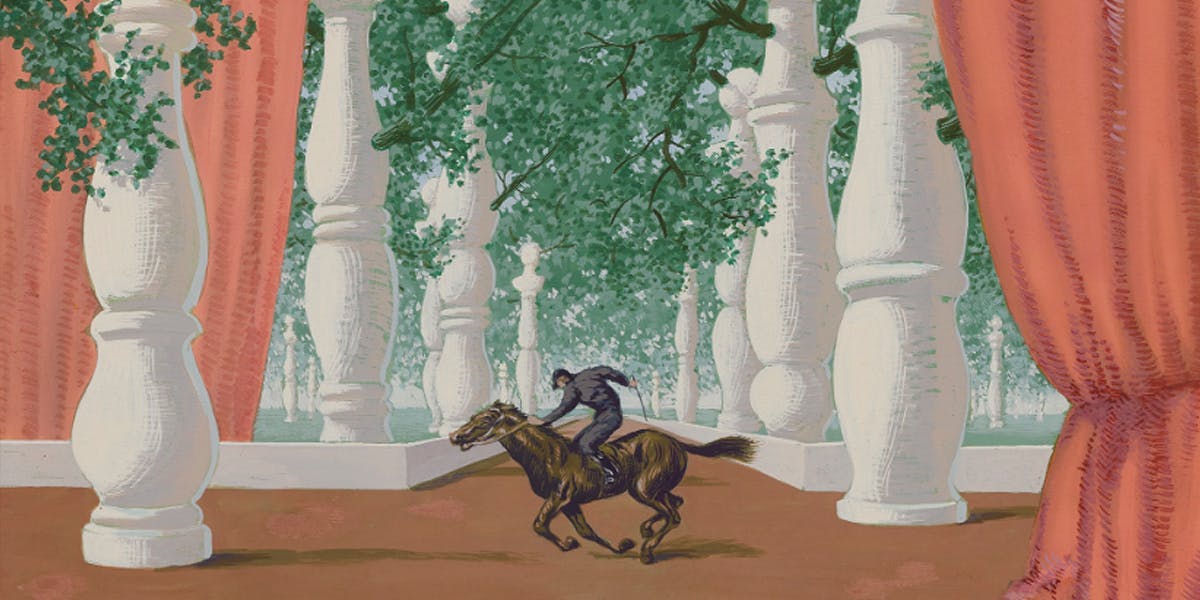
Le Jockey Perdu (The Lost Jockey), the famous image of a rider galloping through a strange forest of bilboquets, was born after t the artist René Magritte, inspired by the collages of Max Ernst and the paintings of Giorgio de Chirico, took a new direction in his practice. The jockey appeared for the first time in 1925-1926 in a work on glued paper, then in an oil on canvas (presented in Brussels in 1927 in his first solo exhibition), before being depicted in a series of gouaches of the same name. This atypical subject happens to be the first that the artist made in several mediums and is one of the most significant motifs in his work.
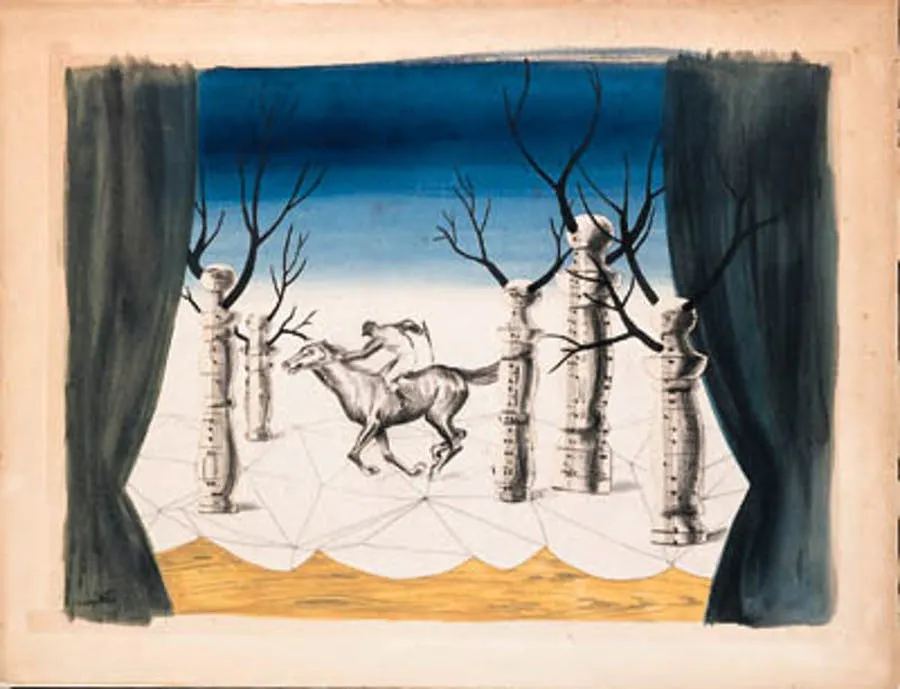
In the early 1920s, Magritte was employed as a set designer by the Théâtre du Groupe Libre in Brussels and some claim that the idea for the curtains, which we find in The Lost Jockey as in many of his works, came from this experience. In the first versions of the work, we can also see the jockey on a theater stage framed by curtains, while cup-and-balls dot the background. The bilboquets, key elements of his work, have the appearance of trees so the bark would be engraved with musical notes, which historians have interpreted as a possible tribute to the pianist and composer Mesens (who was present at his marriage to Georgette Berger).
Related: Magritte's Surrealist Masterpiece Could Sell for $60 Million
"The Lost Jockey is the first canvas I really painted with the feeling of having found my way, if you can use that term..." Magritte once said. In this sense, he considered The Lost Jockey to be his first truly Surrealist work, a movement he joined in 1926 under the influence of André Breton, shortly after arriving in Paris.
This turning point in his practice is partly due to a revelation he had in front of a work by Giorgio de Chirico titled Le chant d'amour (The Song of Love). The painting by the Italian painter, presenting an eccentric assortment of apparently unrelated objects (including a sculpture head from antiquity, a glove and a ball), plunges the viewer into a universe where the logic is not obvious at first glance. While Magritte denied any direct influence or resemblance between De Chirico's work and The Lost Jockey, he nevertheless admitted to being touched by the work, perceiving for the first time the break with reality characteristic of Surrealism and the skillful use of the juxtaposition.
Related: A New Auction Record for Giorgio de Chirico
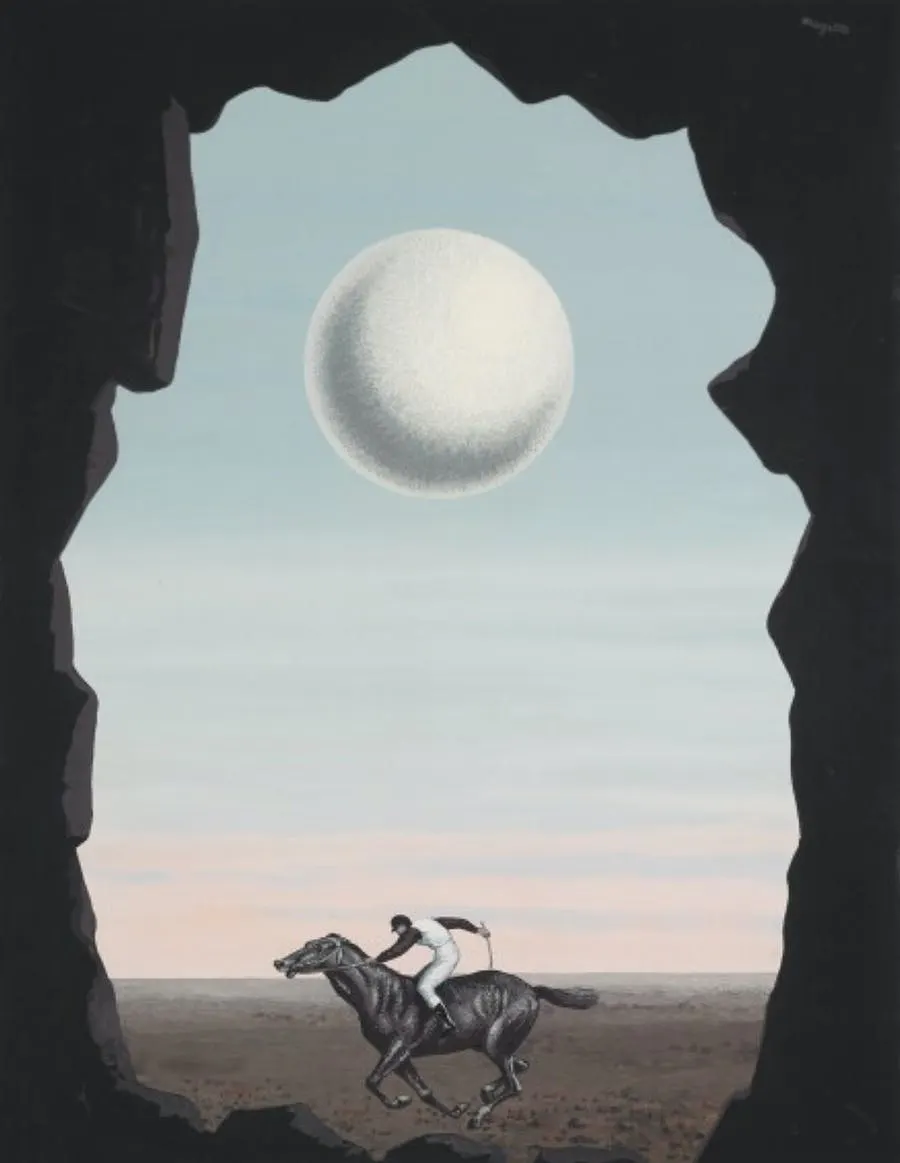
Magritte revisited the theme many times throughout his career, changing each composition slightly from the previous one. Over the decades, we can thus find the jockey against many different backgrounds, from a forest of bilboquets to a desert plain under a full moon.
The subject has also endured through the different stylistic periods of the painter. We know, for example, of a gouache of the jockey produced during his "vache" or cow period, around 1947-1948, when he depicted absurd characters in an exaggereated style. Works resulting from this period were intended for his first exhibition in Paris in 1948 and declared by critics to approach Fauvism. The Lost Jockey, though revived in the middle of the cow period, slipped through the cracks and retained the neat lines more characteristic of the artist, who was probably too fond of the theme to subject it to experimentation.
Related: Surrealism and the Subconscious
of opposites: concealment and revelation, speed and immobility, interior and exterior settings. Between 1926 and 1964, when the last version was painted, the scale of The Lost Jockey increased, perhaps due to the artist's personal interest in this motif and its evolution throughout his life.
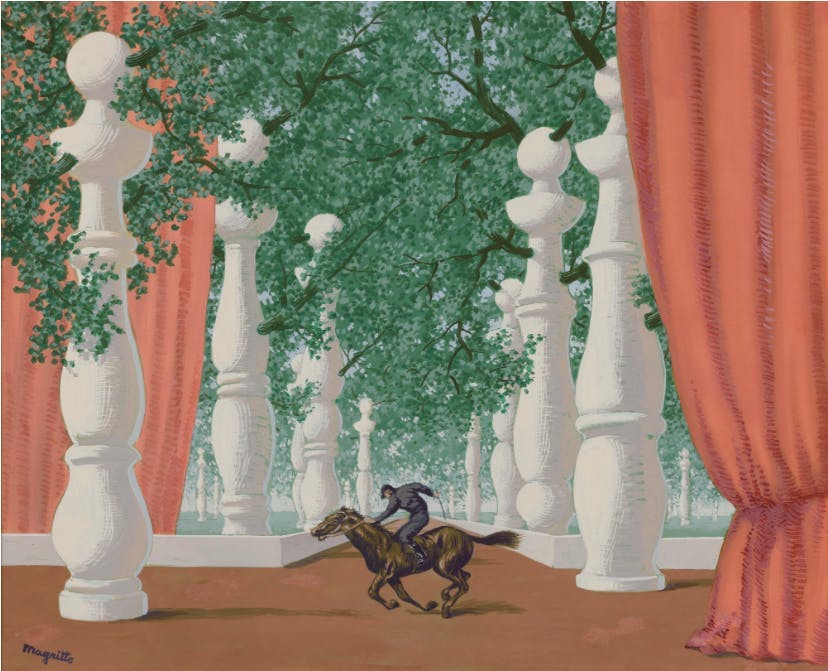
One day questioned by art collector Harry Torczyner on the origin of the jockey, the artist declared that he used to go to horse races when balustrades and cup-and-balls were already part of his artistic vocabulary. Subject to numerous interpretations, the work was also correlated with the universe of Alice in Wonderland by the surrealist critic Patrick Waldberg.
Read also: Leonor Fini: 6 Little Known Facts
In 2018, a 1947 gouache on paper was sold at Sotheby's for £1.92 million ($2.7 million). It came from the collection of William N. Copley, a friend of the artist, who opened his eponymous gallery in Beverly Hills in 1948 and hosted, in less than a year, six legendary exhibitions including Magritte, Tanguy, Ernst, Man Ray, Cornell and Mata.