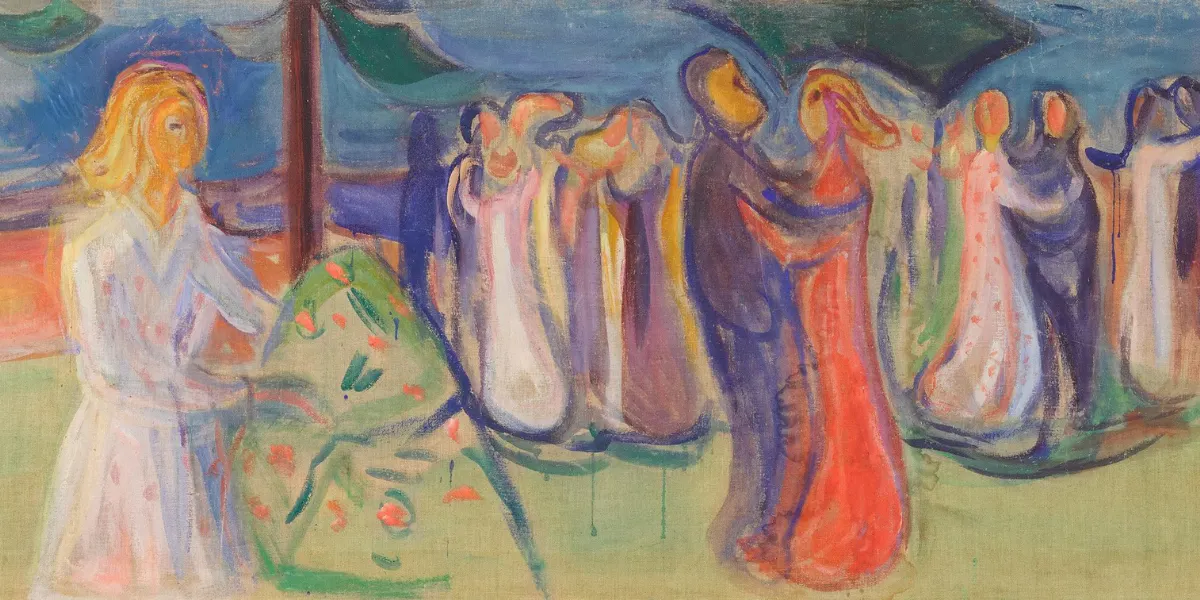
Dance on the Beach was part of 12 major panels painted by Edvard Munch under the commission of Max Reinhardt, a prominent theater director, who in 1906 had asked Munch to design the sets for his production of Ibsen’s plays Ghosts and Hedda Gabler. The canvasses were part of a frieze that surrounded the audience in the upper hall of Reinhardt’s avant-garde Berlin theater. In Munch’s own words, the frieze was meant to evoke “images from the modern psyche”.
Related: Edvard Munch: 5 Things to Know
After the theatre’s refurbishment in 1912, the frieze was split up and the painting Dance on the Beach was acquired by Curt Glaser, a friend of Munch and a distinguished German-Jewish academic and director of the Berlin State Art Library. Glaser had been the first author to publish a German biography on Munch and had throughout the years amassed an extensive art collection.

Prosecuted in 1933 by the Nazis because of his Jewish background, Glaser lost his job and had his apartment seized. Under duress, he was forced to sell his collection, which included this panel by Munch, as well as works by Henri Matisse and Max Beckmann. After fleeing Germany, Glaser escaped to Switzerland and eventually made his way to America, where he died in 1943. In 1934, only months after his escape, Dance on the Beach appeared at an auction in Oslo and was acquired by Thomas Olsen, a Norwegian shipowner and Munch’s neighbor and patron.
Related: 9 Norwegian Artists to Know
Olsen hung the painting in the first-class lounge of his cruise liner MS Black Watch. Dance on the Beach was part of Olsen’s outstanding collection of about 30 works by Munch. After Britain declared war on Germany, Olsen hid the works in a barn in a remote Norwegian forest, and the works have since been in the possession of the Olsen family. His collection also included one of four versions of The Scream, which Sotheby’s sold on behalf of the Olsen family in 2012 for $119.9 million. In 2021, Sotheby’s also auctioned another one of the frieze panels from the barn, Embrace on the Beach, which sold for £16.2 million.
Related: The 12 Most Expensive Paintings Ever Auctioned

Dance on the Beach will be offered in March at Sotheby’s Modern & Contemporary Evening Sale in London. The painting is being sold as part of a restitution settlement with the Glaser family and is estimated to fetch between £12-20 million ($14.8-24.6 million), with the proceeds split with Glaser’s family. About four meters wide, the composition is the most important of the frieze and the only one to remain in private hands.
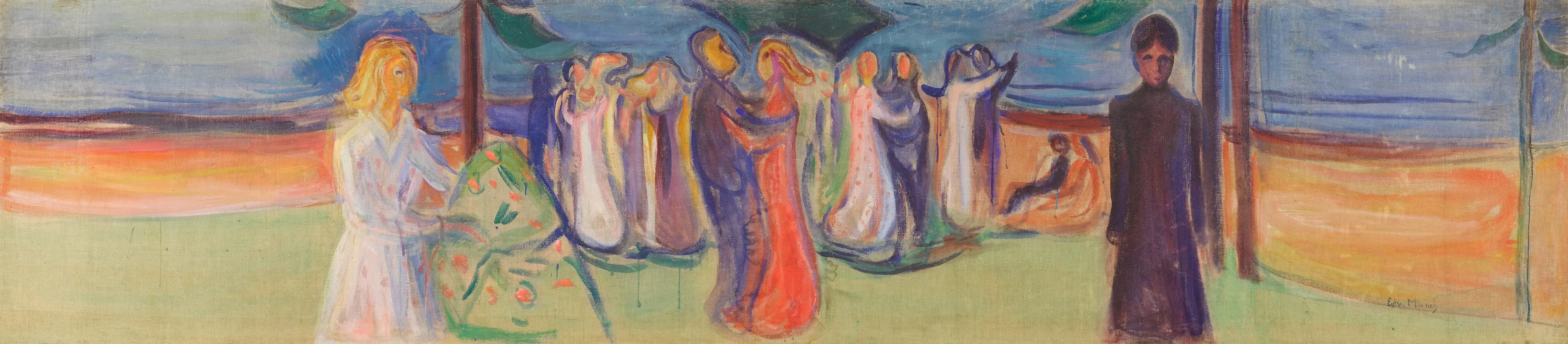
The panel features dancing figures and two of the artist’s great loves in the foreground – Tulla Larsen and Millie Thaulow, with whom Munch ended things in heartbreak, even shooting his own hand after a heated argument with Tulla. Depictions of dancing figures became a key motif of the artist’s works from the late 1890s, and this commission was painted whilst in the grip of addiction and shortly before an acute breakdown in 1908, after which Munch's subjects changed to surroundings and Norwegian landscapes.
Related: 10 Artists Between Genius and Madness
Munch’s childhood and adult life are well documented for their tragedy and sadness. The artist himself would write “I who came into the world sick, in sick surroundings, to whom youth was a sickroom and life a shiny, sunlit window — and out there I wanted so much to take part in the dance, the Dance of Life”. Dance on the Beach captures the sense of life playing out without him, while he watches through a window. The figures in the painting are thought to represent innocence, life, love, and death. Simon Shaw, Sotheby’s Vice Chairman (Fine Arts), commented in a press statement, "This work is among the greatest of all Expressionist masterpieces remaining in private hands — its shattering emotional impact remains as powerful today as in 1906."
Want to receive all the latest art world news straight to your inbox? Subscribe to our free newsletter!
It has often been noted that major consignments in the auction industry are driven by the '3 D's' (death, divorce, and debt). And while this remains true for many record-breaking auctions, it seems that three new players beginning with R have entered the Old Masters game: rediscovery, restitution, and reattribution.