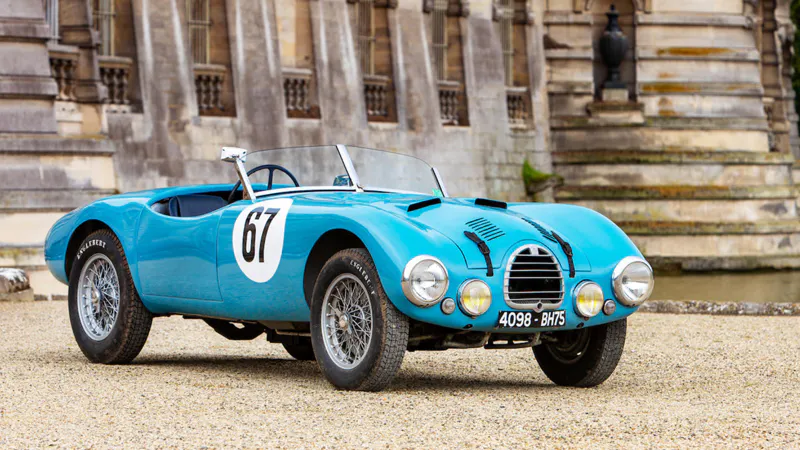
Like many Gordini barquette sports-racers, chassis number 018 was originally a single-seater. It is one of the five Type-11 chassis built in 1946 and 1947. Originally designated chassis number 04 GC and fitted with a Type-11 engine, it was registered in August 1947 as “7090-RQ”, but did not enter any competitions that year. It was probably used as a spare car for Prince Igor Troubetzkoy, the driver of Gordini 02 GC.

In 1947, 04 GC was first entered in competition in the Pau Grand Prix with a 1,220cc engine, serving as a “mule” for Jean-Pierre Wimille. At Perpignan, it was driven by Prince Igor and in Geneva by Robert Manzon. For the 1947 Monaco Grand Prix, which ran under the International Formula specifying 1½-liter supercharged or 4½-liter normally aspirated engines, Amédée Gordini entrusted 04 GC equipped with its normally aspirated 1,430cc engine to Jean-Pierre Wimille. During the race, Wimille surprised everybody by holding 2nd place until lap 57 when he was forced out by a lubrication problem, handing victory to Farina in a Maserati 4 CLT.

At the Reims ACF Grand Prix, which also run under the International Formula, 04 GC was driven by the future quintuple Formula 1 World Champion Juan-Manuel Fangio, who was forced to retire. In the 1949, 1950, and 1951 seasons, Amédée Gordini’s son Aldo, drove 04 GC in 13 races with Type-15 or Type-16 engines and at the 1951 Reims race, with a supercharged Type-15 C engine. On September 10, 1951, Jean Behra won the first qualifying round of the Cadours race in the car and secured a 3rd place in the final.
At the beginning of the 1952 season, Gordini 04 GC, fitted with a Type-18 twin-cam engine, producing 135bhp at 6,500rpm. It was leased to Prince Bira until the Swiss Grand Prix in Bern on 18th May. The following day, it was totally disassembled in Gordini's premises at 69/71 Boulevard Victor in Paris. All the Type-15 S-specific parts were welded onto the chassis and a new purpose-built barquette body was fitted. This chassis was then renumbered as 18 and received the Type-18 engine (number 21) and was registered as 4098-BH-75 on June 12th, 1952, ready to start a new life.

On June 14th, 1952, the Gordini Team entered the new barquette for the Le Mans 24 Hours race. With left-hand drive with no right-side door was driven by Roger Loyer and Charles Rinen. It retired at the 18:20 mark with a clutch issue. But at the Reims Grand Prix Sportscar Race, on June 29th, it was driven by Roger Loyer to a 4th overall and 1st in the 2,000cc class.
Between the 1952 and 1953 seasons, the steering, control pedals, and dashboard were transferred from the left side to right side, and a right-side door fitted. A windscreen and navy blue leather seats were installed, and the body repainted sky blue. At the beginning of April, the Gordini—now referred to as “18 S” was shipped to New York to be shown on Luigi Chinetti’s stand at the Motor Sports Show in the Grand Central Palace. Unsold, it was returned to France.

Back in France, it was entered in the Le Mans 24 Hours by Captain Marceau Crespin. On 5th June, the 1,491cc Type-18 engine number 25 was checked by an ACO-recognized inspector and on June 9th, the chassis number was checked. During the first hours of racing, the Gordini was timed at 118.5mph on the Hunaudières straight, but at 20:42 a piston failed and the car had to be withdrawn.

On June 21st, 1953, “18 S” was entered by the Gordini Team in the AC du Nord in Roubaix for the Argentinian driver Roberto Mieres. In this handicap race, the Gordini finished 2nd ahead of some Maseratis, Porsches, Aston Martins, OSCAs, and Jaguars. Redmond Gallagher and his brother-in-law Dermot O'Clery, two Irish spectators, were impressed by the Gordini’s performance. They asked Jean Lucas, the manager of the Gordini Team, to arrange an appointment with Amédée Gordini. And on June 26th in Paris, “18 S” was sold, together with its windscreen for the two-seater barquette, and a fly-screen and a left-seat fairing for the single-seater, for 2,600,000 Francs (the equivalent to the price of an Alfa-Romeo 1900).
After a major overhaul, the body was painted the colors of Ireland, in dark green with an orange strip all around its lower part. In August Gordini entered the “17 S” barquette in the Goodwood Nine Hours Race and delivered “18 S” at the same time to its new owners. The two Gordinis were driven by Jean Behra and Harry Schell from Paris to Cherbourg where they boarded for Portsmouth. Gallagher took delivery of his new car, which was registered as “RIK-939”.

On September 5th, 1953, the Gordini was entered in the Dundrod Tourist Trophy, in which Gallagher and Cahill were ended up in 10th overall and 1st in the 1,500cc class. In 1954, Gallagher finished 5th at Oulton Park, 15th at Silverstone, 1st in the Wakefield Trophy and 7th in the Dundrod TT. For these races, the engine was fitted with four Amal carburetors. In May 1955, Gallagher placed an advertisement in the SCCA journal in order to sell it, with its original twin-choke Solex carburetors and various additional parts. He did not find a buyer in America but one in Dublin, Colonel John Burk who bought the car and had it repainted sky blue. He took part in a few races, among them the Tralee Hill Climb on August 10th, 1963. In 1967 he sold the car to Colin Crabbe, owner of the Antique Automobiles garage in Baston. An advertisement placed in the October 1967 issue of Motor Sport featured Gordini “18 S”, but without an asking price. Tony Gosnell, a car collector from Farnham, England, bought it but never used it.
In 1978, Tony Gosnell placed an for sale advertisement in Classic Cars at 50,000 Francs (the price of a Citroën CX Pallas). Jean-Louis Hamoniaux, a Gordini enthusiast from Allonnes asked Amédée Gordini and Christian Huet to travel with him to England to examine the coveted Gordini. In April 1978 Amédée Gordini drove Hamoniaux, his wife Anaïck, and Christian Huet to the Gosnell brothers in his Renault 16 TX.
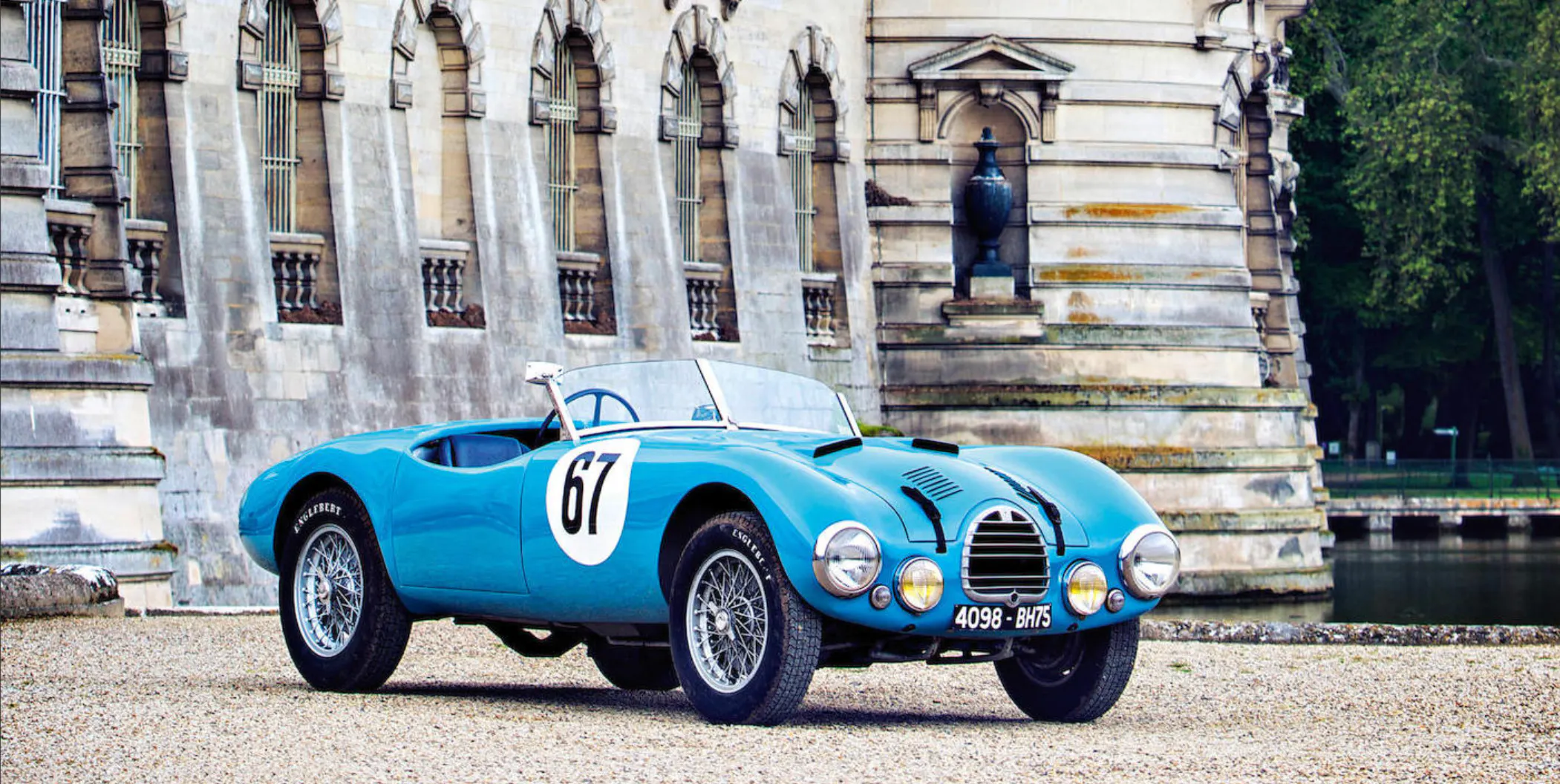
“18 S” was not in running condition but it had not had any major modification, apart from the rear brake drums and a front suspension cylinder, which had been replaced, and the lower fly-screen, which had been lost. Hamoniaux bought “18 S”, returning it to Gordini in Paris while finishing the house where he would keep the car garaged. Amédée Gordini still owned the original 1952 registration certificate, which he wished to keep. He asked Christian Huet to have it duplicated by the Paris Préfecture in order to offer it to Hamoniaux.
The very day Amédée Gordini died on May 25th, 1979, Hamoniaux took possession of the Gordini “18 S”. He was financially not in a position to restore the Gordini until 2005 when Jean Sage provided funds for the car to be restored by Corrado Capello in Zané, Italy. Sage and Hamoniaux would share the passion for driving the Gordini. Together, they took part to the Mille Miglia, Monaco Historique, Le Mans Classic, among other races. When Jean Sage died on October 2009, Hamoniaux retrieved Gordini “18 S” and took part in some static events dedicated to collector cars.

There are only two Gordini “Sports” left in France in private collections, barquette number “18 S” and berlinette number 20. Gordini “18 S” is the only four-cylinder barquette on the market. The other Gordini four-cylinder barquette, chassis number 39, is the property of the Schlumpf Collection/Cité de l’Automobile in Mulhouse.