Kazimir Severinovich Malevich was born to Polish parents in Kyiv on February 11 (Julian calendar) or February 23 (Gregorian calendar) 1879. A pioneer of several modernist movements, he became a central figure in the Russian avant-garde in the early 20th century.
Here are five key facts about Malevich and his work.
1. A path shaped by many influences
Malevich’s interest in art began at the age of 13. In 1895–96 he studied at the Kyiv Drawing School under Mykola Pymonenko, whose realist approach initially influenced him. After several years working as a technical draftsman, he moved to Moscow in 1904 to continue his studies at the School of Painting, Sculpture and Architecture. In the collection of the prominent patron Sergei Shchukin, he encountered Claude Monet’s paintings of Rouen Cathedral, which introduced him to Impressionism.
See also: A Brief History of the Hermitage Museum
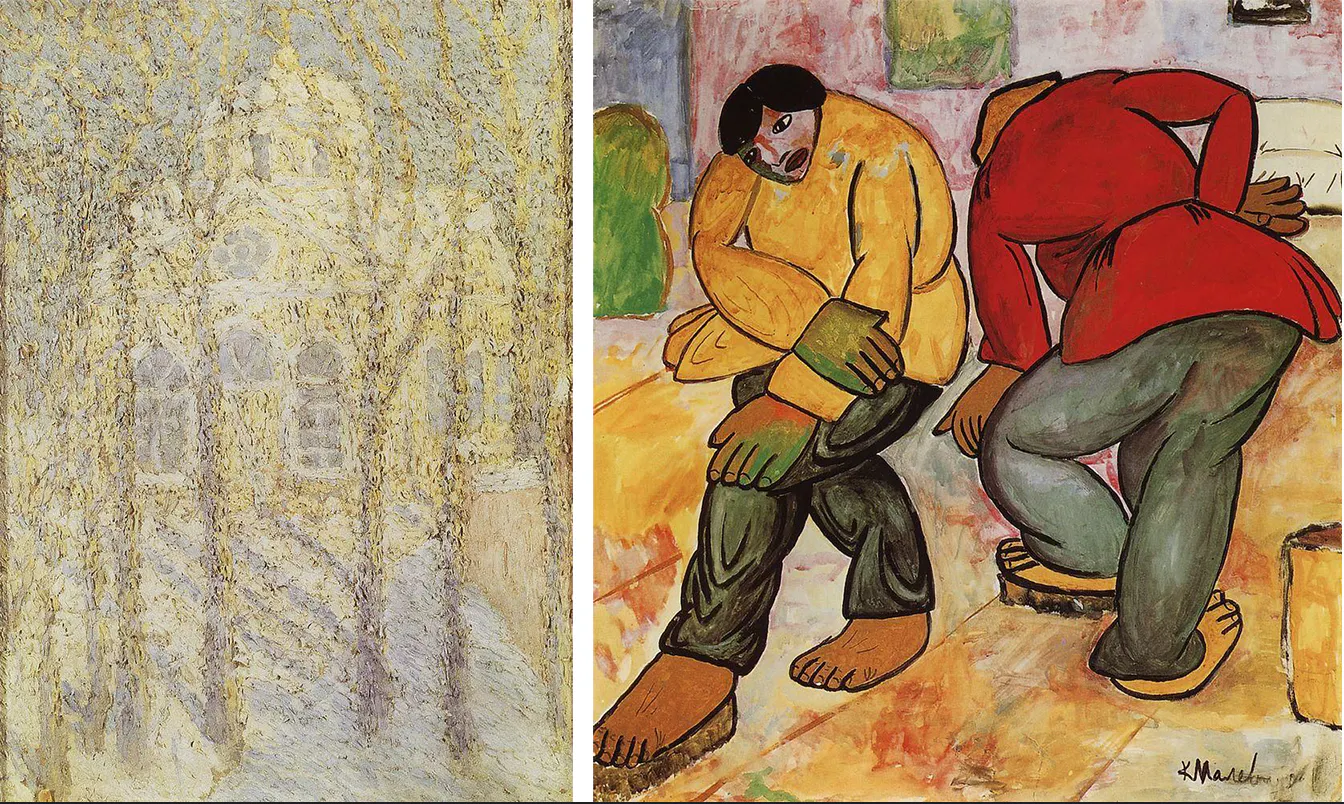
Malevich later continued his studies in a private studio and became involved with artists of the Moscow avant-garde, including Natalia Goncharova and Mikhail Larionov. His work passed through a series of stylistic phases, from Symbolism and Pointillism to Primitivism, Cubo-Futurism and Alogism.
See also: The 15 Most Expensive Female Artists
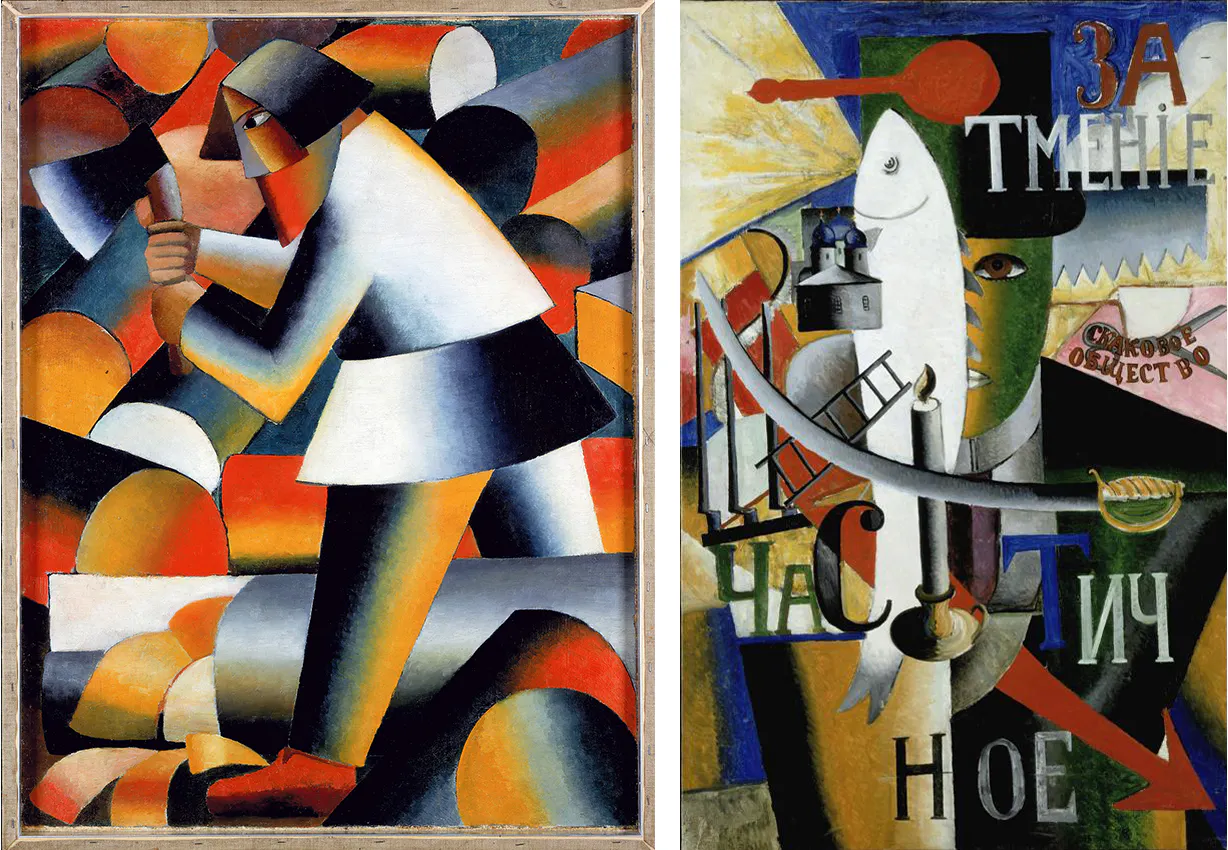
2. Scandal on stage
In the summer of 1913, composer Mikhail Matyushin invited Malevich to design the costumes and stage sets for the futuristic opera Victory over the Sun. Conceived as a challenge to traditional theatre, which the avant-garde regarded as outdated, the work presented a future in which powerful figures capture the sun and create a new world free from established conventions, only to confront uncertainty about what follows.
See also: Collecting Opera and Ballet in Art
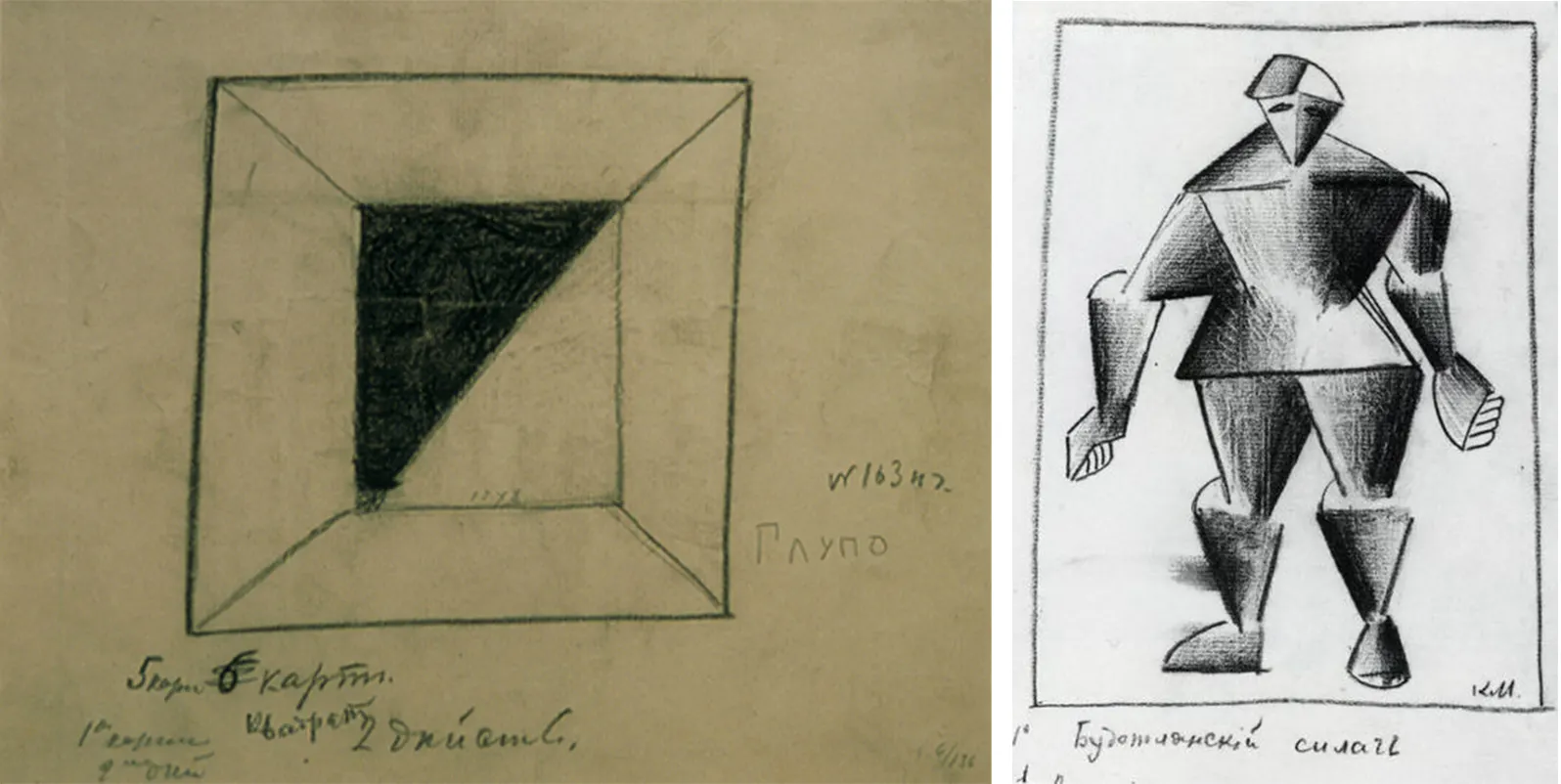
The production reflected the political climate of Tsarist Russia after the revolutionary unrest of 1905, but it was the staging itself that caused controversy. A prologue by the futurist poet Velimir Khlebnikov bore no relation to the plot, which was repeatedly interrupted by incoherent interjections, sometimes delivered in the artificial language Zaum, created by the libretto author Alexei Kruchenykh. The singing was deliberately off-key, and some performers were placed among the audience, directly addressing and confronting spectators in an attempt to extend the action into the auditorium. The experiment provoked strong reactions. After its premiere on 3 December 1913 at the Lunapark Theatre in Saint Petersburg, the opera was performed only once more, two days later, and became one of the most controversial productions in theatre history.
3. The birth of Suprematism
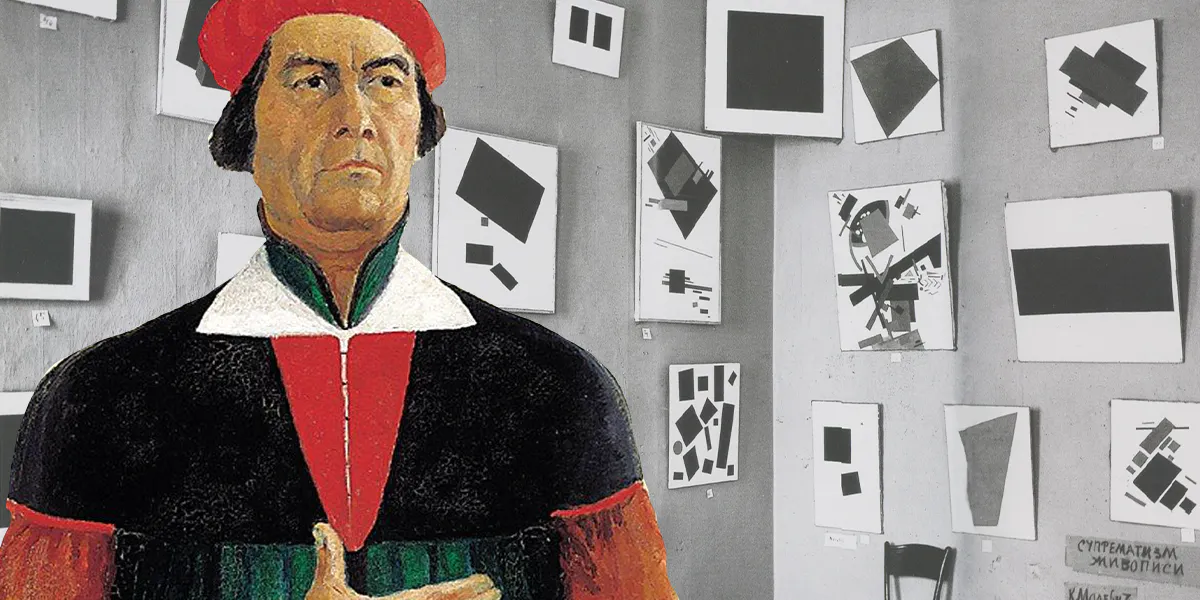
Malevich later described Victory over the Sun as the starting point for the Suprematist style he would develop, noting that he first painted a black square for the stage curtain. The term Suprematism derives from the Latin supremus (“the highest”) and refers to the supremacy of pure feeling, free from representational form. For this reason, Malevich distinguished it from conventional abstraction.
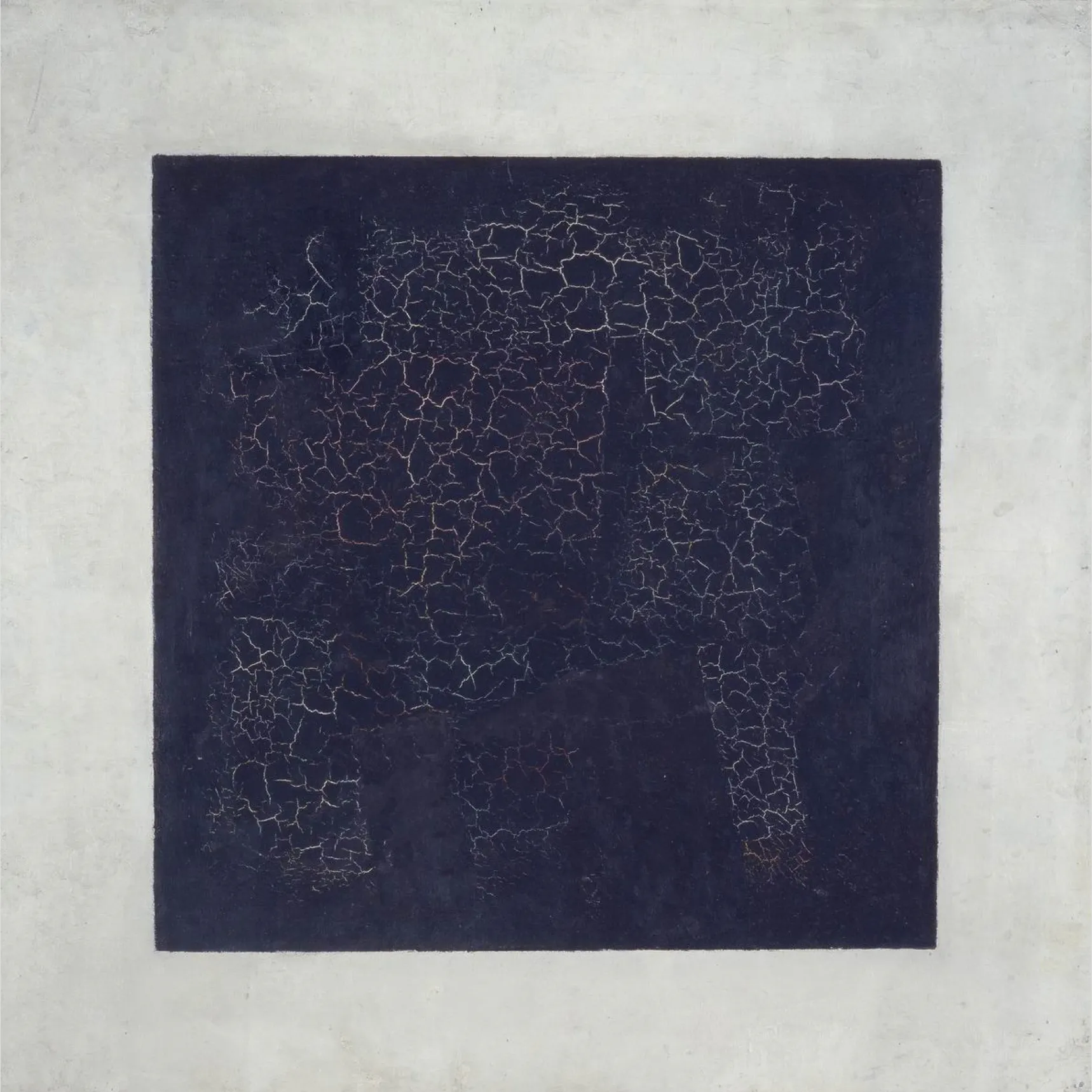
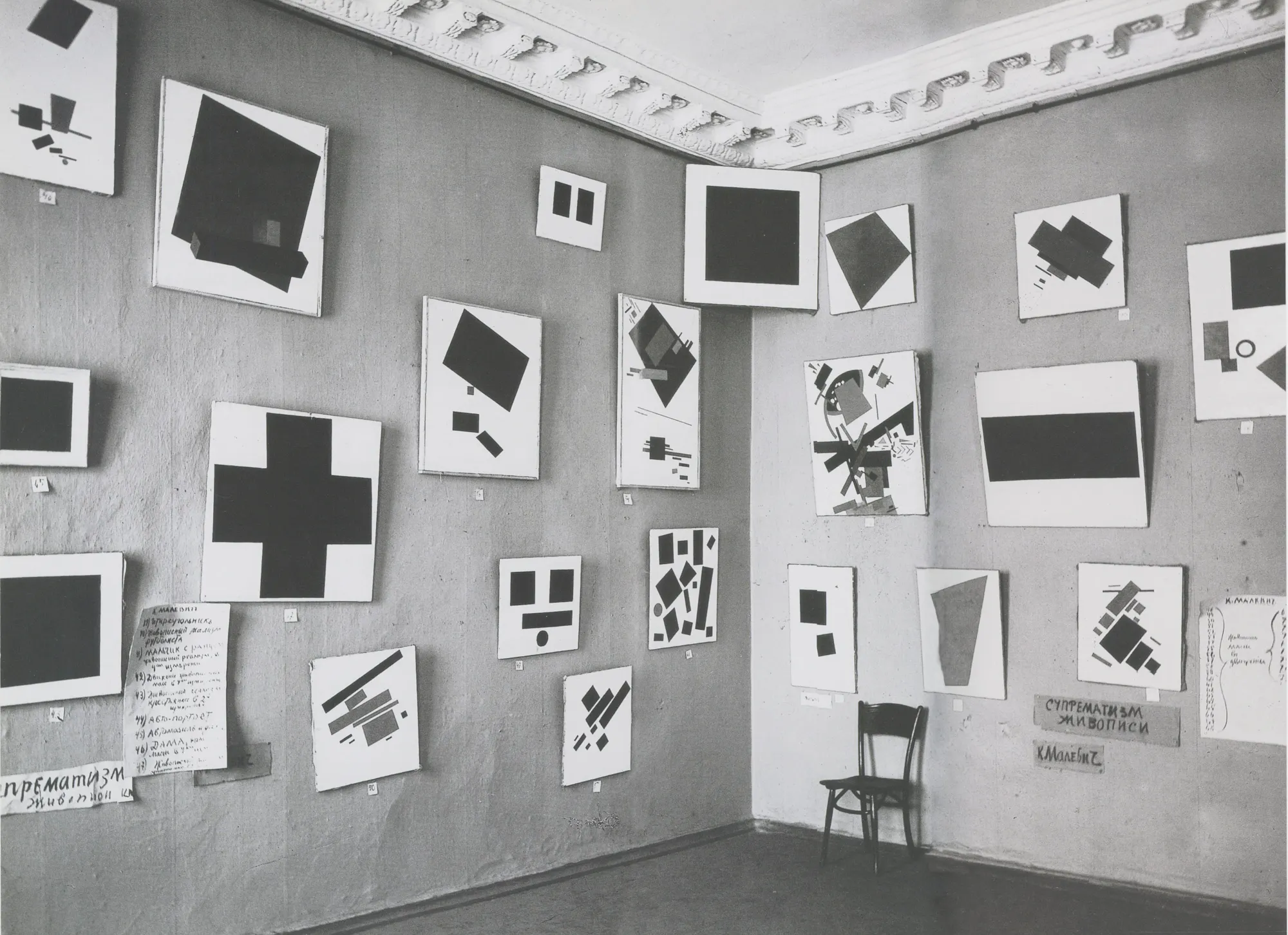
The movement took shape more fully at the 0.10 exhibition, held in Petrograd from December 1915 to January 1916. The exhibition brought together avant-garde artists including Vladimir Tatlin, Llubov Popova, Ivan Klyun, and Olga Rozanova. Although Cubo-Futurism dominated the show, Malevich presented his Suprematist works there for the first time, most notably Quadrilateral (1915), his first Black Square, followed by further versions until the early 1930s.
See also: The 10 Most Scandalous Artworks
The stark composition of black and white oil paint on canvas reflected Malevich’s search for complete freedom from representation. “It wasn’t an empty square that I was exhibiting, but rather the sensation of non-objectivity,” he explained. At the exhibition, the work was hung high in a corner of the room, echoing the traditional placement of religious icons. Today it is regarded as a defining work of 20th-century art.
4. A confrontation with Chagall
In 1919 Malevich travelled to Vitebsk to teach at a newly founded art school established by Marc Chagall, who had grown up in the town, now in Belarus. Having returned there in 1914 to visit his family, Chagall was unable to leave after the outbreak of the First World War. A supporter of the October Revolution, he founded the art school with the backing of the new government, which appointed him Commissar for Fine Arts in the Vitebsk Governorate. He invited several avant-garde artists to teach there, including El Lissitzky, Ivan Puni and Malevich.
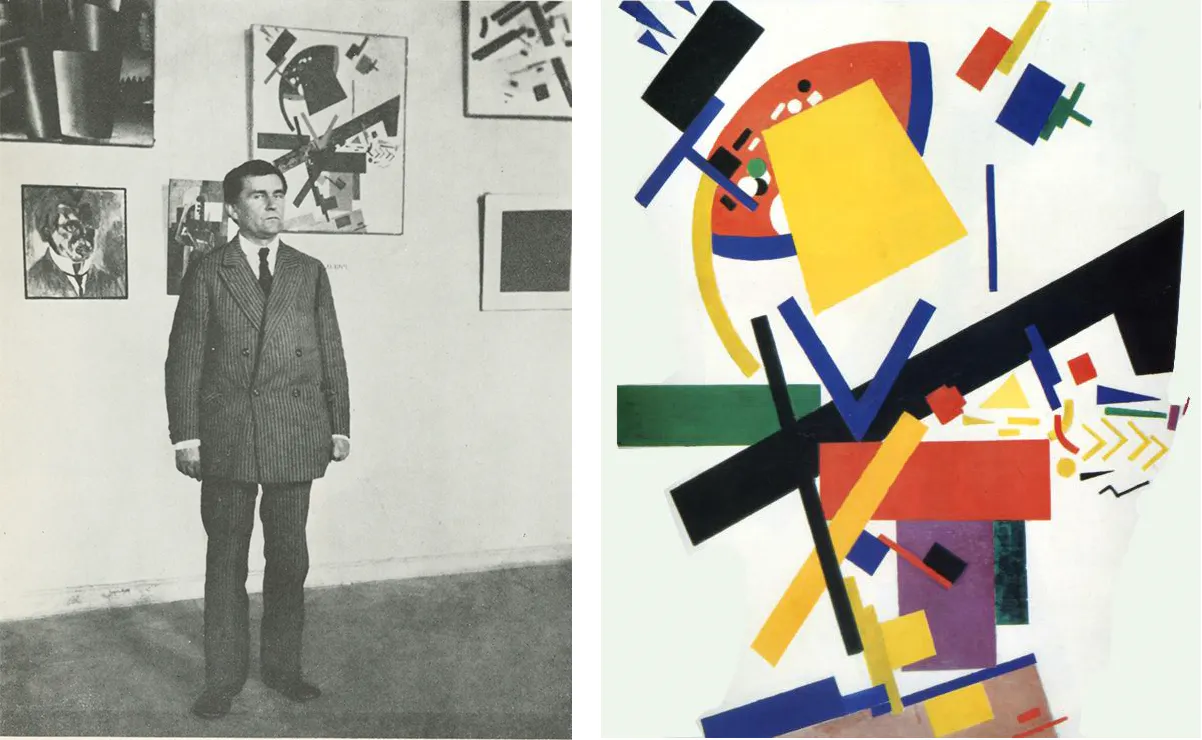
Differences between Chagall and Malevich soon became clear. Chagall maintained a figurative approach, while Malevich pursued the radical non-representational language of Suprematism. Their disagreement developed into a struggle for influence at the school. Chagall resigned in 1920 and returned to France two years later, while Malevich established the influential artists’ group UNOVIS, dedicated to promoting Suprematism.
5. Dating and rediscovery
In 1927 Malevich travelled to Berlin, where he exhibited 70 paintings and architectural models at the Great Berlin Art Exhibition and visited the Bauhaus in Dessau. Although the Bauhaus was less receptive to Suprematism than he had hoped, it agreed to publish his book The Non-Objective World as the eleventh volume in the Bauhaus series.
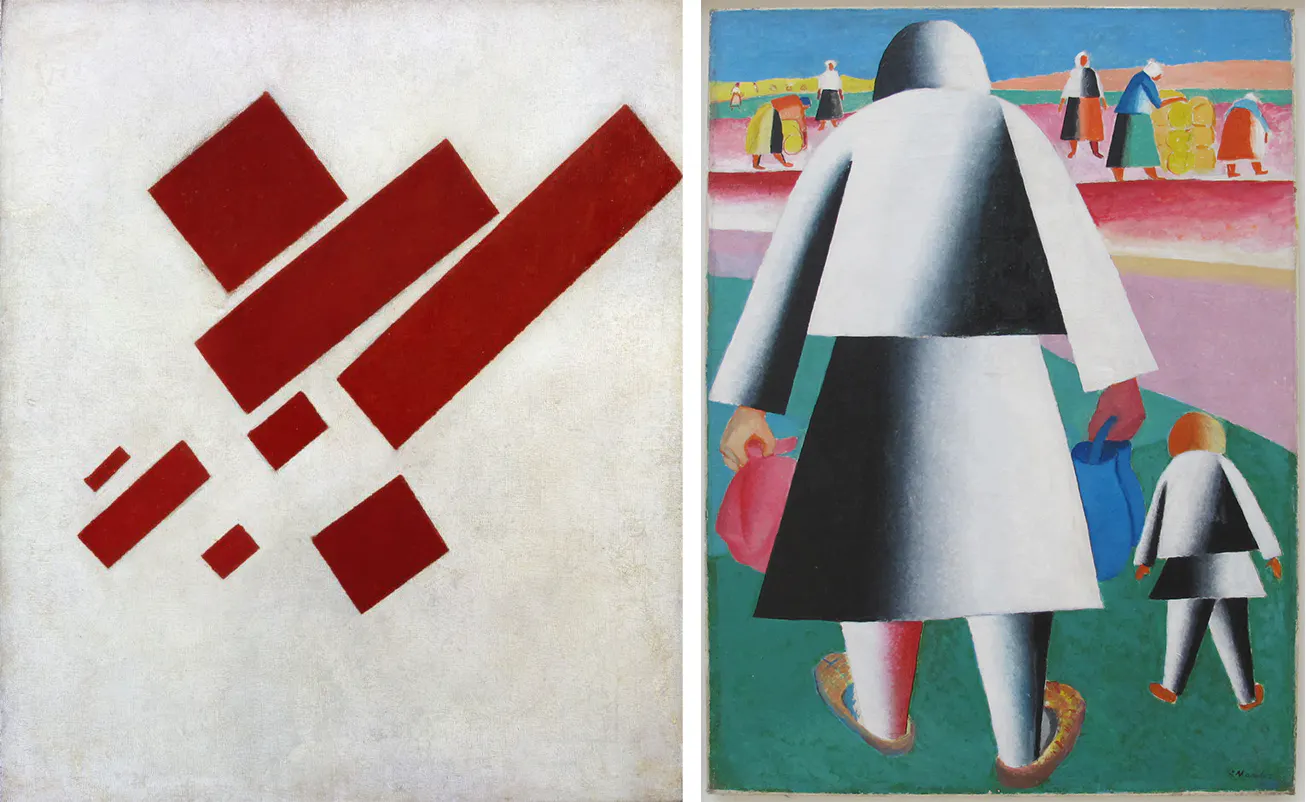
Amid growing political uncertainty at home, and after losing his position as director of the State Institute for Artistic Culture, Malevich left many of the works he had brought to Germany, along with his writings, before returning to Russia. These works were rediscovered in the 1950s and later acquired by the Stedelijk Museum in Amsterdam, which now holds the largest collection of Malevich’s work outside Russia.
Want more articles like this straight to your inbox? Subscribe to our free newsletter!
In the increasingly restrictive cultural climate of the Stalinist Soviet Union, Suprematism fell out of favour. When a major exhibition of his work was planned for the Tretyakov Gallery in Moscow in 1929, Malevich repainted works he had left in Germany and dated them to the original years, which later caused confusion among scholars.
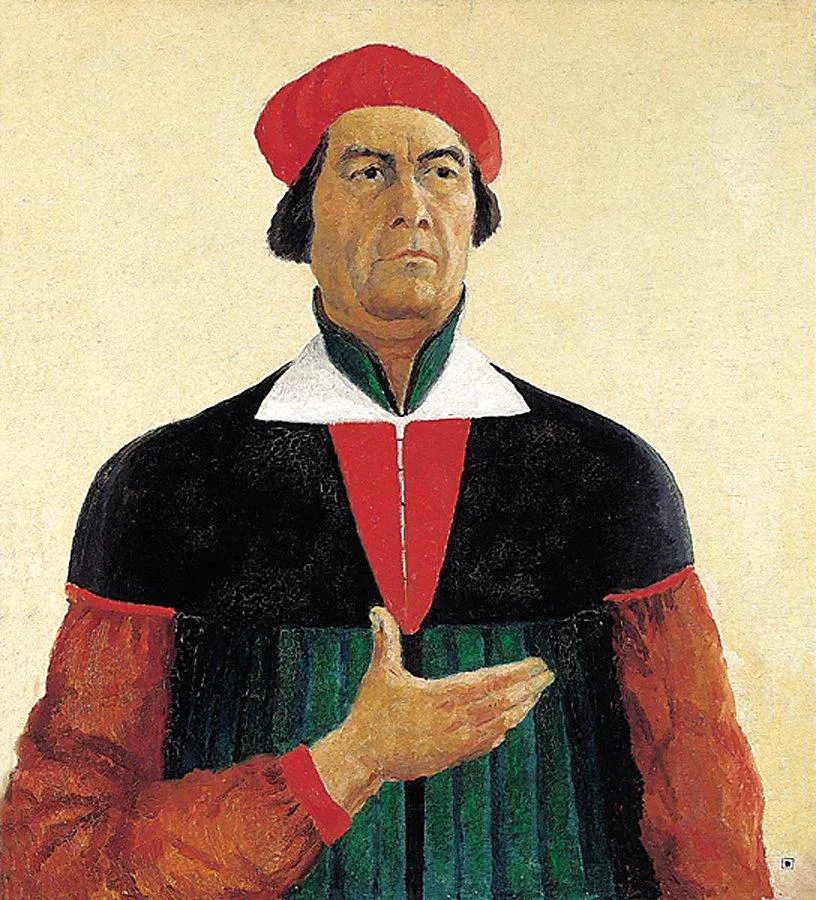
In his later career, Malevich returned to figurative painting without adopting the Socialist Realism demanded by the authorities. Instead he produced stylised compositions of geometric forms, often depicting peasants, as well as portraits recalling Renaissance models. His work at art institutions was increasingly restricted, and he spent two months in pretrial detention in Leningrad. Kazimir Malevich died of cancer on May 15, 1935.