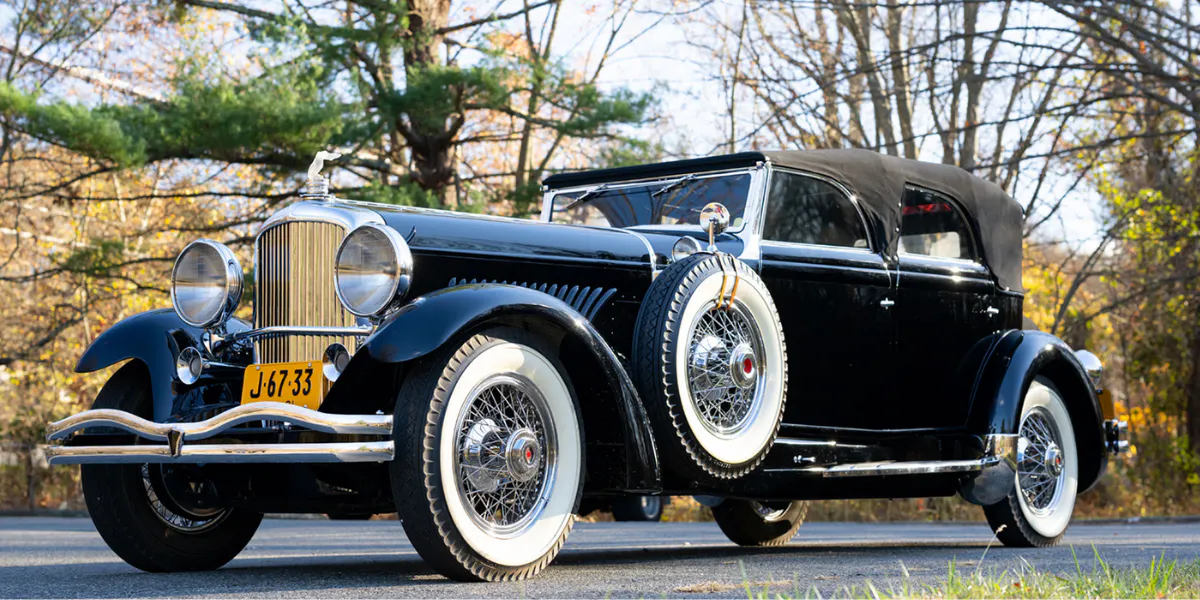
On April 26, Gooding & Company will be offering cars from the Mullin Collection at auction, all without reserve, at the Mullin Automotive Museum in Oxnard, California. Respected visionary Peter Mullin was deeply revered in the collector car world, not only for his world-renowned collection consisting of the finest and most exquisite French and European automobiles, but also for his enduring legacy as a philanthropist and distinguished businessman. Peter and Merle Mullin’s appreciation, enthusiasm and knowledge of pre-war French and Art Deco cars were simply unprecedented in the industry and beyond. With unique models of Delage, Avions Voisin, and Citroëns, Mullin’s collection revealed true connoisseurship. Here are six cars not to miss:
Register to bid on these cars and much more here.
Discover the full catalogue of the Mullin Collection here and get more information here.
1937 Delage D8-120 Three-Position Cabriolet
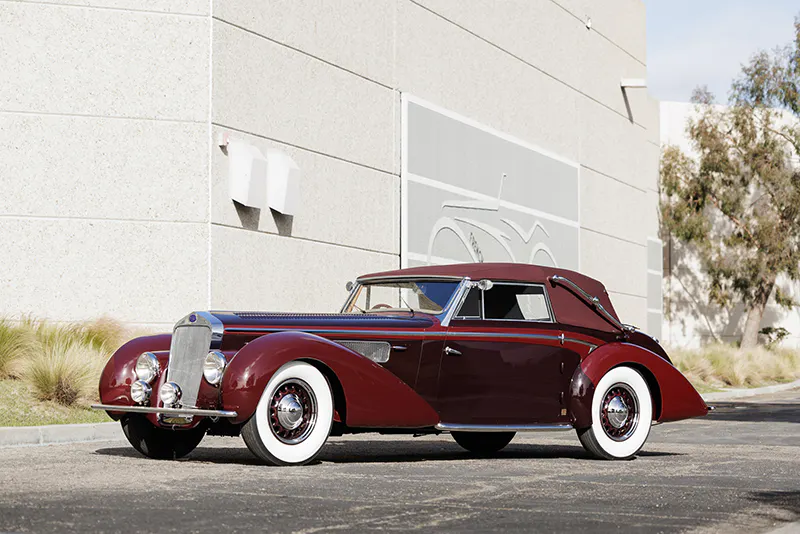
Luxury automobile manufacturer Delage was founded in 1905. Thirty years later, it was acquired by Delahaye and as a result of the reorganization, Delahaye was to become a sporting marque, while Delage would be positioned at the top of the luxury market. In January 1936, work commenced on a new eight-cylinder chassis that was intended to carry the most luxurious coachwork designed by the very elite of French carrosserie.
This Delage, chassis 51760, received four-seat cabriolet coachwork from Carrosserie Henri Chapron of Paris. After WWII, it was shipped to California, where it was sold to the Hollywood film studio RKO.
The car’s graceful styling earned it a role in the 1951 classic film An American in Paris starring Gene Kelly, who was chauffeured around in the open Delage. While owned by RKO Studios, the D8-120 also made appearances in Kiss Tomorrow Goodbye (1950) and Carmen Jones (1954). In 1955, the car was acquired by Thol “Si” Simonson, a member of the RKO Studios production team.
In 1987, the Mullin Collection acquired the Delage from Mr. Simonson. After extensively restoring the elegant D8-120 and finishing it in its lustrous and highly attractive two-tone maroon color scheme, it earned an impressive Third Place award in the Chapron coachwork class at the 2016 Pebble Beach Concours d’Elegance®. As a long-wheelbase variant of the flagship D8-120 model, this Delage is ideal for intercontinental touring. For the collector in search of a refined Delage with beautiful and original open coachwork by the renowned Henri Chapron, the search ends here.
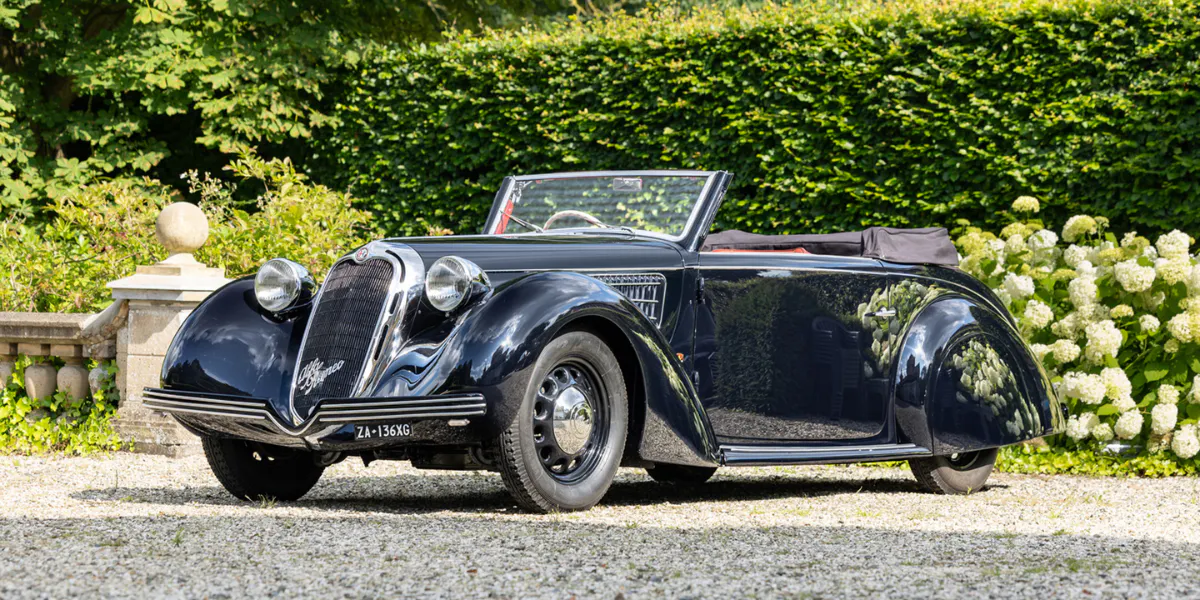
1938 Avions Voisin Type C30 Cabriolet

The 1938 introduction of the Voisin Type C30 in stylish coupe and cabriolet form would prove to be the marque’s final appearance at the Paris Motor Show, and indeed the last Voisin cars produced. In this final iteration of cars bearing the Voisin name, they received a 3.5-liter Graham-Paige engine with a centrifugal supercharger, and a Graham driveline. These cars were built under license by Société des Automobiles Voisin following the closure of the Voisin factory in 1936.
One of about 30 cars made under this arrangement, the C30 Cabriolet offered here was bodied by Carrosserie Louis Dubos of Paris, and this or a similar example was displayed at the Paris Motor Show in December 1938. It was designed in keeping with previous Voisin hallmarks including the barrel-profiled hood panels, sharp-edged fender lines, and vertical, flat-panel dashboard. According to Voisin historian Pascal Courteault, following WWII, this Cabriolet was purchased by pioneering Voisin collector Robert Corniére, and a subsequent owner had it restored by D. Tessier in Tours, France, a specialized body restoration shop. The rare C30 was purchased by the Mullin Collection in 2008, and subsequently displayed in the Mullin Automotive Museum in Oxnard, California, where it was featured as the final bookend in a special exhibit celebrating the Voisin marque.
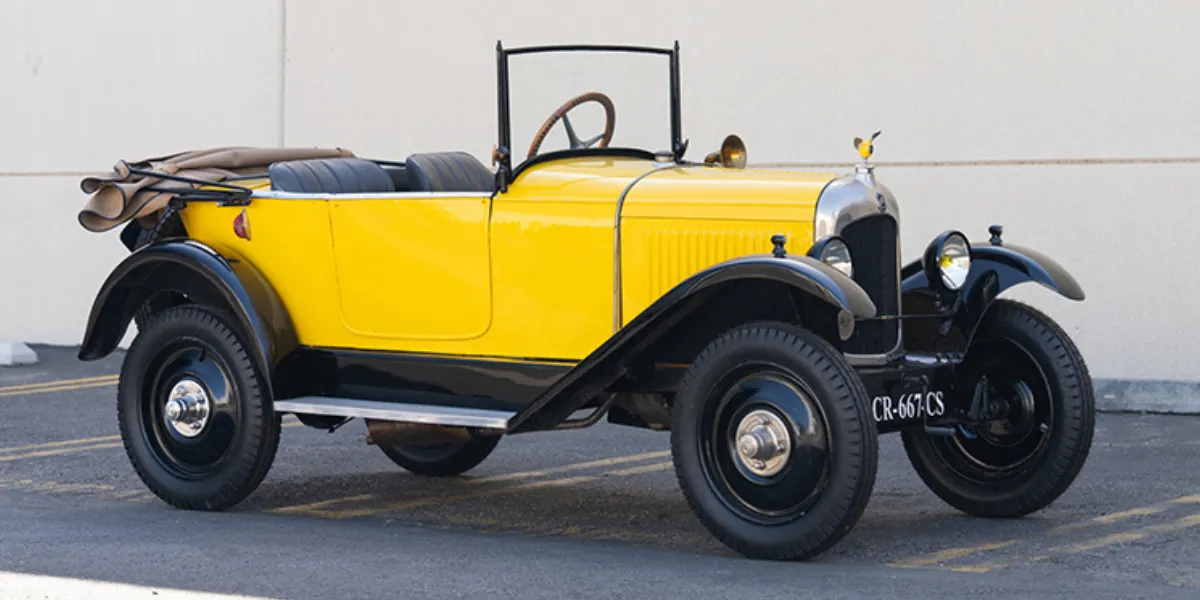
1927 Citroën 5CV Trefle
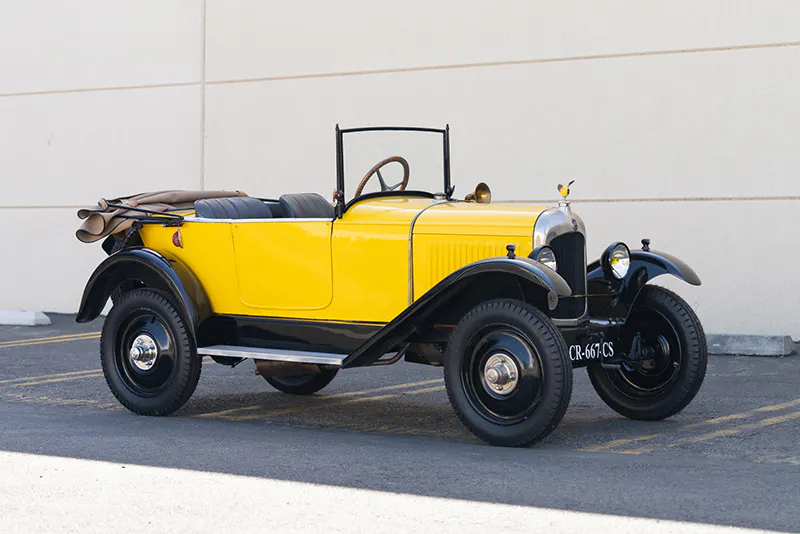
A smaller, more affordable companion to the Model A, the Type C remains affectionately known by Citroën enthusiasts as the Petit Citron or “Little Lemon,” due to initial availability only with a yellow body finish. Debuted at the October 1921 Paris Motor Show, it was subsequently dubbed the “5HP” and then the “5CV” in recognition of its taxable power rating.
Consistent with André Citroën’s renowned innovation and business sense, these “junior” models were marketed to the fast-growing numbers of female drivers, and the company’s newly established consumer finance program ensured strong sales. Several body styles were offered; however, the most attractive and festive was definitely the three-seat open tourer alternatively known as the “Cloverleaf” or “Trèfle,” by virtue of its unique seating arrangement. First made available in 1924, the Trèfle offered a third seat directly behind and between the two front seats, with ample legroom. Visually, this body style and its rounded rear treatment suited the proportions of the Type C chassis very well.
1952 Citroën 2CV
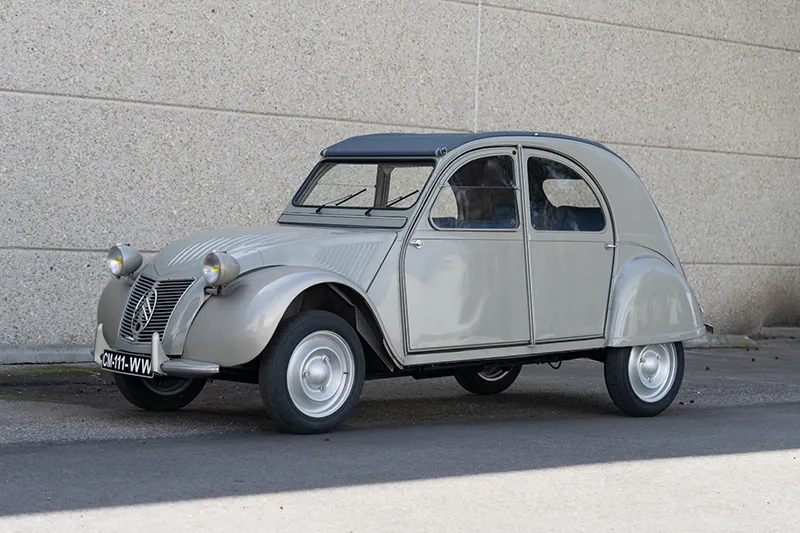
When Citroën introduced the 2CV, short for Deux Chevaux (Two Horses) at the 1948 Paris Motor Show, few onlookers foresaw that this simple, inexpensive “people’s car” would see production of some 5,000,000 examples through 1990.
Sometimes disparaged as the “Tin Snail,” the elegantly simple 2CV featured a minimalistic body, seating for up to four adults, and an incredibly economical, easily serviced air-cooled engine, plus a long-travel suspension offering a comfortable ride with sufficient ruggedness for limited off-road use. These virtues and the legendary resilience of the 2CV ensure its enshrinement on many “Greatest Cars” lists today. Powered by an air-cooled, 375 cc two-cylinder engine rated at 9 hp, this 2CV was restored and refinished in its proper grey paint prior to acquisition by the Mullin Collection in 2015.
1957 Citroën 2CV AZ
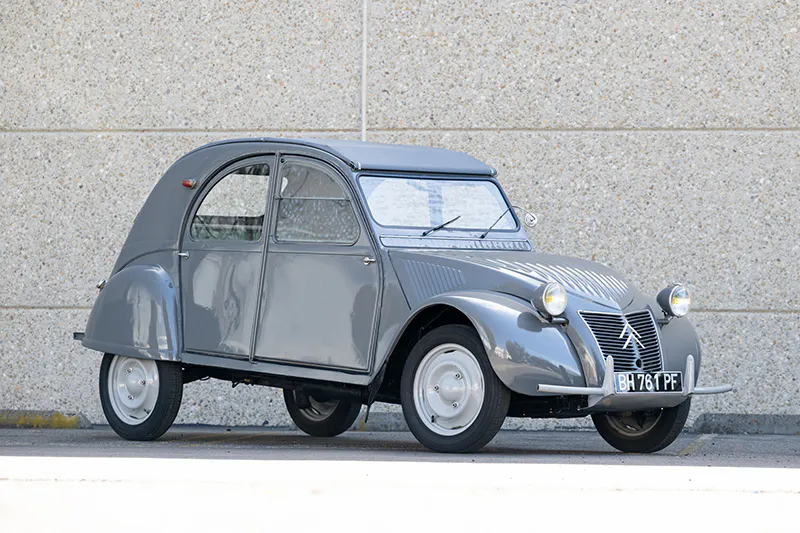
The original Citroën 2CV was an immediate success from introduction in 1948, with availability initially prioritized – at the suggestion of Citroën chief engineer Paul Boulanger – for purchasers who were required to drive for their professions. Select and welcome mechanical improvements were applied to the ubiquitous 2CV by 1954, with an upgraded version offered with a more powerful 425 cc engine delivering 33% more power and improved carburetion. Known as the 2CV AZ, it also featured a centrifugal clutch, aiding drivability in heavy traffic. While certainly functional, the sliding roof of the 2CV was not renowned for being weatherproof in rough and dusty driving conditions, spurring a special reinforced 2CV model.
This high-specification 1957 Citroën 2CV AZ also sports the reinforced body in addition to its 425 cc engine and centrifugal clutch, making it particularly desirable and collectible to marque enthusiasts. Other choice features include a four-speed manual gearbox, four-wheel independent suspension, and four-wheel drum brakes, inboard up front.
1966 Citroën 2 CV Sahara
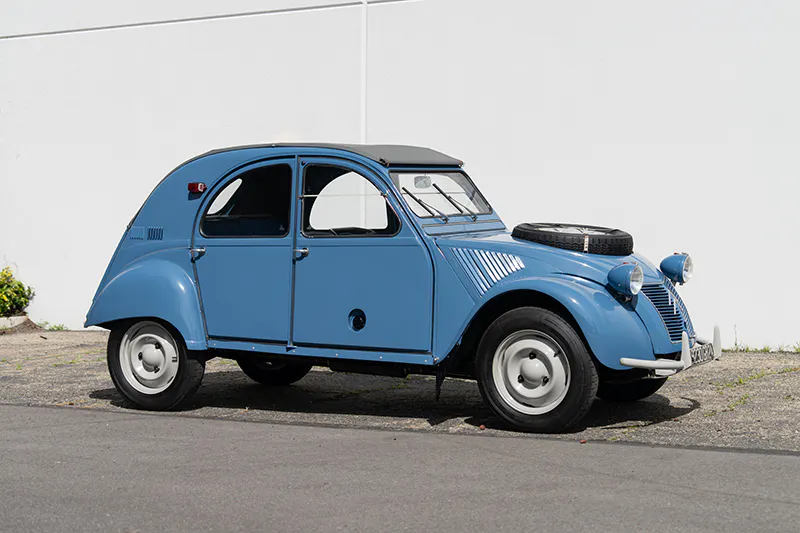
Having earned a near-mythical reputation for its ruggedness and ability to go virtually anywhere, these capabilities of the Citroën 2CV inspired the Sahara, a low-production, dual-engine 4x4 variant. While the standard 2CV could only manage approximately 40 mph, the Sahara was downright speedy with up to 65 mph on tap with both engines engaged. In addition to its interesting and useful mechanical design, the 2CV Sahara was built in limited numbers, with marque experts citing only 694 built when production ended in 1971.
According to copies of registration documents on file, this 1966 Citroën 2CV Sahara was purchased by Gisela Wissmeyer, a Corsican farmer. It passed through the hands of subsequent owners and was restored in 2010, before being sold to its next caretaker in Haut-Beaujolais, France, and in 2015, the Mullin Collection acquired this exceptional Citroën. Among the rarest and most fascinating of all Citroëns, this beautifully restored Sahara represents an enticing opportunity.