
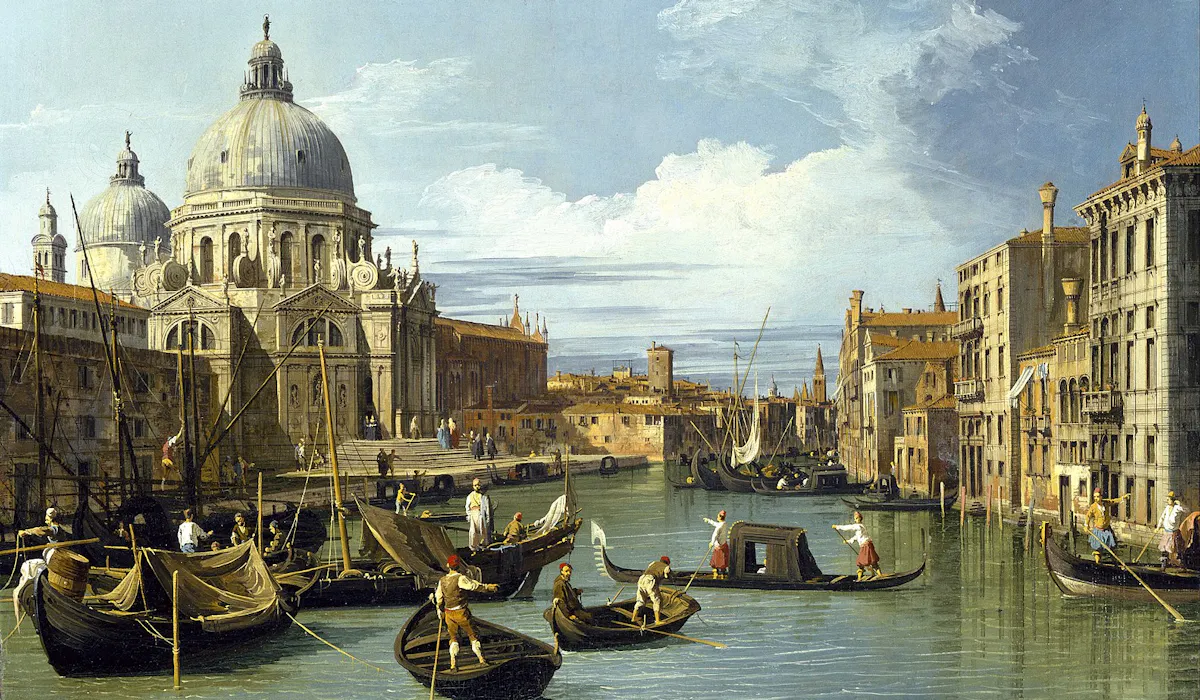
Canaletto, born 1697 in Venice, Italy, never ceased to impress with his talent of painting capricci (imaginary views), which combined reality and imagination. His father Bernardo Canal, a talented painter from a wealthy background, trained him to paint decors for Venetian theaters. This experience with the stage had a lasting impact on the painter: no one managed to equal Canaletto’s ability to represent Venice with the same sense of visual spectacle.
Fashionable in the 18th century, the veduta is an art genre that consists of making a realistic and grandiose portrait of a city. Such paintings offered broad cityscapes in which humans were often reduced to incidental passers-by. The veduta is possibly the most urban-focused genre in the history of painting.
See also: Bronzino: An Ingenious Portraitist
During Canaletto’s era, the veduta had already been around for several centuries in the West. Canaletto, however, was the one who lifted the genre to a new level of perfection. Extraordinarily gifted, the artist quickly won adepts thanks to spectacular city views that unveiled uncanny meticulousness and fidelity to topographical details. For wealthy clients who enjoyed traveling in Europe (often in the course of Grand Tours), his vedute were highly prized as souvenirs or decorative objects.

Until the 1730s, Canaletto’s style was fairly free. The painter’s depictions were suggestive rather than descriptive, as shown by his Arch of Constantine (1720) or Basilica San Marco and Campo San Basso (c.1722). Canaletto also proved his sociological curiosity by depicting both The Beggars’ Canal (1723) and The Grand Canal (1728). The documentary wealth of his compositions is just as valuable today. For example, The Isles of San Cristoforo, San Michele and Murano (c. 1725) testifies to one episode from the history of Venice or La Serenissima: the gathering of glassmakers to reduce the risks of fire.
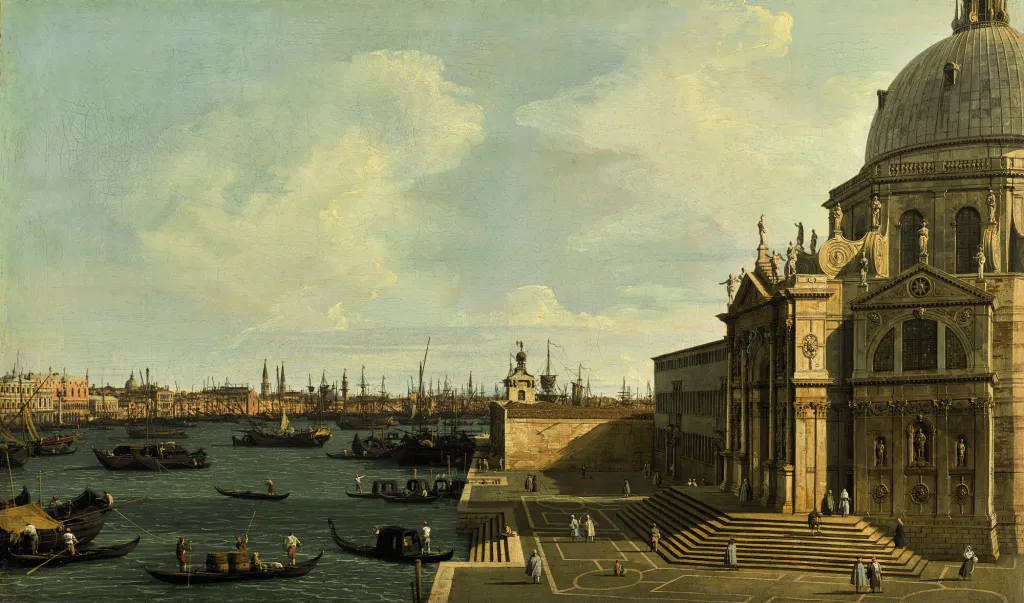
Conscious of the aesthetic attractions that his paintings held for rich European clients, Canaletto did not always adhere to reality. In The North Lagoon Islands from San Pietro di Castello (c. 1725), for example, he blew up the size of the mountains, which were in fact barely visible from the Venetian horizon.
See also: Caravaggio: The Renaissance Rebel
Right from the outset, Canaletto’s vedute showed a heightened interest in light effects. It didn’t take long for his talent to win renown throughout Europe. In 1726, the Duke of Richmond ordered 24 paintings from him. The Duke of Bedford followed this example in 1732. Even King George III of England became one of his clients.
Antonio Canale (Canaletto)... it is like Carlevaris, but you can see the sun shining in it.
As of the 1730s, Canaletto changed his style, paying even painstaking care to detail. European courts were already au fait with this rigour, which the painter had exercised all along for his overseas commissions. It was against this backdrop that Canaletto met the art dealer Joseph Smith, who became his agent. As demand rose, Canaletto took to copying then recopying his paintings, well aware of the financial gain they could reap him. His sublime works were presented as official representations of Venice.
His View of the Rio di Cannaregio (c. 1745) shows some of Venice’s most celebrated palaces in a single sweeping view. He was so successful that dealers would encourage their clients to focus mostly on work of Canaletto by saying for example that, "Antonio Canale (Canaletto)... it is like Carlevaris, but you can see the sun shining in it" (Carlevaris being an Italian painter and engraver).
See also: Cimabue: Late Medieval Genius
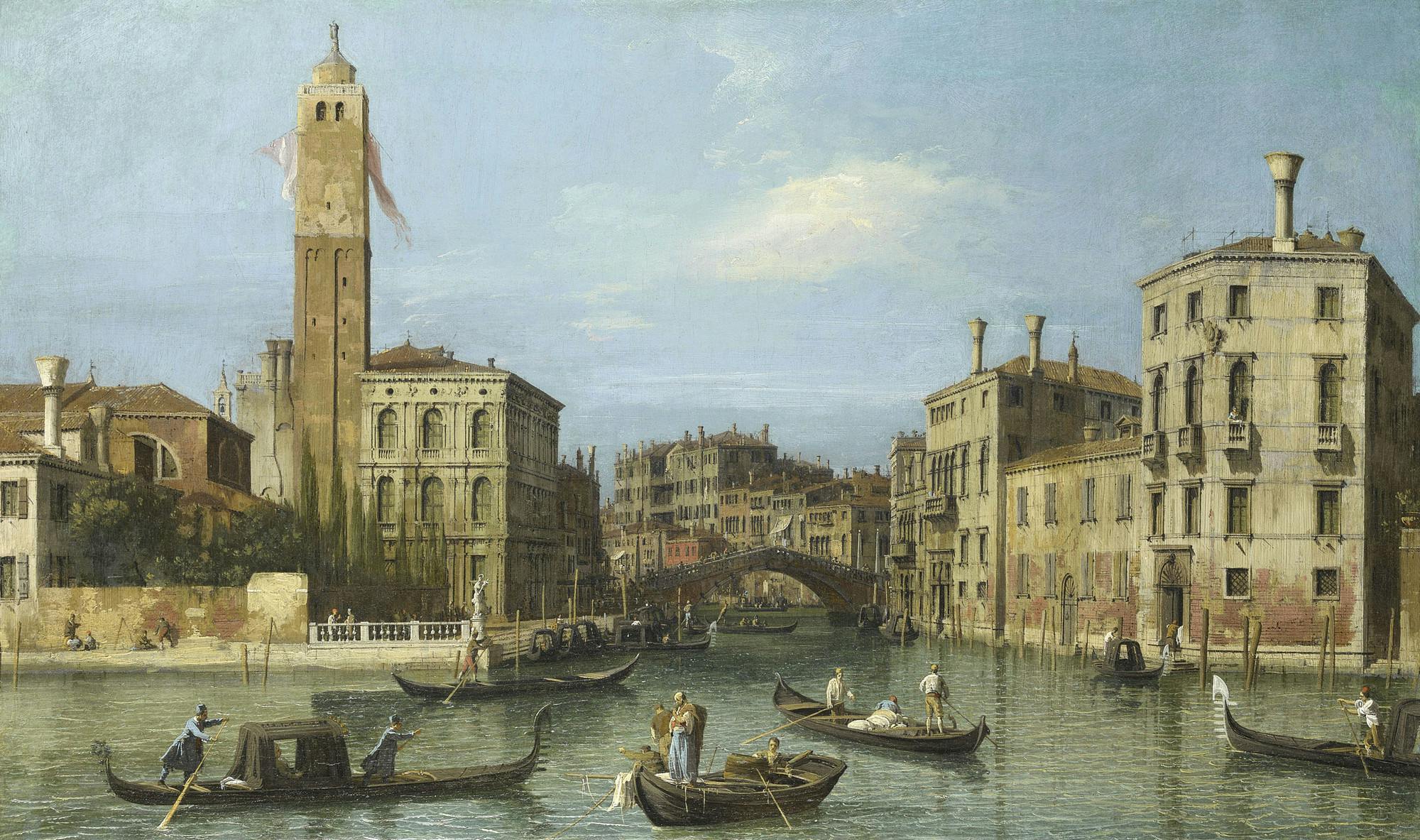
In 1741, the War of the Austrian Succession had effects that spilled over to La Serenissima. Few travellers came to Venice, and Canaletto embarked on a trip himself to England, but the visit didn’t turn out so well. The Venetian found himself embroiled in a few conflicts sparked by his talent and also his strong character.
At the war’s conclusion, Canaletto returned to Italy in 1755. Now at the height of his career, he mingled reality and fantasy in his works – a tendency that had already come to light in his English paintings. He depicted non-existent bridges, for example Palladio’s Design for the Rialto Bridge (c. 1745), and in one work, a close-up view: The Giants’ Staircase in the Palazzo Ducale (c. 1755).
See also: El Greco: A Meeting of East and West
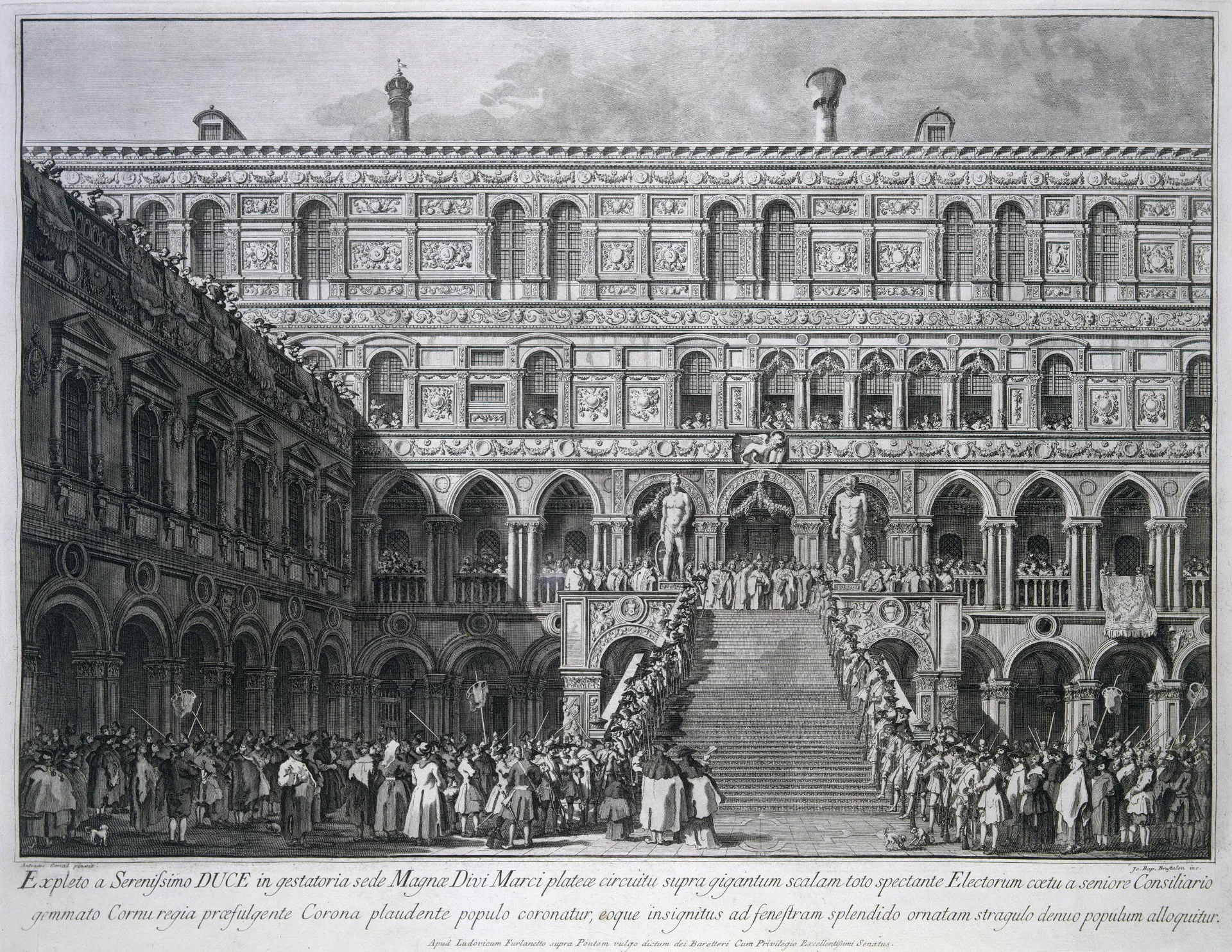
Despite Canaletto’s overwhelming popularity, he didn’t manage to be elected to the Venetian Academy until 1763. In the eyes of Academy members, the vedute remained a minor genre. Age and sickness led to the painter’s death in 1768.
It would be remiss to talk about Canaletto without mentioning his nephew Bellotto and his successor Guardi. These artists, along with Canaletto’s father, also surfed on the success of vedute. The main difference between Canaletto and Guardi lies in realism, the latter taking more liberties in order to create a more dreamlike image of Venice.
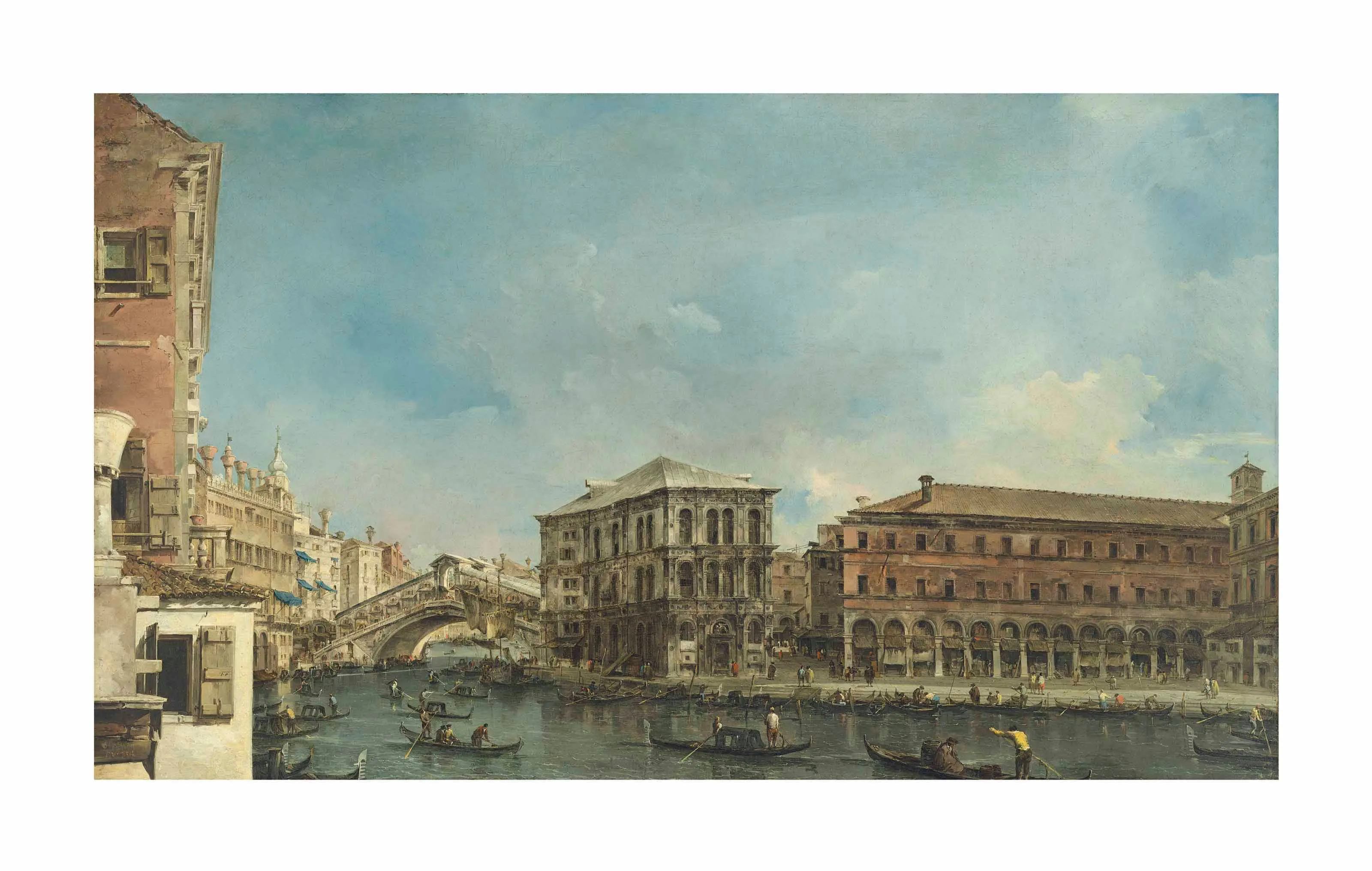
Canaletto and the vedute painters symbolised Venice’s domination of the 18th-century art scene. La Serenissima, also boasting Tiepolo’s decorative talent and Rosalba Carriera’s pastels, set itself up as an artistic rival of Paris. But in fact, the city’s golden age had long passed: the city’s political turbulence meant that at the end of the 18th century, Venice was no longer a coveted tourist destination. In 1797, the Venetian Republic fell when Napoleon Bonaparte deposed the city’s last Doge, and a chapter of Italian history closed forever.
Discover all items related to Canaletto up for auction on Barnebys