The Beatles summon an image. Screaming fans chase after black-sweatered figures. Bright eyes gleam beneath mop-tops. Guitars are held by three thin, rhythmic men, a fourth bopping his head as he drums. The Beatles were a phenomena of lyric and melody, transforming the worldly culture forever. And there are iconic—intimate, occasionally—photos to document it all.
San Francisco Art Exchange offers hundreds of these photographs. Founded in 1983, the Art Exchange specializes in historic pop culture artworks, and represents over 200 of the world’s most accomplished artists and photographers. Today, we focus on The Beatles. The Fab Four worked with a variety of photographers over their cosmic career, of course, but several stick out in both iconography and longevity.

Shahrokh Hatami (known widely as simply “Hatami”) was an Iranian photojournalist whose career took him “across Africa and the Middle East, to penthouses and parties in Paris, London, New York and Hollywood.” He photographed a variety of peoples of importance: Presidents Nasser and King Hussein; Coco Chanel, Elizabeth Taylor, Marlon Brando, Ingrid Bergman, and Steve McQueen; and movie sets such as Fahrenheit 451 and Rosemary’s Baby. Notably, he was sent to Liverpool in 1963 by Paris Match magazine, where he worked his way backstage to document the moments between John, Paul, George, and Ringo before and after their performance at the Cavern. Hatami’s images famously capture three of the most significant guitars in rock history—John's black Rickenbacker, Paul's Hofner bass, and George's Gretsch Country Gentleman—in one shot. It is a documentation of icons both human and inanimate.
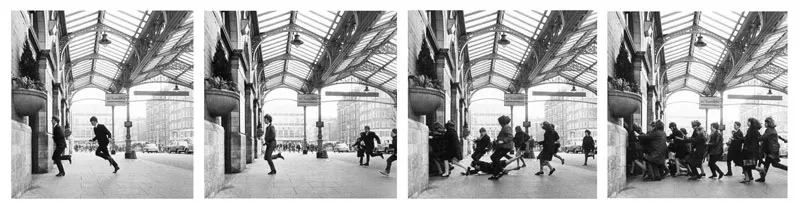
Robert Freeman became a Beatles’ trusted photographer early in their rise. A photojournalist who quickly found his passion for the music world, Freeman captured the band’s interest after sending his portfolio to manager Brian Epstein. The Sunday Times photographer of jazz musicians soared to prominence soon after. He shot several album covers for The Beatles: With the Beatles, Beatles for Sale, A Hard Day’s Night, Help!, and Rubber Soul; during this time, he also crafted the opening sequences for their subsequent films, A Hard Day’s Night and Help!, and documented the insanity that followed. Featured above, as Freeman described it, is, “On location for A Hard Days Night: Fans at Marylebone Station pursue the Beatles into the entrance hall and on to the train.”
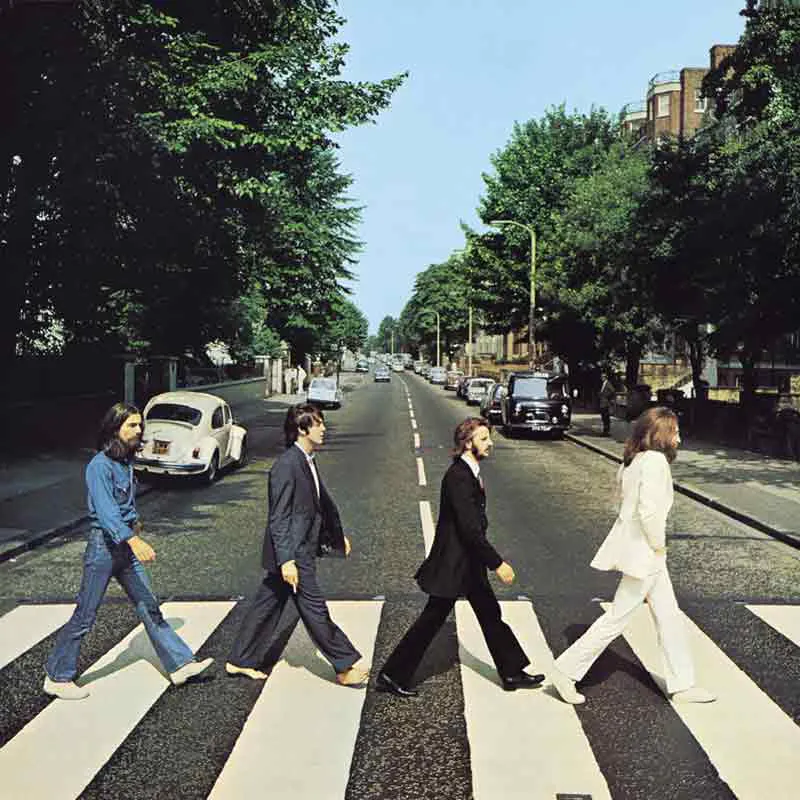
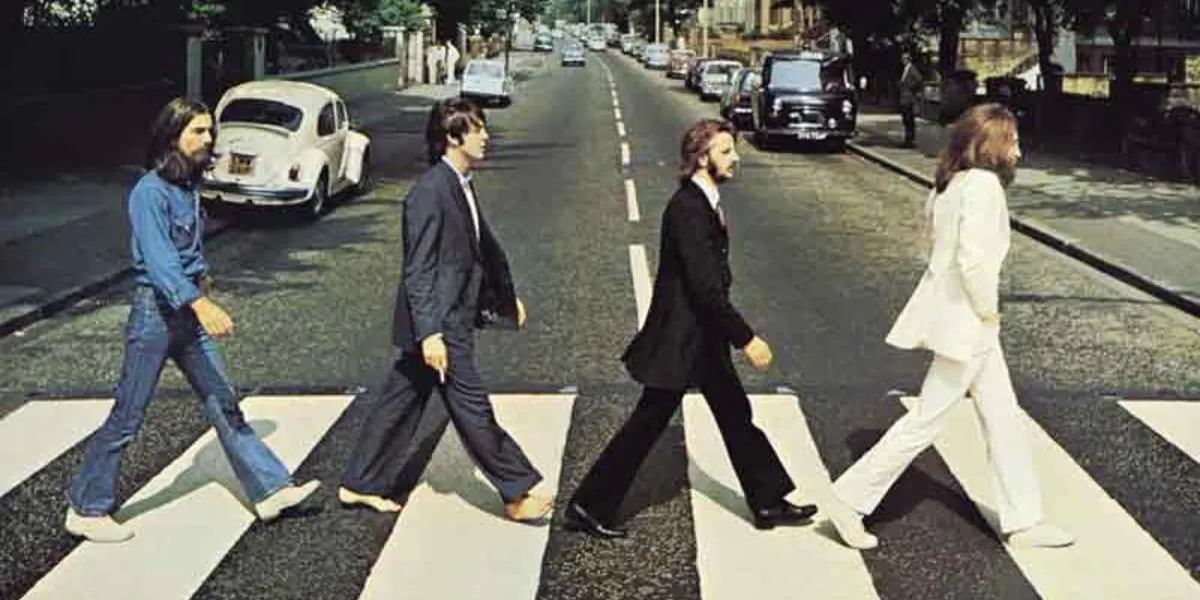
There are few album covers as iconic as The Beatles’ last, Abbey Road. It was the only time Iain Macmillan worked with all four Beatles, and, remarkably, it took only six shots. “I took a couple of shots of the Beatles crossing Abbey Road one way,” Macmillan recalled. “We let some of the traffic go by and then they walked across the road the other way, and I took a few more shots. The one eventually chosen for the cover was number five of six.” Though he would continue working with John and Yoko until 1971, Abbey Road was inherently Macmillan’s Beatles swan song. And what a phenomenal one it was.
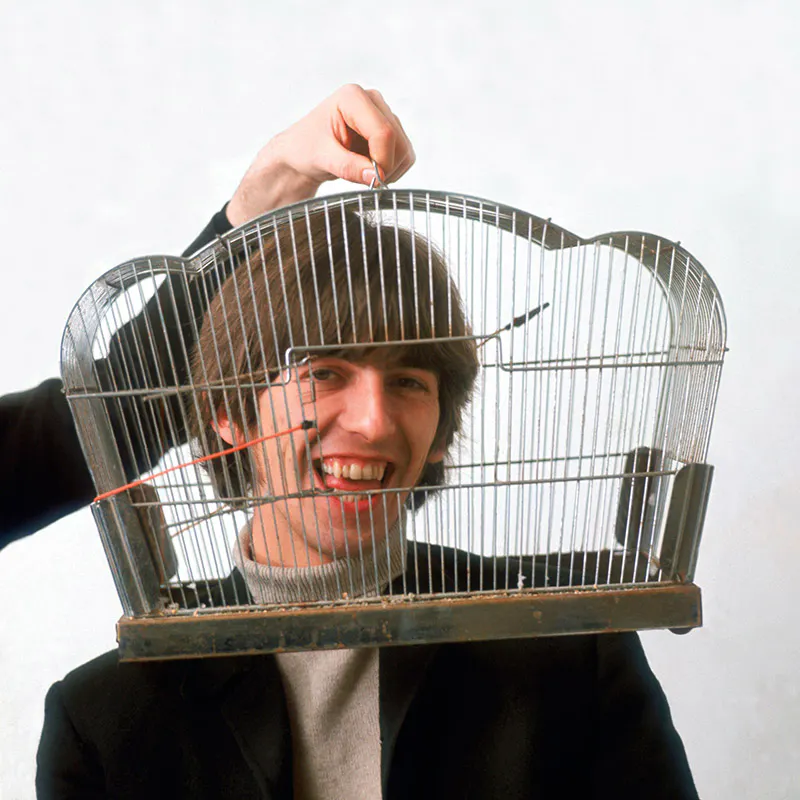
Robert Whitaker came into The Beatles’ circle entirely by accident. After taking a photo of Brian Epstein for a newspaper interview (that Whitaker wasn’t supposed to be at), Epstein himself was so impressed that he invited Whitaker to photograph the band. This led to a working relationship from 1964 to 1966, wherein Whitaker was not simply a photographer. He was a friend. Throughout their two-year professional relationship, Whitaker photographed the Fab Four at work, at rest, at play, on tour, at home, in the studio, during intimate moments, and in formal sessions. Notably, he conceptualized and shot the Butcher Sleeve Session, a frame of which is seen above, in 1966. It was a surrealist shoot designed to metaphorize Beatlemania as religious iconography akin to the golden calf, and was a testament to Whitaker’s care and talent. He was, in fact, a famed photographer outside of The Beatles: “There were about 100 key movers and shakers in the ’60s and I was lucky enough to photograph most of them,” Whitaker once stated. “Of course, my photographs of the Beatles have overshadowed everything else, but that’s OK.”
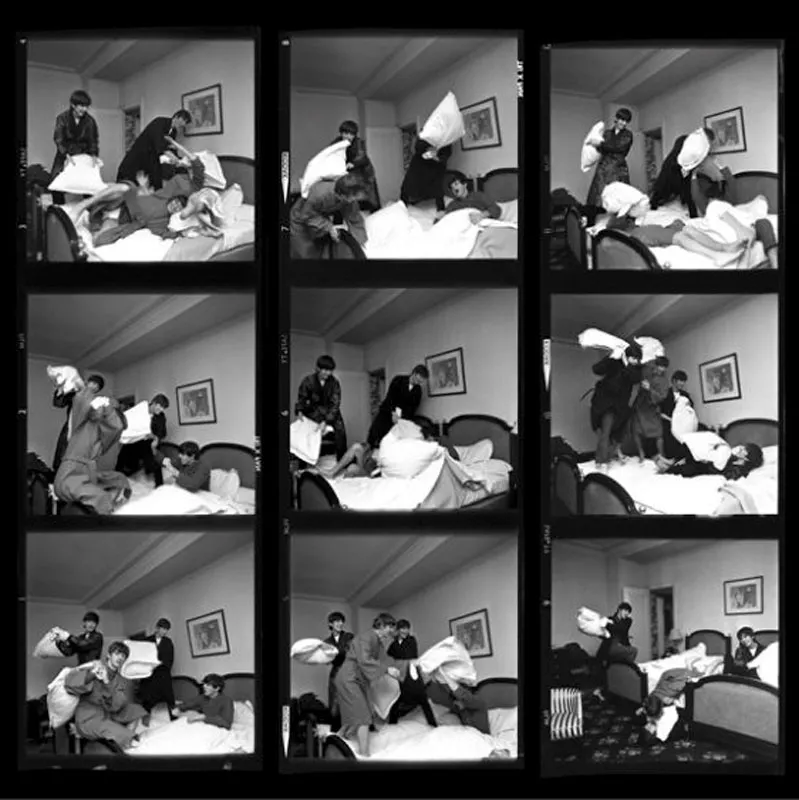
Scottish photojournalist Harry Benson photographed every President from Eisenhower to Obama; Nixon’s resignation; Bobby Kennedy on the night of his assassination; MLK’s Meredith March; IRA maneuvers; the Berlin Wall’s construction and demolition; and Katrina’s aftermath. He was contracted with LIFE from 1970 to 2000. His portraiture rests in the permanent collections of the Scottish National Portrait Gallery and the Smithsonian National Portrait Gallery. But he got his start with The Beatles, traveling with them on their first trip to America in 1964. He documented every moment of that iconic trip, including this one, taking place in Paris just before the American jaunt. Described simply as “happiness and movement” by Benson, this moment is when four young men discovered that “I Want to Hold Your Hand” had hit Number One in the USA.
You can find all these wondrous photographs (and countless others!) at San Francisco Art Exchange. Explore the most iconic, intimate moments of John Lennon, Paul McCartney, George Harrison, and Ringo Starr.