
Bring your auction to collectors worldwide!
Get listed nowBy subscribing, you are agreeing to the privacy policy. Unsubscribe anytime.
Barnebys HQ
Brahegatan 10
BOX 5038
114 37 Stockholm
All auctions / Asian Art / Two Mesopotamian Stone Stamp Seals - Conical & Cylinder

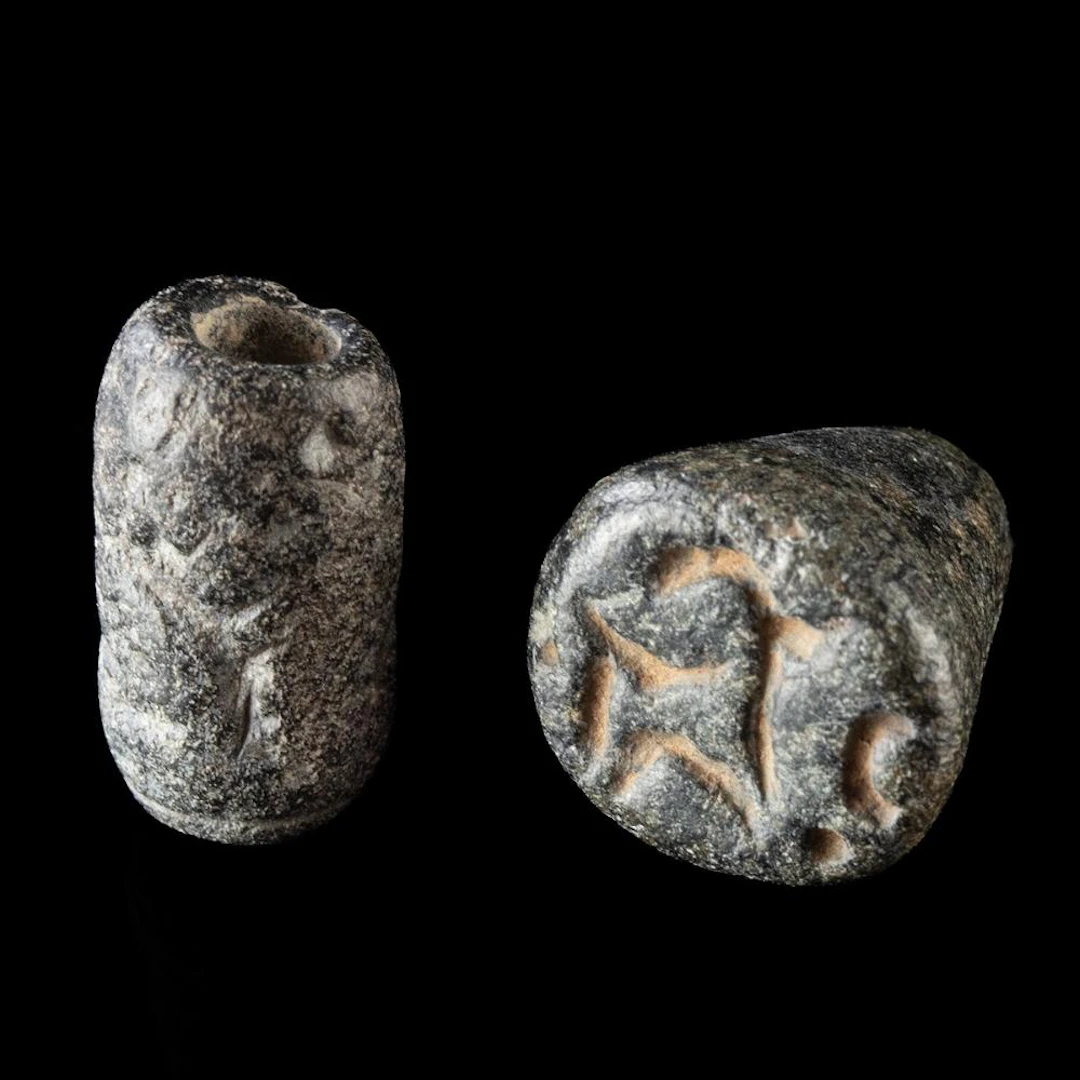
Near East, Mesopotamia. A pair of miniature carved stone seals, both pierced lengthwise for suspension and small enough to be worn at the wrist or neck. The larger is a squat conical stamp of dark speckled stone, its flattened face incised with a horned quadruped, likely a goat or ibex, accompanied by a smaller animal read as its young; drill points and short cut strokes render body, legs, and curving horn in the abbreviated glyptic shorthand of early Near Eastern seal cutters. The second is a slender cylinder of similar mottled stone whose engraved field is worn to near illegibility, retaining only faint traces of its original design. Such seals rolled or pressed their owner's mark into damp clay sealings and tablets, functioning as signature, property tag, and likely amulet at once. The seal is among the oldest instruments of administration. Stamp seals appear across the Near East well before writing, and by the late fourth millennium BCE the cylinder seal, rolled across wet clay to produce a continuous frieze, had become the signature device of Mesopotamian bureaucracy, securing storeroom doors, jar stoppers, and bales of goods before it ever authenticated a tablet. Both forms were normally perforated and carried on the body, so that identity and authority stayed literally attached to their owner. Horned caprids dominate early seal imagery. Goats and ibexes were the practical wealth of the herding economy and, in the visual language of the period, stood equally for fertility and abundance; the pairing of an adult animal with its young reads as an image of increase, apt for a device used to guard stored surplus. Item # 204840
Estimate:$350
To the auctionView all items fromArtemis Fine ArtsorAsian Art
Estimate:
$350


Bring your auction to collectors worldwide!
Get listed now