





All auctions / Books, Maps & Manuscripts / Tito Livio - Le Deche delle Historie Romane - 1540

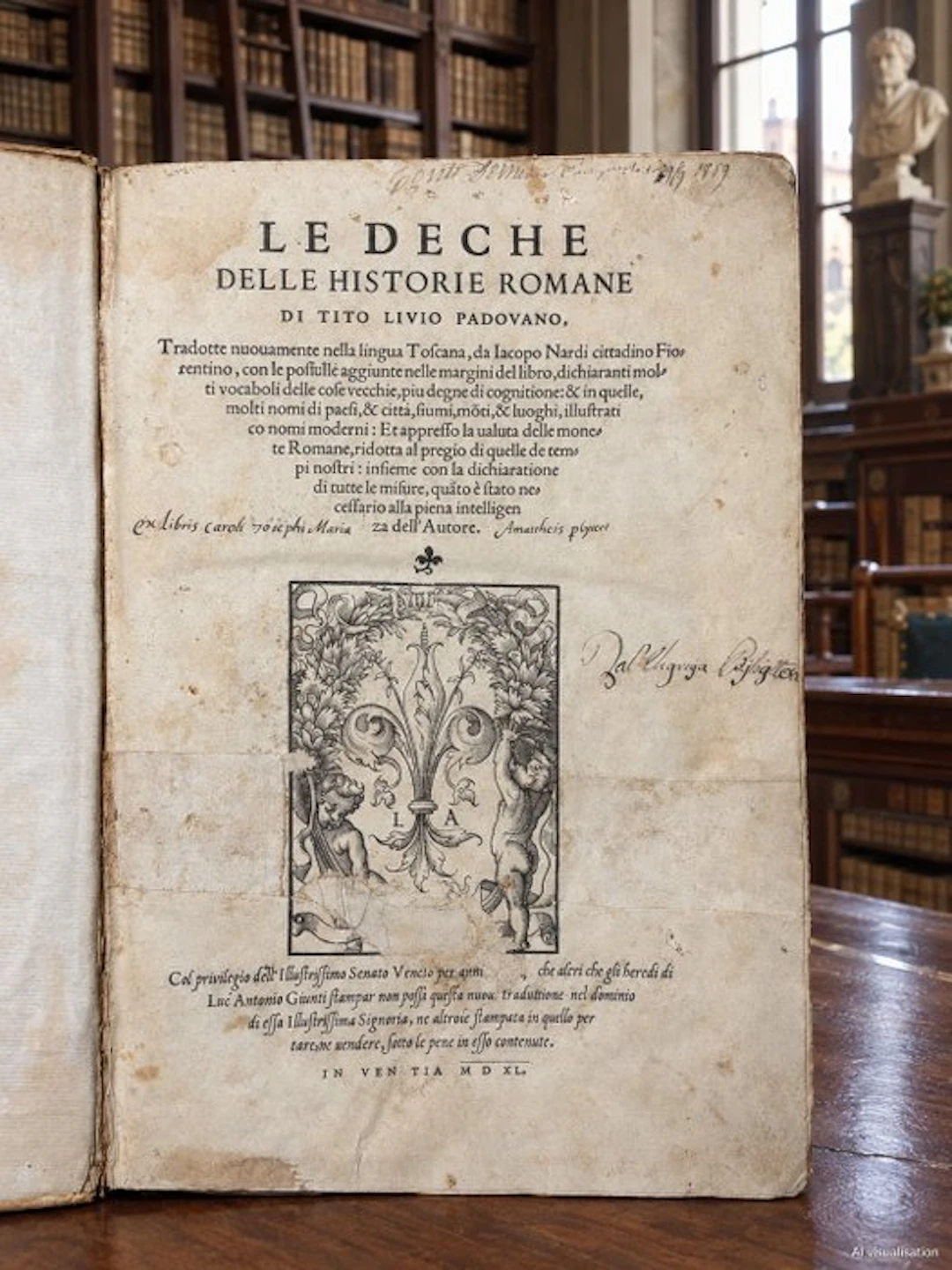
The author of the original Tito Livio (Padua, 59 B.C. – A.D. 17) is one of the greatest historians of ancient Rome. His monumental work, Ab Urbe Condita Libri, narrated the history of Rome from founding myth (753 B.C.) to the death of Drusus (9 B.C.) in 142 books. Of these, only 35 complete books have come down to us (Books I, III, IV and part of V), in addition to summaries (Periochae) of the others. Livy wrote under Augustus, celebrating republican virtues and the destiny of Rome, with an elevated and moralizing style that deeply influenced Renaissance humanism. The translator Jacopo (or Iacopo) Nardi (Florence, 1476 – Venice, 1563) was a Florentine historian, scholar, and politician of firm republican faith. He actively participated in Florentine Republic life, served as Priore and Gonfaloniere, frequented the Orti Oricellari, and was close to Machiavelli’s ideas. After the Medici return and the final fall of the Republic (1530–1532), he was declared a rebel, his possessions were confiscated, and he took refuge in Venice, living as an exile. The translation of Livy, published in 1540, was born precisely in this exile period: Nardi worked on it out of financial necessity and ideological commitment. Livy represented, for him, the model of civic virtue and republican liberty, in clear contrast with the Medicean principate. The work is dedicated to Alfonso d’Avalos, marquis of Vasto, captain-general of Emperor Charles V in Italy. The printer The edition was issued by the heirs of Luc’Antonio Giunti (or Giunta), one of the most important Renaissance printing families. Luc’Antonio Giunti the Elder (Florence 1457 – Venice 1538), a Florentine who moved to Venice, had founded a powerful type foundry specialized in liturgical works and classics. Upon his death (1538) the business passed to his sons Tommaso and Giovanni Maria, who continued to sign themselves “Eredi di Luc’Antonio Giunti Fiorentino.” The famous Florentine lily printer’s mark (visible on the title page) was their distinctive sign. The 1540 edition is in folio and represents a typical product of high-quality Venetian typography of the Cinquecento. Content and characteristics of the edition Nardi translates the surviving Deche of Livy into a cultured and flowingTuscan. He adds: - marginal postils that explain ancient terms, toponyms, rivers, mountains, and places, updating them with contemporary names; - the value of Roman coins converted into 16th-century values; - the statement of ancient measures. These tools made the work accessible and useful not only to scholars but also to those who wanted to understand the Roman world concretely. Subsequent reprintings (1547, 1554, etc.) further enriched the text with indices and tables. Historical meaning and connections This translation has strong political and cultural value. In 1540 Cosimo I de’ Medici was consolidating the Duchy of Tuscany and the Florentine Republic was already a memory. Nardi, an exile in Venice, deliberately chose Livy—the historian of Roman libertas—as a model. The operation fits into the Florentine humanist tradition, which, from Machiavelli (Discourses on the first Decade of Titus Livius) onward, had read Livy as a master of civic virtue and republican government. Relevant historical connections: - the fall of the Florentine Republic (1529–1530) and the siege of Florence; - the exile of dissenters in Venice; - the figure of Alfonso d’Avalos, dedicatee and powerful imperial military leader; - the continuity with Machiavellian thought and with the Orti Oricellari circles. The work also contributed to consolidating the Tuscan vernacular as a literary and historiographical language at a moment when the question of language was still open. Conclusion The Deche of the Roman Histories in Jacopo Nardi’s 1540 translation is not merely a beautiful Renaissance Venetian edition, but a text rich in political and cultural significance. Through Livy’s voice, a Florentine exile spoke still of liberty, virtue, and civics in a Italy dominated by princes and emperors. Today this volume, with its ancient pages and the title page adorned with the Giunti lily, remains a tangible testimony to the ongoing dialogue between ancient Rome and sixteenth-century Italy, and to the role translation played in keeping the republican idea alive even in the darkest moments. Collation and state of preservation: 6pp; (484pp) excellent state of preservation, with slight foxing and beveling but overall an excellent exemplar Shipping: express that will allow you to receive the book in only 24 working hours across the EU, while for non-EU countries it will take 48 hours working.
Estimate:$393.3
To the auctionView all items fromCatawikiorBooks, Maps & Manuscripts
Estimate:
$393.3


VYKORTSSAMLING - SVENSKA KUNGLIGHETER. GUSTAF V, OSCAR II M.FL. I
10/15/2026
$60.53
Est: $100.15


ÄPPELVIKEN, Plankarta över Stockholms Stad med omnejd, 1933, fotolitogr.
10/15/2026
$110.97
Est: $100.15




OCT 17 | 10:00 PM
Bring your auction to collectors worldwide!
Get listed nowBy subscribing, you are agreeing to the privacy policy. Unsubscribe anytime.
Barnebys HQ
Brahegatan 10
BOX 5038
114 37 Stockholm
