



OCT 8 | 3:00 PM

Bring your auction to collectors worldwide!
Get listed nowBy subscribing, you are agreeing to the privacy policy. Unsubscribe anytime.
Barnebys HQ
Brahegatan 10
BOX 5038
114 37 Stockholm
All auctions / Ethnographic / Three European Carved Bone Sewing Tools

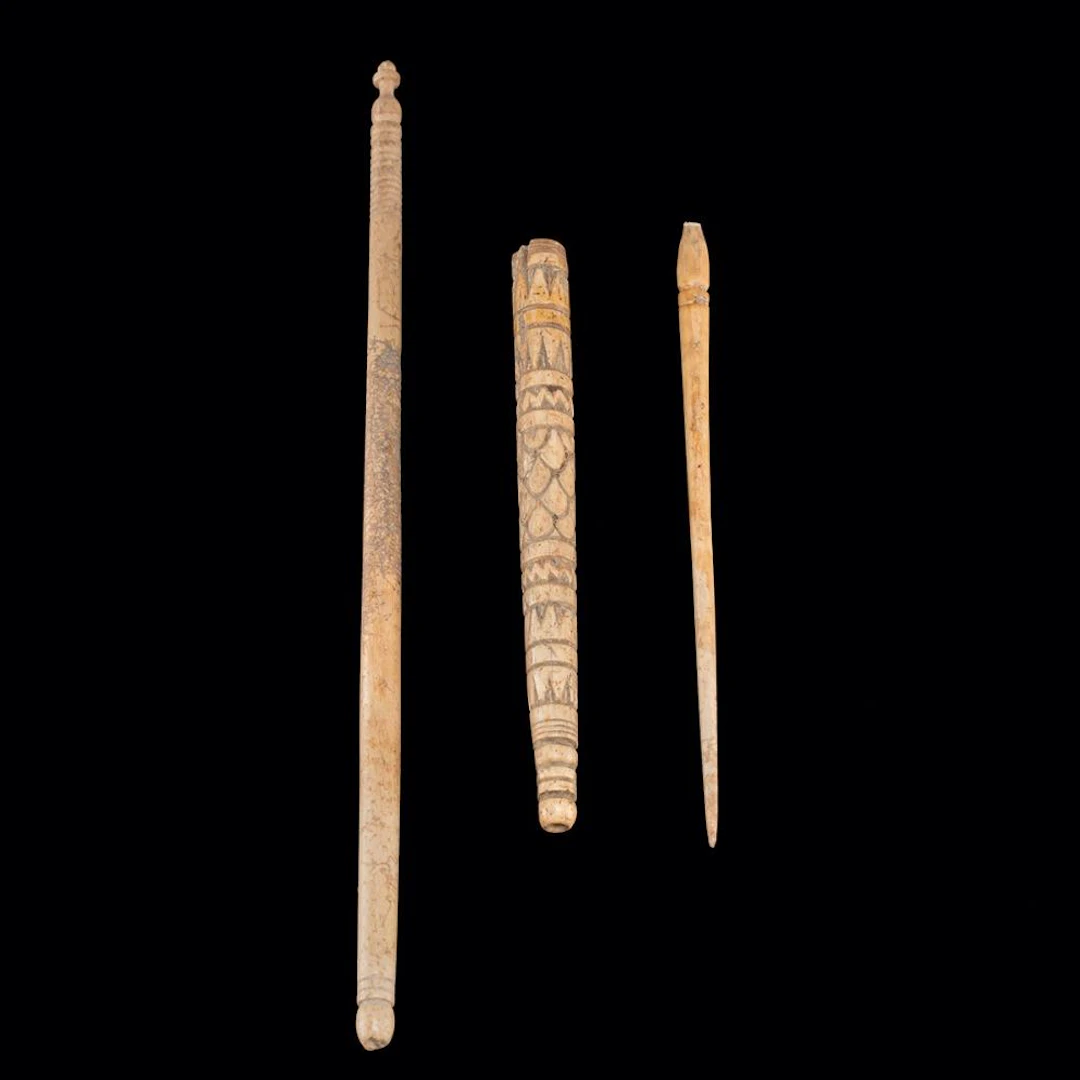
Europe, England or France. A trio of hand-worked animal bone implements assembled from the contents of a lady's sewing etui. The longest is a slender turned rod finished with a knopped, baluster-turned terminal above finely incised ring courses, serving as a bodkin, crochet hook, or knitting pin. The thinnest tapers to a fine point from a collared shoulder: a stiletto or piercer, used to open eyelets in cloth without cutting the weave. The smallest and stoutest is a socketed needle case body, now lacking its screw cap, its surface dense with banded chevrons, hatching, and a central lattice of crosshatched diapering. Warm honeyed patina throughout. Etui fittings were routinely separated and recombined by their owners, which explains why the carved cylinder speaks a decorative dialect distinct from its turned companions. The etui, a small fitted case worn suspended from a chatelaine or tucked into a workbox, was the essential accessory of nineteenth-century needlework. Bone, cheap, close-grained, and kind to the lathe, was the workhorse alternative to ivory for its fittings, and prisoner-of-war and cottage-industry turners in England and France produced them in quantity. The stiletto earns its keep in whitework and broderie anglaise: pressed through a woven ground, it parts the threads rather than severing them, so the resulting eyelet can be overcast into a permanent opening. Needle cases of this socketed form typically took a threaded or friction-fit cap, and it is the cap, small and easily pocketed, that almost always goes missing first. Item # 204551
Estimate:$225
To the auctionView all items fromArtemis Fine ArtsorEthnographic
Estimate:
$225
OCT 8 | 3:00 PM


OCT 8 | 3:00 PM

Bring your auction to collectors worldwide!
Get listed now$10.06
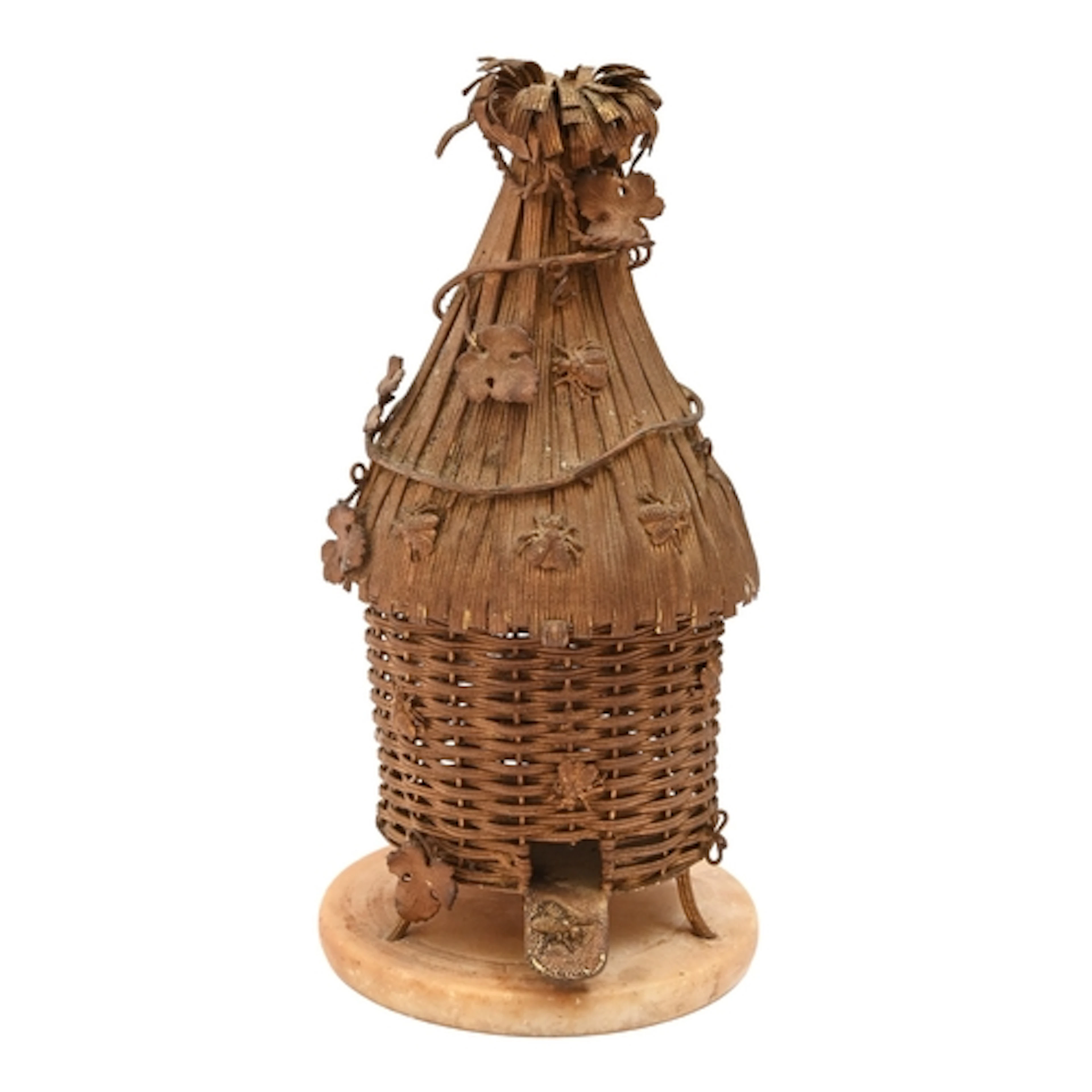
A French gilt wirework box in the form of a bee skep, second...
10/06/2026

$158.57
Est: $200.53