



NOV 8 | 1:00 PM

All auctions / Books, Maps & Manuscripts / TACITUS - NO RESERVE - Ex Lipsii editione cum not. et emend. H. Grotii - 1640

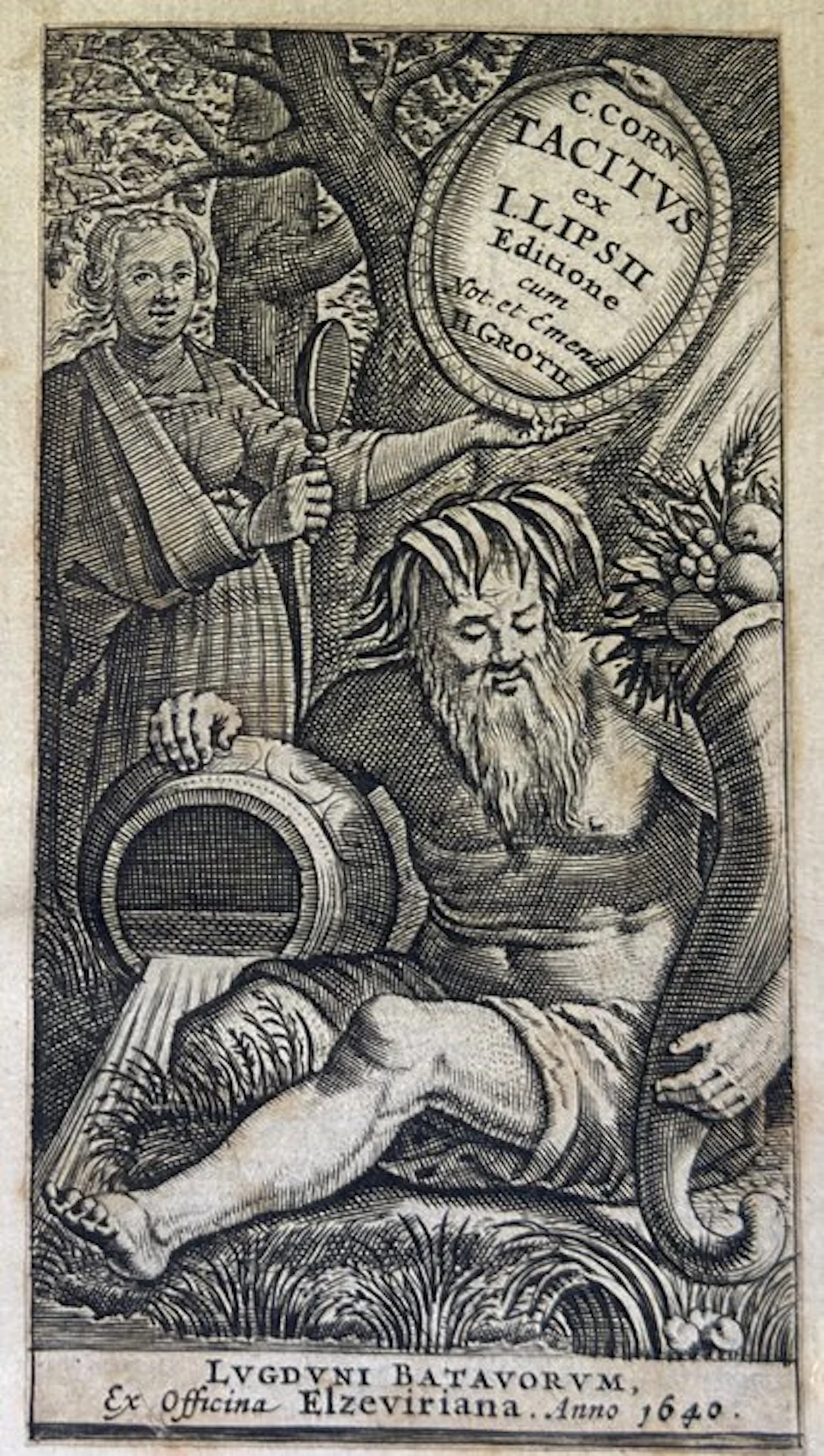
The Syston Park Tacitus: The Elzevier Edition, in Two Red Morocco Volumes with Three Distinguished English Provenances. MOUSEION CURATOR NOTE “Tacitus understood that power leaves its traces in language, silence, and memory. This little Elzevier bears another kind of evidence: three English collectors preserved in heraldry and gilt leather. In the Syston Park bookplate, the ancient historian of emperors enters a library built to preserve the intellectual inheritance of Europe.” THE BOOK TACITUS (Publius Cornelius Tacitus). LIPSIUS, Justus, editor. GROTIUS, Hugo, annotator. C. Corn. Tacitus ex I. Lipsii editione cum not. et emend. H. Grotii; with C. Cornelii Taciti Historiarum libri quinque, et alia ejusdem quae exstant. Lugduni Batavorum [Leiden]: Ex officina Elzeviriana, 1640. 2 vols., small 12mo, [16], 746, [16] pp. (continuously paginated); engraved allegorical title, engraved imperial portrait plate of Augustus, Livia, and Tiberius, decorative woodcut headpieces and initials, and the Elzevier Non solus device. The folding genealogical table Stemma Augustae domus is lacking. Dimensions: 13 × 7cm per volume. Matching English red long-grain morocco bindings, gilt-ruled covers, gilt edges, and marbled endpapers. First edition to incorporate the annotations and emendations of Hugo Grotius. Provenance — three distinguished English collections: 1. Syston Park Library — the armorial bookplate of the Thorold family’s celebrated Lincolnshire library, one of the great English country-house collections of classical literature, early printed books, and Elzevier editions. 2. Cecil Thompson — an engraved armorial bookplate bearing the motto Nosce teipsum (“Know thyself”). 3. Austin Smith — a red leather ownership label, lettered in gilt. BOOK DESCRIPTION An elegant two-volume printing of Tacitus, issued by the celebrated Elzevier press at Leiden in 1640, distinguished by the scholarship of Justus Lipsius and Hugo Grotius, its handsome uniform red morocco bindings, and an exceptional history of English ownership preserved through three original bookplates and labels. The text follows the influential recension of Justus Lipsius (1547–1606) and incorporates the annotations and emendations of Hugo Grotius (1583–1645), appearing here for the first time in an Elzevier Tacitus. The historical writings of imperial Rome were thus presented through two of northern Europe’s most consequential humanist minds. Tacitus’s Annals and Histories examine the precarious workings of imperial authority: the tensions between emperors and senators, the ambitions of military commanders, the uses of public praise, and the dangers of private candour. The surviving shorter works—Agricola, Germania, and the Dialogue on Orators—extend his attention to character, peoples, and the changing place of speech in political life. Such writings acquired renewed urgency among early modern readers interested in sovereignty, civic virtue, corruption, and the moral burdens of government. The intellectual partnership across generations is particularly significant. Lipsius’s scholarship established an exceptionally influential reading of Tacitus, while Grotius, whose work ranged across history, jurisprudence, and the relations of states, brought further philological and historical scrutiny. The 1640 edition is consequently more than a handsome reprinting of an ancient historian: it registers a particular moment in Europe’s continuing effort to read its own political world through Rome. The engraved allegorical title, showing a contemplative bearded figure with another figure holding a mirror, is an effective prelude to this historian of appearances and realities. A separate engraved plate portrays Augustus, Livia, and Tiberius, bringing the principal figures of the early principate before the reader. The plate is signed by Cornelis Duysend. Ornamental headpieces, carefully proportioned type, and the Non solus printer’s device give the set the characteristic elegance of the Leiden press. Its matching English red long-grain morocco bindings, with restrained gilt borders and colourful marbled endpapers, make the two volumes particularly pleasing as objects. The provenance is of exceptional bibliophilic interest. The large engraved Syston Park armorial bookplate connects the set to one of the most distinguished private libraries of nineteenth-century England. The library was assembled by Sir John Thorold (1734–1815), whose collecting interests included a particular enthusiasm for Elzevier editions, and greatly enlarged by his son, Sir John Hayford Thorold (1773–1831). The Thorold collection at Syston Park, Lincolnshire, became celebrated for its classical literature, early printed books, fine bindings, and important editions from the great European presses. Sir John Hayford Thorold substantially expanded its holdings and commissioned a purpose-built library in the 1820s, creating one of the notable country-house book collections of the period. The presence of this 1640 Elzevier Tacitus in the Syston Park collection is therefore particularly appropriate. The compact scholarly editions of the Dutch printers appealed directly to the Thorold family’s collecting interests, combining classical learning, typographical refinement, and the material qualities sought by discerning bibliophiles. Substantial portions of the Syston Park library were dispersed from 1884 onwards, and the surviving armorial bookplate preserves the connection between this set and its former place in that remarkable collection. The subsequent ownership marks add further distinction. The engraved armorial bookplate of Cecil Thompson, with its elaborately decorated heraldic shield and the motto Nosce teipsum (“Know thyself”), introduces another chapter in the books’ English collecting history. The motto is especially resonant in a work by Tacitus, whose historical writing so often concerns the difficult relationship between human character, public conduct, and political ambition. The small red leather label of Austin Smith, neatly lettered in gilt, records another owner and adds a final element to the series of surviving ex-libris. Together, the three ownership marks form an unusually attractive record of English bibliophily. Their survival, accompanied by the carefully matched red morocco bindings, gives the set an individuality extending well beyond the printed edition. This is not merely a seventeenth-century Tacitus, but a copy whose history illuminates the reception and preservation of classical literature among successive generations of English collectors. CONDITION REPORT An overall good-condition, handsome and uniformly bound two-volume set in English red long-grain morocco, with gilt-ruled covers, gilt edges, and coloured marbled endpapers. The bindings present attractively, with minor rubbing and handling wear to the extremities. Internally, the leaves show light age toning, occasional spots, and scattered foxing. The folding genealogical table Stemma Augustae domus is lacking. The engraved title-frontispiece has been remargined, and a tear to the engraved imperial portrait plate has been repaired. Both engraved illustrations remain present. The recto of the eighth preliminary leaf bears the end of the list of consuls, an identifying bibliographical feature of the edition. The marbled endpapers preserve the Syston Park armorial bookplate, the Cecil Thompson armorial bookplate, and the Austin Smith gilt-lettered leather label, all visible in the photographs. The photographs should be consulted, as they form an integral part of the condition report. ADDITIONAL INFORMATION Tacitus became a central author for Renaissance and early modern political thought precisely because he refused to make power simple. His pages ask how a society speaks under an emperor, how institutions bend without disappearing, and how historical judgment can survive the passions of its subjects. The scholarship of Lipsius and Grotius helped make this Roman inheritance part of the learned conversations of seventeenth-century Europe. The 1640 Elzevier edition gives that intellectual tradition a notably intimate physical form: two small volumes, elegantly printed, which could accompany the reader rather than remain confined to a lectern. The Syston Park provenance adds a further dimension to the historical significance of this copy. For the Thorold family, beautifully printed classical editions were not merely useful texts, but monuments of scholarship and craftsmanship. Their collection embodied a particular vision of the private library: a place where intellectual inheritance and the art of the book were preserved together. The subsequent Cecil Thompson and Austin Smith ownership marks demonstrate the continuing appeal of such editions to later collectors. Their bookplates and label remain material witnesses to the passage of the volumes through English libraries. The scholarly importance of the first Elzevier Tacitus with Grotius’s annotations, its surviving engravings, matching red morocco bindings, and especially its distinguished Syston Park, Thompson, and Smith provenances make this a particularly engaging example of seventeenth-century classical printing and its later collecting history.
Estimate:$1,120.23
To the auctionView all items fromCatawikiorBooks, Maps & Manuscripts
Estimate:
$1,120.23
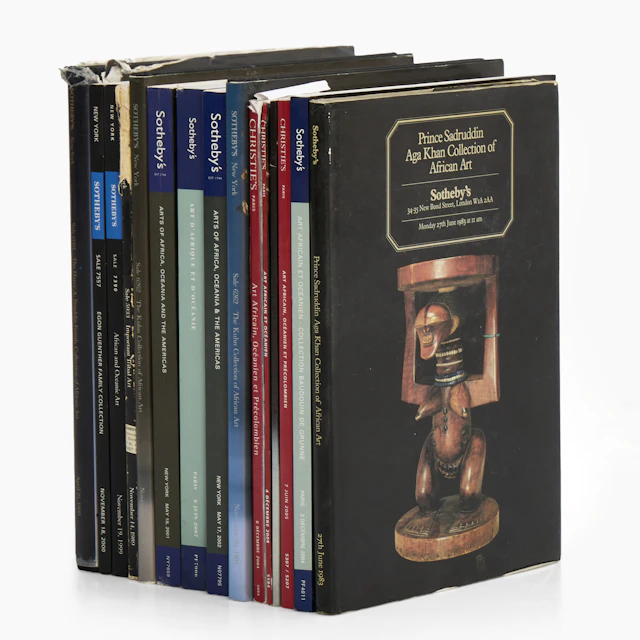
AUKTIONSKATALOGER, 15 st mellan 1983-2009, Sotheby's - Chtisties.
10/23/2026
$55.47
Est: $100.93

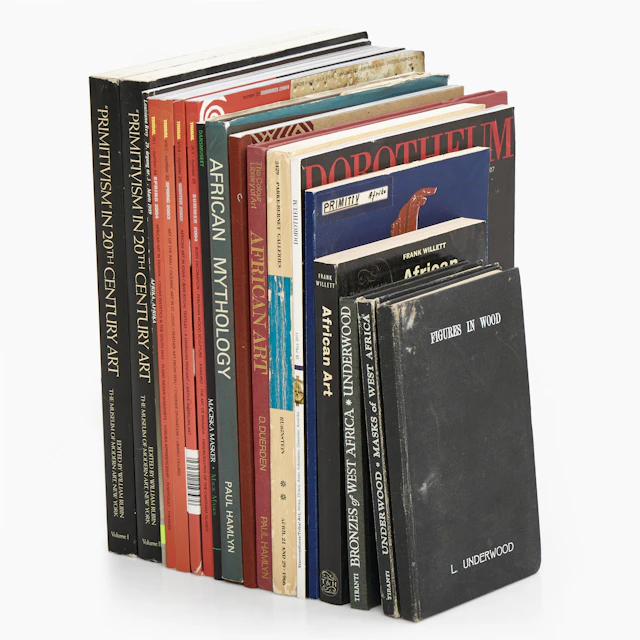
BÖCKER, TIDSKRIFTER, diverse om primitivism och afrikansk konst, bl.a. Tribal.
10/23/2026
$55.37
Est: $100.93

ANDREAS LUNDBERG (född 1973). "TRUST", monogramsignerad samt numrerad
10/23/2026
$100.68
Est: $201.76
NOV 8 | 1:00 PM


OCT 31 | 4:00 PM


OCT 27 | 4:00 PM
Bring your auction to collectors worldwide!
Get listed nowBy subscribing, you are agreeing to the privacy policy. Unsubscribe anytime.
Barnebys HQ
Brahegatan 10
BOX 5038
114 37 Stockholm
