



Bring your auction to collectors worldwide!
Get listed nowBy subscribing, you are agreeing to the privacy policy. Unsubscribe anytime.
Barnebys HQ
Brahegatan 10
BOX 5038
114 37 Stockholm
All auctions / Ethnographic / Skull Lot: Fluorite 112 g + Mozambique Agate 66 g –...

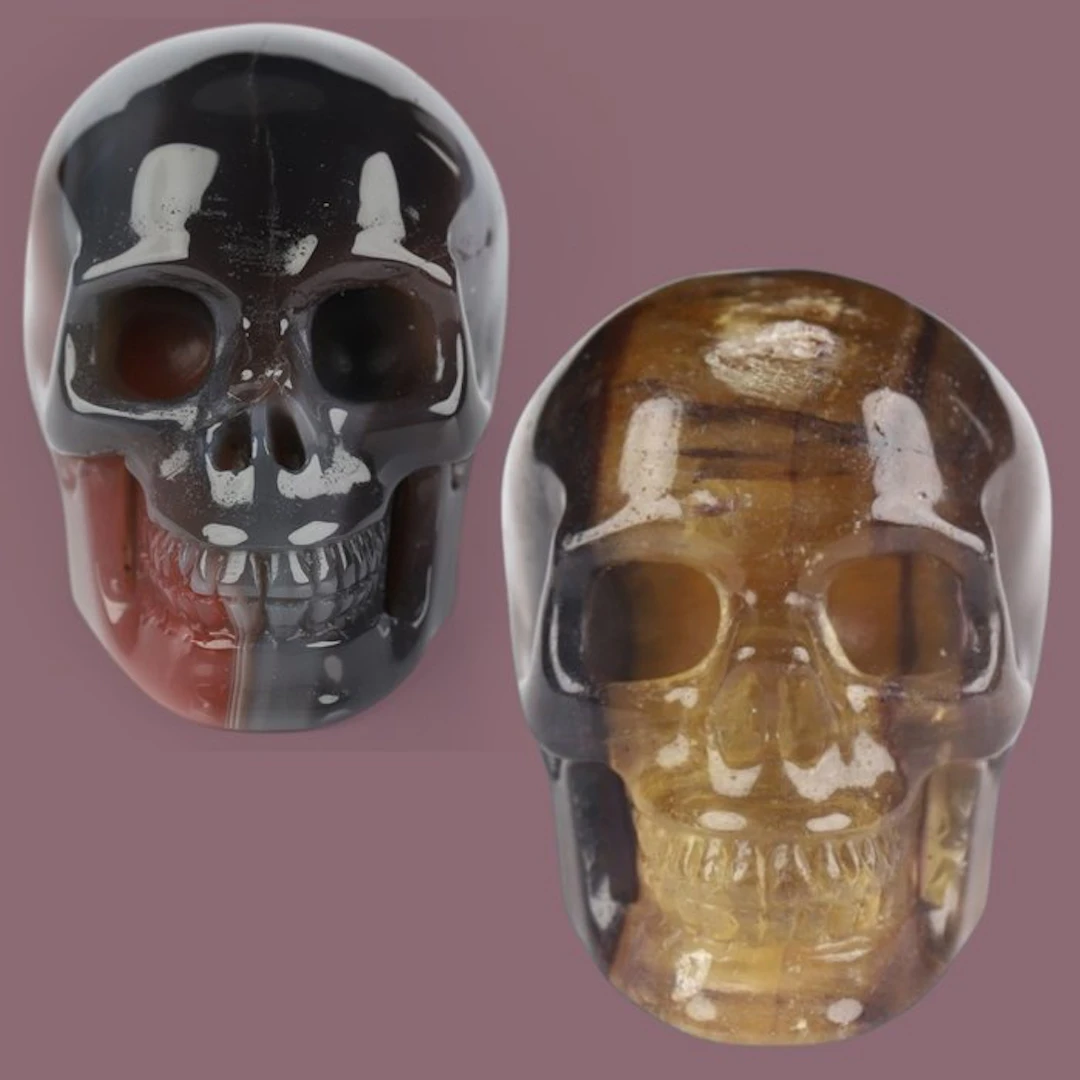
When Pompey the Great returned victorious from the East in the 1st century BCE, he consecrated in the Temple of Jupiter Capitolinus for the first time vessels the Romans had not known before: the Vasa Murrina, cut from a translucent, multicolor flowing stone from distant Parthia. Pliny the Elder describes in his Natural History how a single cup could cost seventy talents, more than gold, more than silver—a consul is said to have loved his murrhine cup so much that he chewed at its rim. To this day scholars dispute the true material, but the most convincing trace leads to fluorite, whose flowing color transitions produce exactly the effect Pliny described. Exactly this property is contained in this piece: honey-yellow and champagne-gold blend into one another with no hard boundaries. Only when illuminated from behind does the real secret reveal itself—color changing to deep purple on one side and delicate pink on the other, just as the Romans sought in their most precious Murrhine vessels: color that awakens only in the light. Beside it lies a second vessel of transformation, born of a completely different legend. When gods and demons in the cycle of legends of the Puranas stirred the cosmic Milky Ocean together to obtain the elixir of immortality, the Kaustubha emerged from the agitated waves—a gemstone of lotus color, so radiant that it illuminated the three worlds. This very agitated cosmos is reflected in the waves that curl over this skull, finally merging into a wax-like, cosmic red-violet—as if a drop of that ancient ocean had solidified there. Fluorite (CaF2) crystallizes in cubic form, and its color variety arises from trace elements and natural irradiation; the name derives from the Latin fluere (“to flow”), originally used as a flux in iron smelting—in 1852 the term “fluorescence” was coined after it. The Mozambique agate is a chalcedony variety, whose wavy banding results from rhythmic deposition of silica-rich solutions in cavities of volcanic rock; the red-violet coloration is due to finely distributed iron oxides. Two cups, two legends of transformation—a collection piece for both. Fluorite: Dimensions 5.1 x 3.9 x 3.3 cm, weight 112 g, color honey-yellow to champagne gold in incident light, under transmitted light color-changing to purple/pink, special features exceptionally high transparency with visible internal growth structures Mozambique Agate: Dimensions 4.6 x 3.0 x 3.2 cm, weight 66 g, color wavy deep red to violet banding
Estimate:$1.13
To the auctionView all items fromCatawikiorEthnographic
Estimate:
$1.13


Bring your auction to collectors worldwide!
Get listed now