





All auctions / Books, Maps & Manuscripts / Peri Giovanni Domenico - Fiesole distrutta - 1621

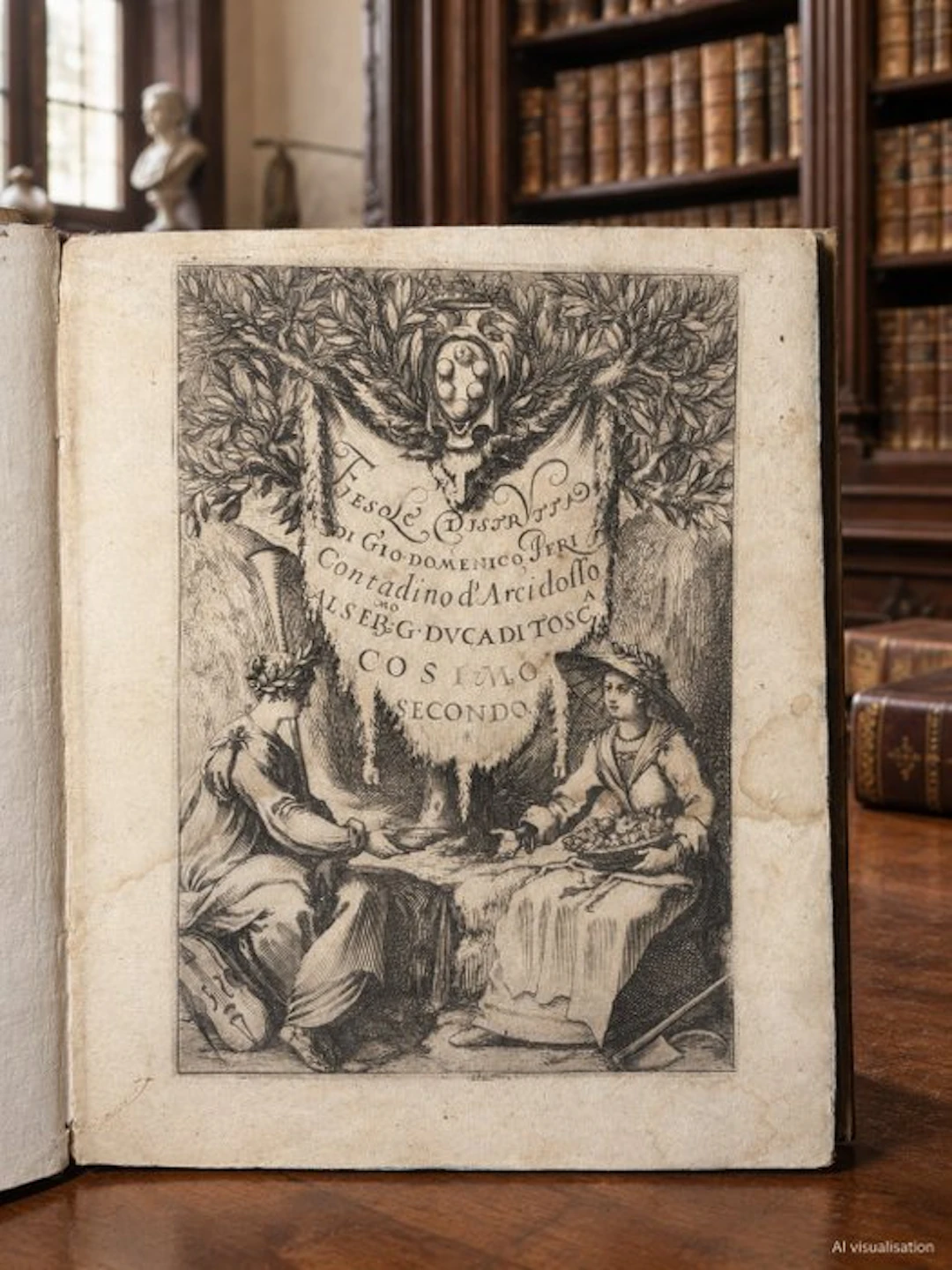
Sure. I will prepare for you a **presentation structured like an oral exposition**, with historical, literary, and cultural connections. I have also verified an important detail: **the work was first published in 1619; the 1621 edition is the second edition**, printed again by Zanobi Pignoni in Florence. ([Treccani][1]) # Fiesole Distrutta by Giovanni Domenico Peri ## 1. Introduction The work **Fiesole distrutta** is an epic poem by **Giovanni Domenico Peri**, a poet and playwright from Arcidosso in Tuscany. The **1621** edition, which we refer to, was printed in **Florence in the workshop of Zanobi Pignoni**. It is important to note that this is not the first edition: the poem had already been published in **1619**, while the 1621 edition is the second. The volume runs about 200 pages and is characterized by an elegant engraved frontispiece and the author's portrait by **Jacques Callot**, one of the most important engravers of the seventeenth century. ([lillit.share-family.org][2]) The work is interesting not only from a literary point of view, but also because it helps to understand the relationship between **ancient history, culture of the Seicento, Tuscan identity, and the Medici power**. --- # 2. The author: Giovanni Domenico Peri **Giovanni Domenico Peri was born in Arcidosso in 1564 and died in 1639.** He is known mainly as a poet and dramatist and is often remembered with the epithet **"peasant poet"**, because he came from a rural background and did not belong to the great aristocratic circles of Italian culture. ([BiblioToscana][3]) Despite his origins, Peri managed to approach the most important cultural circles of Tuscany. During his stays in Florence he came into contact with literati and musicians linked to the **Camerata de' Bardi**, a fundamental environment for Florentine culture between the Sixteenth and Seventeenth centuries. ([Treccani][1]) A key moment in his life occurred in **1610**, when he returned to Florence and was protected by **Giovan Battista Strozzi il Giovane**. Precisely during a stay in Fiesole, Strozzi suggested the theme of a heroic poem dedicated to the city’s history. Peri also had the opportunity to enter the circle of **Cosimo II de' Medici**, to whom he read some cantos of the poem. ([Treccani][1]) This is a very important point: Peri does not simply write a history set in antiquity, but tries to transform the history of Fiesole into a literary work suitable also for the Medici court. --- # 3. The work and its content **Fiesole distrutta** is an epic poem divided into **twenty cantos**. The starting point is an episode of ancient history: the conquest and destruction of Fiesole in **90 B.C.**, during the **Social War**, when the city came into conflict with Rome. The sources relating to the history of Fiesole connect the conquest to the Roman army led by **Porcius Cato**. ([Treccani][1]) Fiesole was one of the most important cities of the **Etruria** and therefore represented a reality much older than Florence itself. Peri takes this historical episode and transforms it into a true **epic-chivalric poem**. We do not find only battles and historical events, but also: * loves; * duels; * escapes; * abductions; * magics; * heroic characters; * warrior women; * sentimental and adventurous episodes. One of the most significant episodes is the love story of **Rosmondo and Mirtilla**. Their tale clearly recalls some models of the preceding chivalric literature. ([Treccani][1]) --- # 4. Literary models: Ariosto and Tasso To truly understand the work it is necessary to connect it to two great Italian authors: ### Ludovico Ariosto Peri has a deep knowledge of the **Orlando Furioso**. From Ariosto he mainly borrows the adventurous and romanesque structure: loves, journeys, escapes, battles, and interweaving among different characters. The relationship between **Rosmondo and Mirtilla**, for example, recalls that of **Ruggero and Bradamante** in the Orlando Furioso. ([Treccani][1]) ### Torquato Tasso Even more important is the model of the **Gerusalemme liberata**. The central theme of siege and war directly echoes the Tassian structure. Some Peri characters are also built on the model of those in the Gerusalemme liberata: * Rosmondo recalls **Tancredi and Rinaldo**; * Mirtilla recalls **Clorinda**; * Armilla evokes **Erminia**; * the garden of Cefille echoes the famous **Garden of Armida**. ([Treccani][1]) Peri thus demonstrates his intention to insert the story of Fiesole within the great tradition of Italian epic. --- # 5. The relation to Dante and Petrarch The work looks not only toward Ariosto and Tasso. Peri also uses elements from **Dante** and **Petrarch**. A particularly interesting example concerns the description of the moat that surrounds Fiesole. Peri compares it to the moat that surrounds the city of **Dite** in Dante’s Inferno. ([Treccani][1]) This shows how the Seicento literary culture was still deeply linked to the great authors of the Trecento and the Renaissance. --- # 6. The printer: Zanobi Pignoni The 1621 edition was produced in Florence in the **stamperia of Zanobi Pignoni**. ([lillit.share-family.org][2]) Pignoni was a very active printer in Florence at the time. His activity extended beyond literature: he published numerous musical works as well, collaborating with important Florentine musicians. Between 1614 and 1615, for example, works by **Giulio Caccini**, **Marco da Gagliano**, **Raffaello Rontani**, and other leading figures in Florentine musical culture were published in his workshop. ([Treccani][4]) The collaboration between Peri and Pignoni is therefore significant because it places the poem in the lively cultural environment of **Medicean Florence**. --- # 7. Jacques Callot and the importance of the visual aspect Another important element of the book is the work of **Jacques Callot**, a famous engraver from Nancy who also worked in Florence. Callot produced the **engraved frontispiece and the portrait of Peri** found in the edition. ([Cultural Heritage Catalog][5]) This detail shows that in the Seicento the book was not considered merely a text container. The book itself became an artistic object. Peri’s portrait is especially interesting because it presents around the figure of the author elements tied to his identity as a **poet and man connected to the agricultural world**. The fact that a “peasant poet” is depicted in a prestigious publication also shows an effort to construct a public image of the author. ([Cultural Heritage Catalog][5]) --- # 8. Why dedicate the work to Cosimo II? The full title of the work includes a dedication to **Cosimo II de’ Medici**, Grand Duke of Tuscany. This is fundamental to understanding the political and cultural significance of the poem. Cosimo II ruled Tuscany from **1609 to 1621**. He was an educated prince and was also a pupil and patron of **Galileo Galilei**. ([Sias Archivi][6]) The dedication to Cosimo II allows Peri to connect his work to the **Medici dynasty**. The poem speaks of an ancient Tuscan city and thus contributes to the construction of a glorious memory of Tuscany. In other words, Peri transforms the past of Fiesole into material capable of indirectly celebrating the present of Medicean Tuscany. --- # 9. The connection with Florence One of the most interesting aspects of the work concerns the relationship between **Fiesole and Florence**. Fiesole is a city much older than Florence and was one of the main centers of Etruria. Over the course of history, however, Florence progressively assumed a dominant role in the region. The medieval and literary tradition had already created a link between the two cities. Even **Dante**, in canto XV of the Inferno, speaks of the inhabitants of Florence as a people who “descended from Fiesole.” ([GuardaFirenze][7]) For this reason Fiesole is not simply the backdrop of an ancient war. It becomes a symbol of the remote origins of Tuscany and of Florence. Telling the destruction of Fiesole thus also means questioning the origins of the city and Florentine identity. --- # 10. The connection with ancient Rome The conflict recounted by Peri can be linked to the **Social War (91-88 B.C.)**, one of the pivotal events in the history of the Roman Republic. The Italic peoples rose up against Rome seeking mainly citizenship and greater political integration. Fiesole became involved in this process and in 90 B.C. it was conquered by Roman forces. Subsequently the Fiesole territory was involved in the struggles between **Marius and Sulla** and in the political transformations of the late Roman Republic. ([Wikipedia][8]) Peri thus uses an episode from the crisis of the Roman Republic to build a grand epic narrative. It is interesting to note that the history of Fiesole allows linking the work to fundamental figures in Roman history: * **Porcius Cato**, connected with the conquest of Fiesole; * **Marius and Sulla**, protagonists of the civil wars; * **Julius Caesar**, linked to the subsequent reorganization of the territory; * **Catiline**, who in 63 B.C. had relations with the Fiesole territory. --- # 11. The historical context of the Seicento The work emerges in a period substantially different from the era it depicts. We are at the beginning of the **Seicento**, in the heart of the Baroque. In **1618** the **Thirty Years' War** began, one of the most devastating conflicts in European history, which would gradually involve many of the great powers of the continent. Meanwhile Italy was politically divided and much of the peninsula was under the influence of major European monarchies. Tuscania of the Medici represented one of the most important Italian states. In this context culture also had a political function: celebrating the past, the dynasty, and the prestige of one’s own territory was a way to reinforce national identity. --- # 12. The connection with Galileo Galilei A particularly interesting connection is with **Galileo Galilei**. Cosimo II had been his student and later supported him as a scientist. Galileo dedicated the **Sidereus Nuncius**, published in 1610, to Cosimo II, in which he announced his astronomical observations and the satellites of Jupiter, initially associated with the Medici name. ([Istituto e Museo di Storia della Scienza][9]) So in the same Florentine cultural environment we find two different forms of knowledge: **Peri → poetry, historical memory, epic, and myth** **Galileo → scientific observation, mathematics, and a new conception of the universe** This makes Cosimo II’s Florence a particularly interesting environment: on the one hand classical culture and literary tradition survive; on the other a new science is born. --- # 13. The meaning of the work The meaning of **Fiesole distrutta** can be interpreted on several levels. ### 1. Historical meaning Peri recovers an episode of ancient Tuscan history and transforms it into literary matter. ### 2. Identity meaning Fiesole represents one of the ancient roots of Tuscany. Telling its story means recovering the memory of the land. ### 3. Political meaning The dedication to Cosimo II places the poem in the culture of the Medicean court and contributes to the celebration of Tuscany and its dynasty. ### 4. Literary meaning Peri seeks to show that even a local affair can be transformed into a grand epic, using the models of Ariosto and Tasso. ### 5. Cultural meaning The work shows the Seicento’s taste for a fusion of **history, myth, adventure, love, war, and the marvelous**. --- # 14. What was the impact on the era? It is important not to overstate the work’s impact. **Fiesole distrutta did not achieve a fortune comparable to Orlando Furioso or the Gerusalemme Liberata** and did not become a central work of the Italian literary canon. Modern studies emphasize that the poem remained mainly tied to circulation within court and Tuscan urban cultural circles. ([CORE][10]) Nevertheless it had its importance. The fact that the work was **reprinted in 1621**, after the first edition of 1619, shows that there was sufficient interest to justify a new edition. ([Maison Bibelot][11]) Furthermore, the quality of the print, the frontispiece, and the portrait by Callot demonstrate that the book was produced with a certain artistic ambition. Its importance does not lie so much in changing Italian literature as in being a testimony of the **Tuscan culture of the early Seicento**. --- # 15. A particularly interesting connection: memory of the past A particularly modern aspect of the work is the relationship between **history and memory**. Peri takes an event that happened more than 1700 years earlier and rewrites it according to the sensibilities of his time. This means that the past is not simply “remembered”: it is **reinterpreted**. Fiesole becomes a heroic city, theater of loves, battles, and passions. In this sense Peri performs a similar operation to that undertaken by many writers and artists throughout history: using the past to speak indirectly about the present. --- # 16. Conclusion In conclusion, **Fiesole distrutta** is an important work especially because it brings together several aspects of Seicento culture. On one hand we have the **ancient history**, with Fiesole, the Etruscans, Rome, and the Social War. On the other hand we have the **epic literature**, with Ariosto and Tasso as models and with references to Dante and Petrarch. Then we have the **culture of the Medicean court**, represented by the dedication to Cosimo II, and the artistic world of sixteenth-century Florence, represented by the printing of **Zanobi Pignoni** and the engravings of **Jacques Callot**. Finally, the work can be linked to the great cultural transformation of the early Seicento: while Peri looks to history and literary tradition, in the same environment Cosimo II protects **Galileo Galilei** and a new science. For this reason **Fiesole distrutta** can be considered a kind of meeting point between **antiquity and the Seicento, history and myth, poetry and politics, local memory and court culture**. Its main value today does not lie in its literary fame, but in its ability to show us **how a seventeenth-century Tuscan intellectual viewed the past and sought, through poetry, to give meaning to the origins of his own land**. Collation and preservation state: 4pp, 197pp in excellent preservation, note gore on some pages but overall an excellent specimen.
Estimate:$280.92
To the auctionView all items fromCatawikiorBooks, Maps & Manuscripts
Estimate:
$280.92





OCT 17 | 10:00 PM
Bring your auction to collectors worldwide!
Get listed nowBy subscribing, you are agreeing to the privacy policy. Unsubscribe anytime.
Barnebys HQ
Brahegatan 10
BOX 5038
114 37 Stockholm
