


OCT 8 | 3:00 PM

Bring your auction to collectors worldwide!
Get listed nowBy subscribing, you are agreeing to the privacy policy. Unsubscribe anytime.
Barnebys HQ
Brahegatan 10
BOX 5038
114 37 Stockholm
All auctions / Toys & Collectibles / onbekend - Toy Bagatelle of Tivoli spel - 1920-1930 - Netherlands

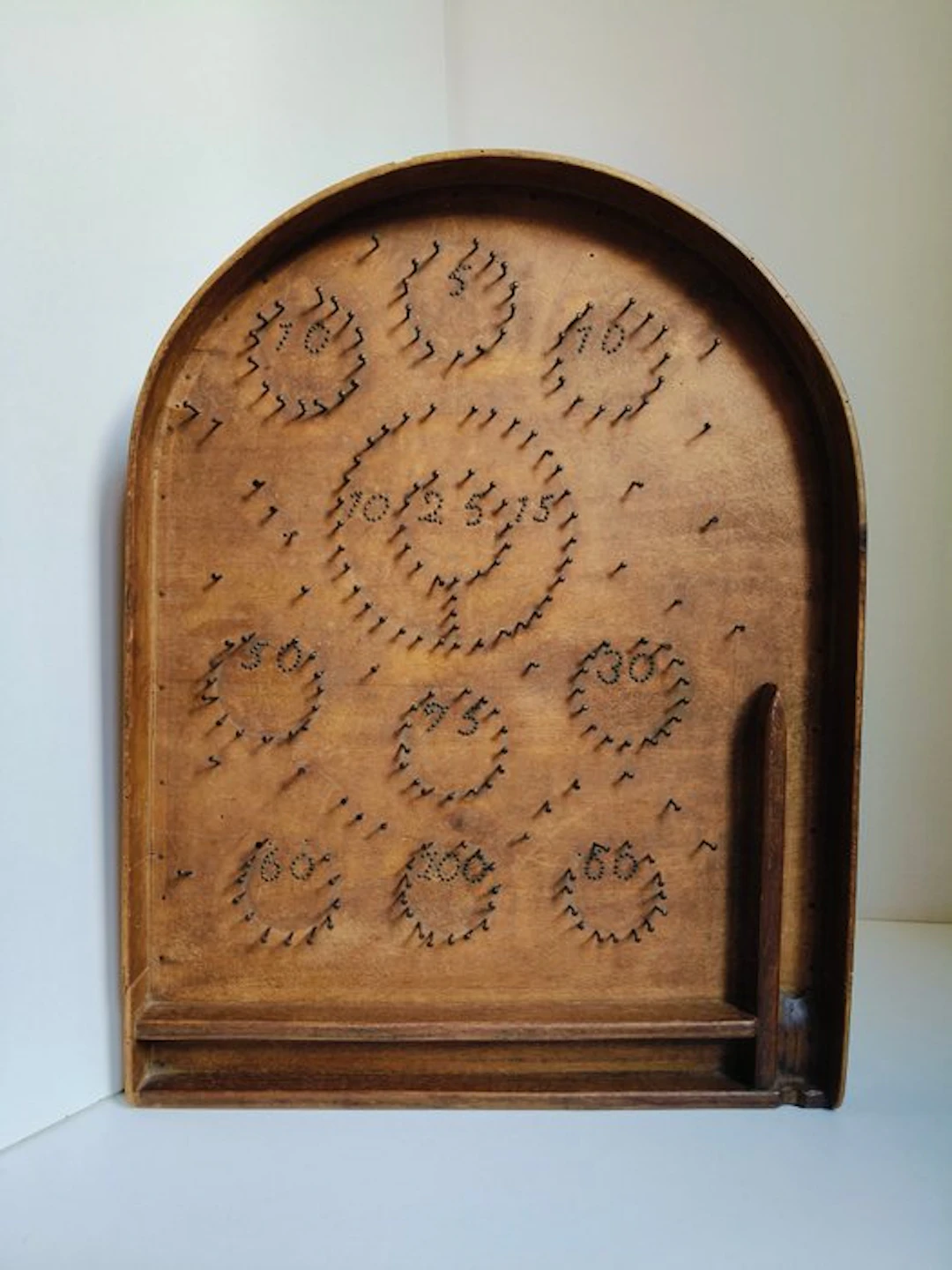
This object is a classic wooden marble board, in the Netherlands also often referred to as a Tivoli game or Bagatelle. This type of toy is the direct historical precursor of the modern pinball machine. A wooden rod with a small ball at the end—the mini cue (cue stick)—is missing for this game. You place a marble in the right launching lane, press the cue against the marble and strike it with a solid tap up into the arch. The marble then rolls down and bounces against the nails until it stays in a numbered compartment or arch to score points. This game was originally played with small wooden marbles or early clay marbles, because glass marbles were too heavy and too hard for the thin nails. In the 1920s and 1930s, Dutch streets saw intensive marble playing. Glass marbles (often called ‘marbels’ or ‘glasknikkers’) were expensive imports at the time and also too heavy for the thin nails on this handmade board. Therefore, small turned wooden marble beads or ‘kleiertjes’ (baked clay marbles) were used. These marbles are no longer present on this board. This board was purchased in the province of Zeeland, Zierikzee. In this maritime and agricultural province, Zeeland, the game had a very special place; it was entertainment during the winter. The winter months on the Zeelandic islands (such as Schouwen-Duiveland, where Zierikzee is located) were quiet and isolated at the time. After harvest or when storms prevented sailing, social life moved to the warm stove. The marble board was one of the few active indoor games for the whole family. Larger, more luxurious bagatelle boards were often found in Zeeland village cafes as early gambling or skill games. The smaller variants, like this board, were purely for the living room. Because the game is compact, it could be tucked away on a cabinet or behind a door after use. Of course, this game has undergone a technological transition. The period 1910–1940 shows a clear evolution in how the game was played. Before 1930, the game was traditionally played with a loose cue, exactly like this model. It required a lot of dexterity; a too hard strike would sling the marble off the board, a too soft strike wouldn’t get it over the top. After 1930, with the rise of mass production, the loose cue was increasingly replaced by an built-in metal tension spring with a plunger. This board truly hails from the early, pure tradition of the game. I date this game to between 1910 and 1940 for other reasons as well. The dark rings around the nails are caused by a chemical reaction (alkali/oxidation) between the iron of the nails and the natural acids (tannin or tannic acid) in the wood. This occurs when it comes into contact with moisture. This process takes a long time and is a strong indicator of the authenticity and age of this board. It confirms that the board was likely made between 1910 and 1940. On cheap reproductions from the 1970s or later you almost never see these deep, ingrained oxidation stains. In the 1920s and 1930s, the Netherlands experienced a deep economic crisis. Ready-made toys from the shop were unaffordable for many families. The bagatelle game was the perfect candidate for home craft at the time. The concept was simple: a sheet of plywood or oak, a handful of cheap iron nails, and a pencil to lay out the design. Popular craft magazines and Christian or socialist youth journals regularly published working drawings at the time. Fathers often made these boards in the winter months secretly in the attic as Santa or Christmas gifts for the children. The board is elevated, rising from the front to the back. The pencil marks under the nails prove this was a handmade project. The maker—father or carpenter—first drew the circles and numbers with a pencil to determine exactly where the nails should go before they were hammered in by hand. The fact that these lines remain gives the board a unique, authentic charm and a historical character. This board is a beautiful and tangible piece of Dutch cultural history; it exudes the atmosphere of the sober yet cozy living rooms of the interwar period. Dates: Length: 56.5 cm Width: 43 cm Depth: 11 cm at the top and 4 cm at the bottom Weight: 1950 grams, almost 2 kg Plenty of signs of use. Here and there a dent. Insect holes. Scratches. A piece of wood is missing. The game is not varnished or painted. Likely stored in a shed next to a leaking can of blue paint, see underside photo. It has a beautiful patina on the wood and the nails. The board is a very attractive object to look at, in a game room, children's room, or in a shop window. It can serve as wall decor. Solid wood components, the board has been extensively photographed. If you’re interested, please study the photos carefully. The photos form part of the description. I will ensure careful packaging and insurance for shipping.
Estimate:$2.25
To the auctionView all items fromCatawikiorToys & Collectibles
Estimate:
$2.25

OCT 8 | 3:00 PM

OCT 17 | 10:00 PM

Bring your auction to collectors worldwide!
Get listed now$10.06

PLÅTLEKSAKER, rymdskepp, 2 st, litograferad plåt, Nomura & Modern
10/06/2026
$50.6
Est: $99.61

OCT 8 | 3:00 PM