
NOV 8 | 1:00 PM

All auctions / Ancient Art / Medieval

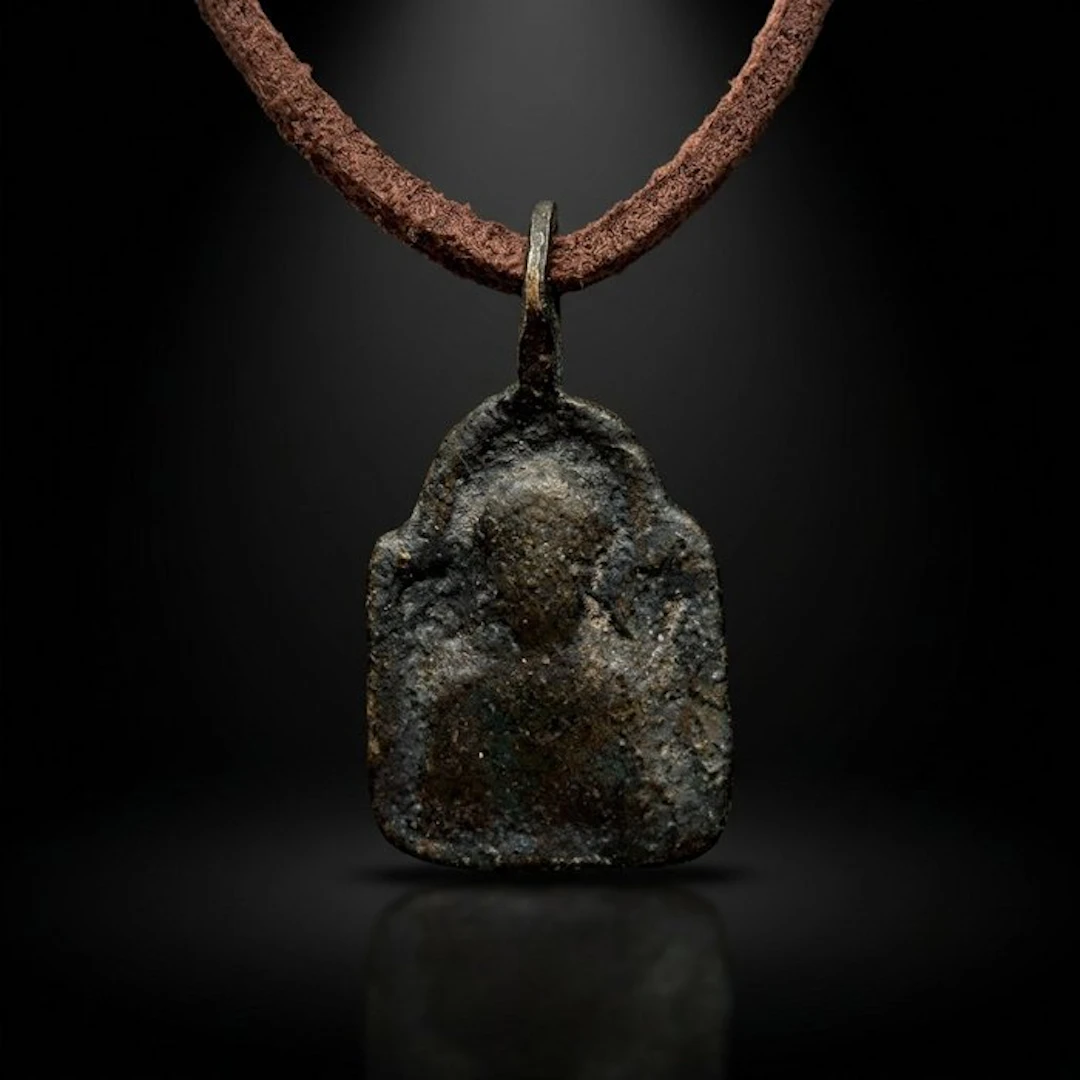
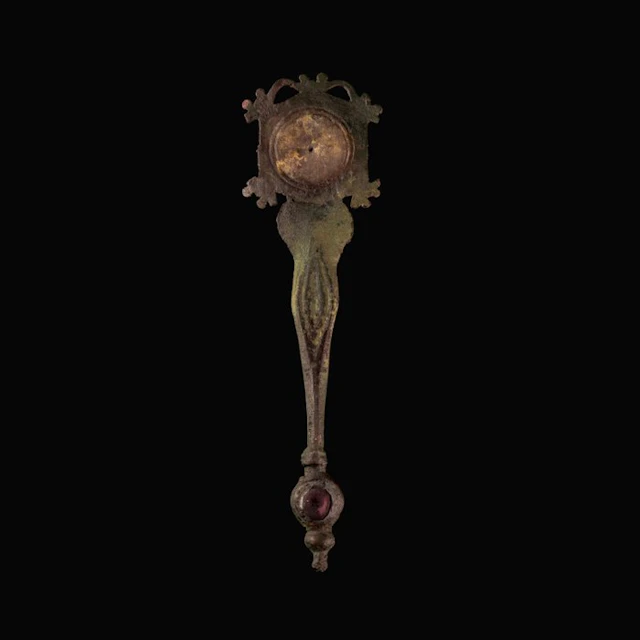
An exceptionally delicate Byzantine-style bronze icon pendant depicting Christ the Saviour, tentatively attributed to the 11th–13th centuries AD, a period of remarkable religious and artistic interaction between the Byzantine Empire and the Christian world of the Crusades. Despite its miniature dimensions of just 26 × 14 mm and its remarkably light weight of 1.5 grams, this small devotional object possesses a distinctive historical character. The pendant features a gently rounded upper section, an elongated suspension loop, and a heavily worn relief traditionally identified as Jesus Christ the Saviour. Centuries of apparent wear have softened the original image, leaving only faint traces of the sacred composition. Christ the Saviour — The Sacred Image of Byzantine Christianity At the heart of the pendant is a heavily worn relief, interpreted as a representation of Jesus Christ the Saviour. In Byzantine religious art, Christ the Saviour was among the most important and revered sacred images. He represented divine wisdom, mercy, salvation, and the promise of eternal life. Images of Christ appeared throughout the Byzantine world, from magnificent mosaics and monumental church frescoes to small personal icons intended for private devotion. The image of Christ Pantocrator — Christ as the Almighty Ruler and Judge of the Universe — became particularly significant in Byzantine iconography. Small devotional pendants bearing sacred images allowed believers to carry a visible reminder of their faith wherever they travelled. On the present example, the original relief has become considerably worn. Although the iconographic identification cannot be independently confirmed from the surviving details, the pendant retains the characteristic appearance of a small medieval religious image. A Personal Icon — Faith Carried Close to the Heart In the Byzantine Empire, icons occupied a central place in Christian spiritual life. Alongside large sacred images displayed in churches and monasteries, smaller personal devotional objects were also used by believers. Miniature bronze icon pendants could be worn around the neck, carried during pilgrimages, or kept as personal expressions of religious devotion. For their owners, such objects were more than decorative accessories. They could represent faith, hope, divine protection, and a spiritual connection with Christ. The exceptionally small size of this pendant suggests an object intended for personal use, easily carried or worn close to the body. The Mystery of an Image Worn by Time One of the most intriguing characteristics of this pendant is its heavily worn surface. The original relief decoration has been softened to such an extent that only faint traces of the composition remain visible. The upper section displays a rounded area that may correspond to the head or halo of a sacred figure, while the lower surface preserves subtle irregularities that could represent remnants of the original image. The precise details of the composition can no longer be confidently reconstructed. This creates a particularly evocative impression: an image that may once have been immediately recognizable to its owner has gradually become almost invisible. Yet the pendant itself has survived, preserving the outline of a personal religious object. Byzantium and the Age of the Crusades During the 11th–13th centuries, the Eastern Mediterranean became a region of intense contact between Byzantine, Western European, and Middle Eastern cultures. Pilgrims, merchants, travellers, and participants in the Crusades carried small religious objects across considerable distances. Crosses, devotional medallions, and miniature icons were among the personal possessions that could accompany believers on their journeys. Bronze was particularly suitable for producing small devotional objects because it was durable, relatively accessible, and capable of preserving cast decorative details. The present pendant reflects the general artistic tradition of such personal religious objects, although its precise geographical origin and historical context remain unverified. Shape and Construction The pendant has an elongated, approximately rectangular body with a rounded upper section and a nearly straight lower edge. A narrow, extended suspension loop rises from the top, allowing the object to be attached to a cord or chain. The front surface is slightly convex and retains faint traces of relief decoration. Its compact proportions and extremely low weight make it a particularly interesting example of miniature religious jewellery. Condition The pendant retains a dark grey-green patina, an uneven surface, and extensive traces of wear. The original relief is heavily worn, and its finer details are no longer clearly distinguishable. The overall silhouette remains preserved, including the elongated suspension loop. The aged appearance and softened relief give the object a distinctive visual character. Specifications Culture: Presumably Byzantine / Byzantine Christian Artistic Tradition Proposed Dating: 11th–13th century AD Historical Context: Byzantine and Crusader Period Type: Miniature religious icon pendant Material: Bronze Iconography: Christ the Saviour — traditional or proposed identification; heavily worn relief Dimensions: 26 × 14 mm Weight: 1.5 g Special Features: Miniature devotional format, rounded upper section, preserved suspension loop, and traces of a sacred relief image Condition: Heavily worn relief, dark patinated surface, visible traces of age and wear; overall silhouette preserved Provenance: Acquired on the European antiquities market. Shipping: European Union only. The Legend of the Sacred Image That Time Could Not Erase The following story is a literary interpretation inspired by medieval Christian traditions, rather than a historically documented account of this particular object. Long ago, a travelling pilgrim approached a craftsman and asked him to create a small image of Christ the Saviour — something light enough to carry on the longest journey and precious enough to keep close to his heart. The craftsman cast a tiny bronze icon and carefully formed the sacred image upon its surface. When the pilgrim received the pendant, he asked: "Will this little image protect me when I am far from home?" The craftsman replied: "The bronze may grow dark, and the face may one day disappear beneath the passing of centuries. But faith does not live in the metal alone. It lives in the heart of the person who carries it." The pilgrim placed the icon around his neck and departed. Years passed. Roads changed, cities rose and fell, and generations disappeared into history. The little bronze pendant remained. Its once-visible sacred image gradually faded, until only the faintest traces survived upon the metal. Yet the object continued to carry the memory of its original purpose. And perhaps this is its most moving quality: Time may erase the features of a sacred image, but it cannot erase the human desire for faith, hope, and protection. A Small Icon with a Remarkable Presence This miniature bronze pendant is fascinating not because of elaborate decoration or precious materials, but because of its simplicity, distinctive form, and the mystery of its almost vanished image. Weighing only 1.5 grams, this Byzantine-style bronze icon pendant, tentatively identified as depicting Christ the Saviour, is an evocative object for collectors of Byzantine antiquities, medieval Christian devotional jewellery, and historical religious artefacts.
Estimate:$168.03
To the auctionView all items fromCatawikiorAncient Art
Estimate:
$168.03
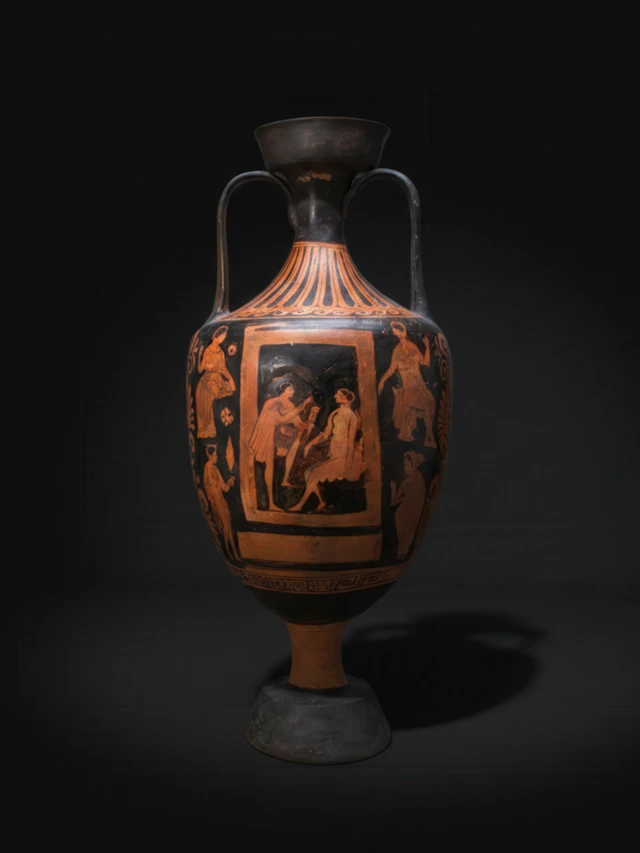
LARGE APULIAN RED-FIGURE AMPHORA WITH NAISKOS SCENE AND ALTAR
06/21/2026

$7,285.3
Est: $6,709.15
NOV 8 | 1:00 PM


OCT 31 | 4:00 PM


OCT 27 | 4:00 PM
Bring your auction to collectors worldwide!
Get listed nowBy subscribing, you are agreeing to the privacy policy. Unsubscribe anytime.
Barnebys HQ
Brahegatan 10
BOX 5038
114 37 Stockholm
