




NOV 8 | 1:00 PM

All auctions / Sports & Leisure / Maison Émile Michot Balle-Pelote

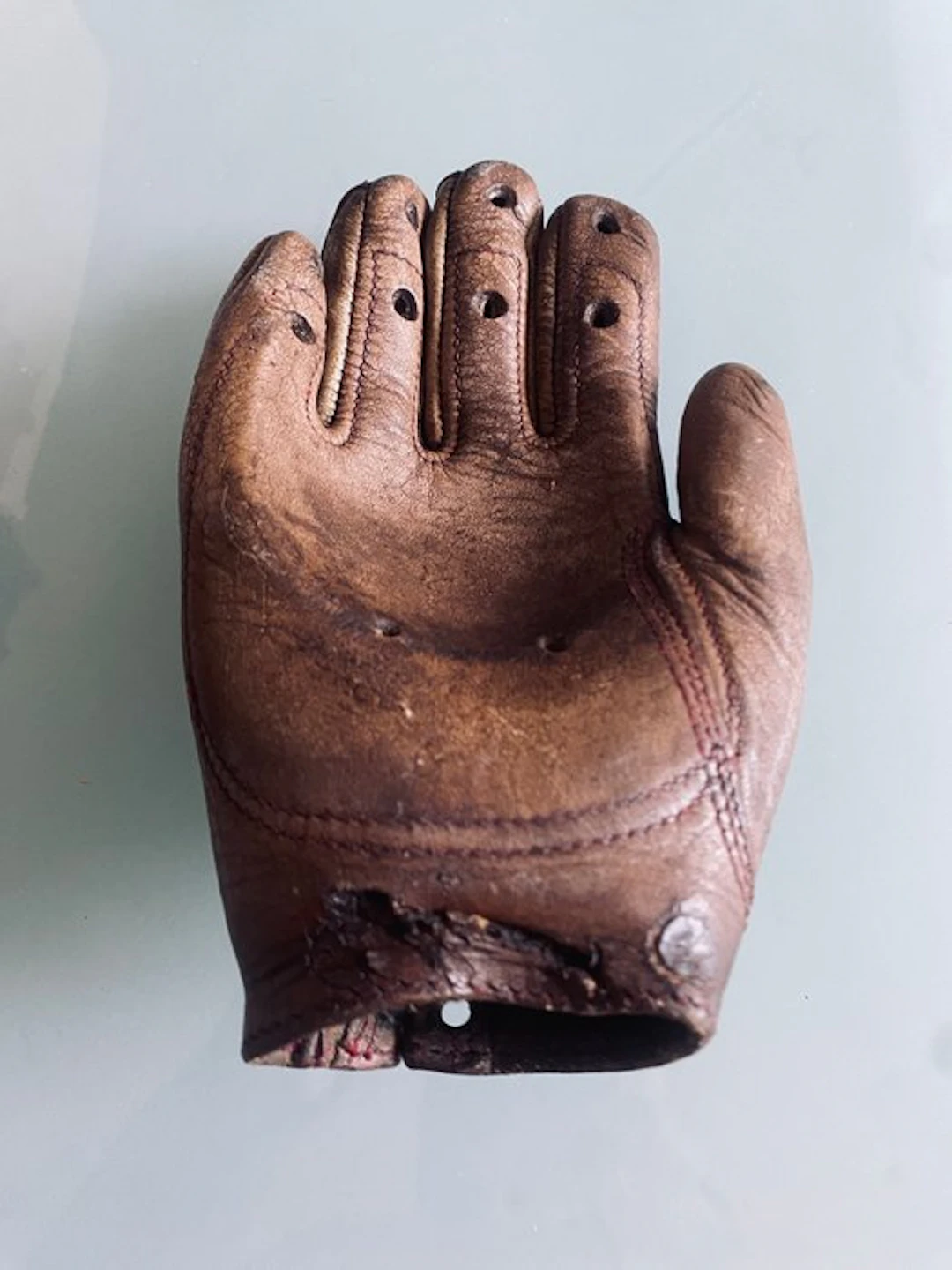
ANTIQUE BELGIAN BALL-PELLOTE GLOVE Balle-Pelote, traditional Belgian folk sport Historical leather glove of the “gant casserole” type Belgium, circa 1910–1920, proposed dating Category: historical sports equipment, Belgian cultural heritage, old leather craft Item: traditional leather glove for playing balle-pelote Proposed maker: Maison Émile Michot, Lessines, Belgium, attribution requiring archival confirmation Material: thick natural leather, metal fittings, rivets and stitching Dimensions: approximately 23 × 13 cm Depth of profile: approximately 8 cm Marking: number 204514, placed on the side of the cuff Dating: circa 1910–1920, based on analysis of construction and historical context; exact year not established Auction estimate: 250–300 EUR 1. Item description The item on offer is an antique, heavy leather glove associated with a traditional Belgian ball game known as balle-pelote. It represents a specialized category of vintage sports equipment whose form was strictly guided by the demands of the game and the skills of craftsmen handling thick leather. The glove is made of dark brown natural leather. Its distinctive, voluminous form, deeply contoured profile, and sturdy construction clearly set it apart from ordinary work gloves or everyday leather goods. Visible perforations, stitching, metal fasteners, and a buckle constitute an integral part of its construction. The surface features red-brown stitching, metal rivets, fittings, and a roller buckle. The construction is functional, with elements fitting together into a compact whole. The thick leather has been formed to give the glove a pronounced spatial profile suited to the specifics of the traditional game. Of particular interest is the internal structure. The visible corrugation and shaping of the leather create a bowl-like profile characteristic of gloves designed to contact a ball. This kind of solution is important when analyzing historical leather-forming techniques and comparing old products from different workshops. The cuff side bears the number 204514. This preserved marking is an important identifying feature of the specimen. Inside the cuff is also a worn, oval stamp impression whose content is not currently fully legible. The combination of the number, stamp impression, and distinctive construction provides material for further research into the item’s origin. The glove is attributed to a Belgian maker, likely Maison Émile Michot of Lessines. This attribution is based on analysis of the object and comparisons with historical gloves of this type. Final confirmation of the producer would require legible reading of the stamp or the discovery of workshop or catalog documentation. 2. Internal construction and manufacturing technique One of the most interesting elements is the formation of the glove’s inner part. Deep leather corrugation and a clearly dimensional profile indicate deliberate shaping of the material rather than a simple construction from flat, stitched pieces of leather. The bowl-like profile should be interpreted in the context of its sporting function. Ball-pelote gloves were specialized equipment for players, and their form had to accommodate the way the ball is struck and the demands of a particular variant of the game. Proper shaping of the leather was therefore important both functionally and structurally. Regular corrugation, profile depth, and the massiveness of the material are important comparative features. They can help relate this piece to other gloves preserved in museum collections or attributed to specific workshops. Visual analysis suggests the glove was made using traditional craft techniques requiring appropriate preparation, forming, and leather joining. However, there are not enough grounds to determine the exact forming temperature, type of press, or specific workshop technology from the photos alone. That is why the internal construction is especially valuable for research: it provides concrete traits for comparisons, but should not be treated as independent proof of a specific date or producer. 3. Metal components, buckle and fastenings Another characteristic element is the metal fittings, including the roller buckle, fastenings, and rivets. Their placement and method of attachment to the leather are an important part of the glove’s construction. The use of a mechanical fastener allowed the glove to be tightened. The buckle, strap, and metal elements form a functional arrangement whose details can be compared with sporting equipment and leather goods from a similar period. The rivets have wide collars, and their setting indicates a durable mechanical connection of parts. The red-brown stitching further emphasizes the glove’s construction. Together they create the distinctive appearance of an old utilitarian product where mechanical joins and stitching played a crucial role. The roller buckle and the way it is mounted are in keeping with the general character of older leather goods, but they do not alone provide a definitive dating criterion. Similar solutions were used in various periods and in many types of equipment. Without material analysis, one cannot be certain whether the elements are iron, copper, brass, or an alloy of a similar look. In the context of the proposed dating of circa 1910–1920, metal details should be treated as part of a combined technical analysis rather than as independent proof of the exact year of production. 4. Marking 204514 and the faded stamp The number 204514, placed on the side of the cuff, is one of the most important identifying details of the glove. Its preservation matters for further documentary research, as it allows searching not only by item type but also by the specific designation. In the analysis accompanying the item’s documentation, the number is proposed to be interpreted as a Belgian patent number or a mark related to a registered design. This hypothesis is linked to the assumption that the number referred to a particular structural solution of the glove. At this stage, however, no credible archival entry has been found linking the number 204514 to a balle-pelote glove, the Michot company, or a specific industrial pattern. Therefore, it cannot be confirmed as a patent number, nor that it denotes a form used during production. The six-digit inscription may be an important starting point for further inquiry, but interpretation requires finding a proper register or source document. Inside the cuff there is also a faded oval stamp impression. Its location matters because maker marks were often placed in areas less exposed to direct wear. It is not sufficient, however, to attribute the stamp to a particular workshop without a legible reading. The combination of the number 204514, the oval stamp trace, and the glove’s distinctive construction warrants further research into its provenance. 5. Proposed attribution: Maison Émile Michot, Lessines The most probable attribution indicated in the item’s analysis is Maison Émile Michot from Lessines, Belgium. The Michot name appears in the context of historical balle-pelote gloves, and preserved examples offered on the antiquarian market are described by sellers as products of this maker. In analyzing the offered glove, particular attention is paid to its deeply formed profile, interior construction, metal fastenings, and the oval stamp trace. These features form the basis for comparison with gloves attributed to Michot. A key comparative material is a historical glove offered on the collector market bearing a designation read by the seller as “MICHOT successeur.” Such offerings confirm that the Michot name appears in the trade of balle-pelote gloves. However, the mere market listing does not constitute independent expert evidence that every similar glove came from the same workshop. At present, the most responsible stance is to designate Maison Émile Michot as the proposed maker rather than as a producer confirmed by archival documentation. If the faded stamp is read or if a maker’s catalog showing identical construction is found, the attribution can be strengthened accordingly. This approach preserves the important lead regarding Michot without treating it as a settled fact. 6. The Dehon family of Jolimont as a comparative reference point A second important name in the history of Belgian sporting glove-making is Dehon, linked to Jolimont, a district of La Louvière. Belgian cultural heritage materials describe the Dehon family as craftsmen who for several generations professionally produced balle-pelote gloves. The last member of this lineage ceased activity in the 1990s. The Dehon family tradition shows that glove production for this discipline was a specialized craft tied to local sporting needs and transmitted across generations. Different workshops could have developed their own solutions for the glove’s shape, fastening, stitching, and profile. In the case of the offered piece, Dehon serves mainly as an important reference point for comparative research. There are currently insufficient grounds to attribute this glove to the Dehon family instead of Michot. Indicating Maison Émile Michot remains the proposed attribution, while the Dehon tradition helps to illuminate the broader context of Belgian glove-making. An additional source for understanding this trade is Guy Symoens’ article La fabrication des gants de balle-pelote : une histoire de famille chez les Dehon, published in 2014 in Cahiers no. 75. The bibliographic record confirms an existing study on the history of this family’s production. However, until the full text is analyzed, one should not assign it specific conclusions about the Michot glove. 7. Dating: circa 1910–1920 The proposed dating of the glove to around 1910–1920 results from a combined analysis of its construction, materials, metal components, and the historical context of the Belgian balle-pelote. This is a period when the sport already had an organized federation structure, established in 1902, and its sporting tradition was strongly rooted in regional life. The development of organized competitions fostered the specialization of equipment and the activity of craftsmen making gloves for players. Thick leather, voluminous profile, interior corrugation, metal fastenings, and the distinctive method of construction create a set of features consistent with interpreting the item as old sporting equipment. However, these do not by themselves determine a specific production year. Also, the museum-style glove with dimensions 23 × 13 cm is not dated, so it cannot be used directly as evidence that the offered piece comes from 1910–1920. The most precise catalog wording is therefore: circa 1910–1920, a dating proposed on the basis of visual analysis and historical context. It is a more concrete hypothesis than a broad statement like “early 20th century,” but still requires confirmation by manufacturer documentation or archival sources. 8. Balle-pelote: historical significance of the Belgian game Balle-pelote belongs to the historical family of handball-type ball games. Its tradition is strongly linked to Belgium’s Wallonia, particularly the province of Hainaut and towns where matches for generations formed an important part of social life. According to Musée du Jeu de Balle in Ath, the oldest traces of handball-type games in this region date to the 14th century. In the following centuries, various variants developed, and balle-pelote flourished in the 19th century. Matches were played in squares and streets, with local teams drawing crowds. The game was not only a sport; it was a social centerpiece, binding communities and preserving regional customs. The federation’s creation in 1902 marked a major step in sport organization. In 1928, an international confederation united the Belgian, French, and Dutch federations. Up to World War II, balle-pelote remained highly popular and competed for public attention with football in many towns. This history is important for interpreting the offered glove. Specialized sports equipment provides tangible evidence of how the game evolved, how players’ needs changed, and how local artisans responded. In December 2023, balle-pelote was recognized as intangible cultural heritage by the Wallonia-Brussels Federation. This confirms the importance of this tradition as part of Belgian regional history. 9. Museum counterpart and significance of comparison In the official Belgian movable heritage inventory there is an item described as Gant en cuir et balles du jeu de balle pelote. The record states glove dimensions of 23 × 13 cm and inventory numbers V 2010.064 and V 2010.066. The item is undated, and its catalog provenance is linked to a donation from the Musée National des Jeux de Paume in Ath. After comparing photographs, the offered piece has been identified as corresponding to the glove shown in the museum record. The match of dimensions and appearance is a strong identification basis, as it allows linking the item with a specific object in Belgian heritage documentation. However, it is important to distinguish visual agreement from provenance confirmation. There are currently no grounds to claim that the offered glove is the same object as in the museum record, or that it was donated by the museum. It is appropriate to describe it as an item matching the type and appearance of the documented comparative exemplar. This comparison has historical and cataloging value. It indicates that the glove’s form fits the recognized category of Belgian balle-pelote equipment, and that its dimensions align with those recorded in official inventories. 10. Family origin According to family information provided, the glove was kept by a Polish family living in Belgium during the interwar period. This is an intriguing clue about the item’s history, though no archival documentation was presented to independently confirm all earlier usage phases. The original owner’s name, the team in which the glove might have been used, or the specific town of origin have not been established. Therefore, it should not be attributed to a particular player or club without additional evidence. Family origin remains a valuable element of the object’s history. In combination with the glove’s distinctive construction, the number 204514, and the museum comparison, it forms a basis for further research into its history. 11. Condition The glove retains its characteristic spatial form and identifiable structural features. Visible signs of age and wear are part of its current appearance and should be evaluated in the context of the object’s historical character. Leather, stitching, perforations, rivets, metal fittings, and the fastener constitute the most important elements for inspection. The leather’s elasticity, the durability of fastenings, and the functionality of the buckle should be assessed through direct examination of the item, not solely from photographs. From a collector’s perspective, it is especially important to preserve the original construction and all markings. Number 204514 and the faded oval stamp should remain documented in photographs, as they may be significant for future identification research. The glove should be presented as a historic sporting and collectible object, not as modern equipment for regular play. 12. Collecting significance The item belongs to a specialized collecting category encompassing historical equipment for traditional sports. Its appeal stems from a combination of features: distinctive form, thick leather, metal elements, the number 204514, faded marking traces, and the proposed Michot workshop attribution. A key asset is the possibility to compare with the glove documented in the Belgian museum inventory. The context of Musée du Jeu de Balle in Ath and documentation of traditional Belgian glove-making place the object within a broader history of regional sport. The glove may interest collectors of antique sports accessories, Belgian history, traditional ball games, leather craftsmanship, and objects tied to early 20th-century material culture. An additional advantage is the potential for further identification. Reading the stamp, comparing the number with archival documentation, or finding the producer’s catalog could help in the future to more precisely determine the maker and date of manufacture. Nonetheless, one should not equate investigative potential with guaranteed market value. Final collector interest will depend on condition, documentation quality, attribution credibility, and market conditions. 13. Auction estimate Proposed auction estimate: 250–300 EUR. This range reflects the item’s specialized nature, its construction, the preserved number, the proposed Michot attribution, and comparison with the item noted in the Belgian museum inventory. It is an estimate for auction listing purposes, not an official museum valuation nor a sum confirmed by a completed sale. The museum record provides a comparative reference for the glove’s type and dimensions, not a price tag. The final auction result will depend on collectors’ interest, condition, photo quality, and the extent to which the producer and dating can be corroborated. Catalog summary Antique Belgian leather glove for the traditional balle-pelote game, dating proposed to around 1910–1920 and attributed to the workshop Maison Émile Michot of Lessines. Made of thick natural leather, with a voluminous profile, inner corrugated construction, metal roller buckle, rivets, and stitching. The cuff side bears the number 204514, and the interior shows a faded oval stamp trace. The type of item is supported by comparison with a 23 × 13 cm glove described in Belgium’s official movable heritage inventory. The item represents an interesting example of vintage sports equipment and material heritage of Belgium’s ball-game tradition. attribution to Maison Émile Michot and dating of circa 1910–1920 remain a hypothesis based on visual analysis and historical context. Interpreting the number 204514 as a Belgian patent or registration number has not yet been confirmed by archival documents. Auction estimate: 250–300 EUR.
Estimate:$1.12
To the auctionView all items fromCatawikiorSports & Leisure
Estimate:
$1.12


NOV 8 | 1:00 PM


OCT 31 | 4:00 PM

OCT 23 | 8:00 AM
Bring your auction to collectors worldwide!
Get listed nowBy subscribing, you are agreeing to the privacy policy. Unsubscribe anytime.
Barnebys HQ
Brahegatan 10
BOX 5038
114 37 Stockholm
