

OCT 31 | 4:00 PM

All auctions / Ancient Art / Late Bronze Age to Early Iron Age

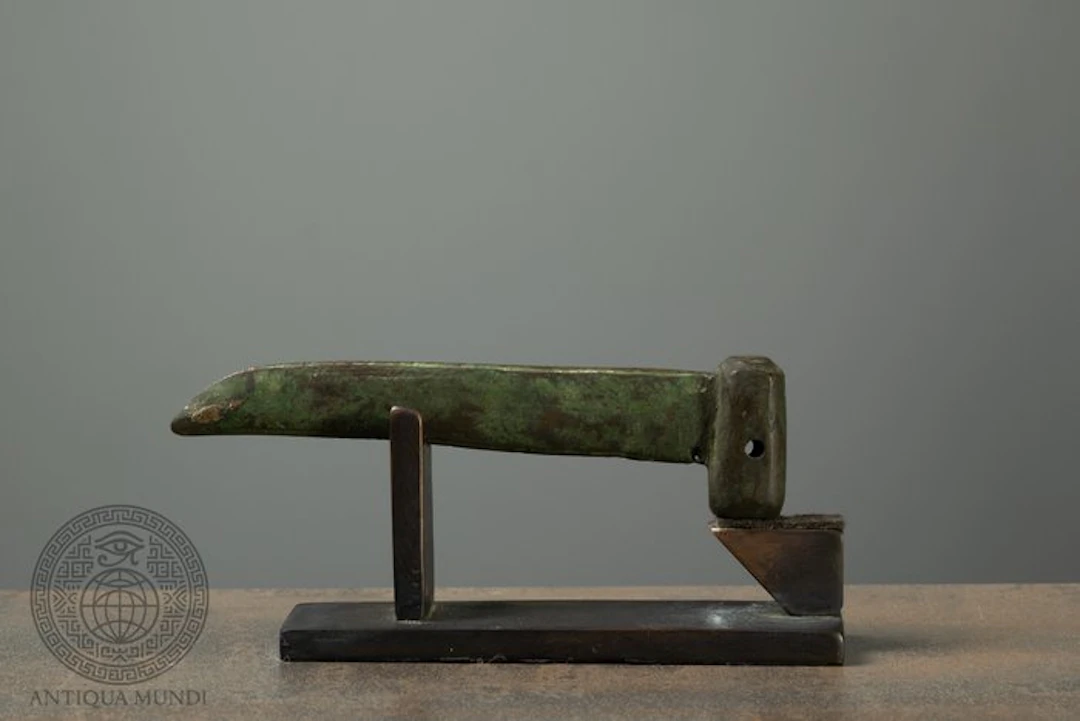
A well-preserved Central European bronze sickle with a distinctive perforated hafting tang, attributed to the Late Bronze Age to Early Iron Age tradition. Measuring approximately 14.5 cm in length, the implement is characterised by its elongated, gently curved blade and substantial rectangular hafting section with a circular perforation. The relatively broad blade extends almost straight from the reinforced hafting section before gradually curving towards its rounded, slightly downward-projecting tip. The upper edge forms a gently convex back, while the opposite edge constitutes the cutting section. The blade gradually narrows towards its free end, creating a balanced and functional profile. Particularly characteristic is the solid, approximately rectangular hafting tang, which is considerably thicker than the blade and has softly rounded edges. A clearly defined circular perforation passes through this section and was probably intended to assist in securing the bronze implement to a wooden handle. The combination of the substantial hafting section, perforation and carefully shaped blade reflects the practical construction of prehistoric bronze harvesting tools. Hafting and Construction The sickle was originally fitted with a wooden handle, which is no longer preserved. The perforated hafting section probably allowed the blade to be secured by means of a pin, peg or comparable fastening arrangement. Such features were intended to provide stability during repeated cutting movements and to prevent the metal blade from becoming detached during use. The precise original hafting arrangement cannot be reconstructed without the surviving wooden components. Typology and Dating Bronze sickles are among the characteristic agricultural implements of prehistoric Central Europe, particularly during the Bronze Age and the subsequent transition to the Early Iron Age. A variety of forms developed over time, differing in blade curvature, proportions and methods of attachment to wooden handles. The present example belongs broadly to the tradition of cast bronze sickles with a reinforced hafting section and additional fastening provision. Its elongated blade, substantial tang and circular perforation are consistent with prehistoric bronze-working traditions. A connection with the Hallstatt cultural horizon is possible. However, bronze sickles were already widespread during the preceding Bronze Age, and the presence of a perforated hafting section alone does not establish a specifically Hallstatt-period date. The object is therefore conservatively attributed to the Late Bronze Age to Early Iron Age, approximately 1200–450 BC, with a more precise chronological attribution remaining open. This broad dating is a preliminary typological assessment rather than a date established through archaeological excavation or scientific testing. Function Bronze sickles were primarily used as agricultural harvesting implements, particularly for cutting cereal crops, grasses and other plant materials. Their curved blades enabled the user to gather and cut stems through a controlled pulling motion. The reinforced hafting section of the present example would have provided a stable connection between the metal blade and its original wooden handle. In addition to their practical use, bronze sickles are also known from prehistoric hoard deposits, demonstrating their wider importance within the material culture of Bronze Age communities. Without a documented archaeological context, however, the present example should primarily be regarded as a functional agricultural implement. Surface and Patina The bronze displays a pronounced green to greenish-brown patina, with darker brown oxidation and areas of mineral accretion. The surface exhibits variations in colour and texture, including localised deposits, wear and irregularities. The surviving surface details allow the construction of the blade and its reinforced perforated hafting section to be clearly appreciated. Condition Good condition considering its attributed age. The blade and perforated hafting section are preserved. The cutting edge and rounded tip show areas of wear, minor irregularities and small localised losses. The circular perforation remains clearly visible and unobstructed. The bronze surface displays corrosion, oxidation, mineral deposits and age-related wear, together with darker discolouration in places. Please examine all photographs carefully, as they form an integral part of the condition description. The modern display stand is used solely for presentation and is not included in the sale. Provenance Formerly in the Madeleine & Erich Dammann Collection, Germany. Acquired during the collectors’ extensive travels between 1950 and 1970. The collection is documented in Germany by 1970 through historical photographs of the family residence and subsequently remained in continuous family ownership. The objects were acquired privately during the collectors’ travels. As was customary for private purchases made at local markets during the 1950s and 1960s, purchase receipts or invoices were generally neither issued nor requested. Historical photographs and biographical documentation relating to the Dammann Collection are available and support the long-standing provenance of the collection.
Estimate:$505.19
To the auctionView all items fromCatawikiorAncient Art
Estimate:
$505.19

RARE EGYPTIAN BRONZE CAT STATUETTE WITH GOLD EARRINGS - LARGE SIZE
06/21/2026

$29,141.2
Est: $26,836.62
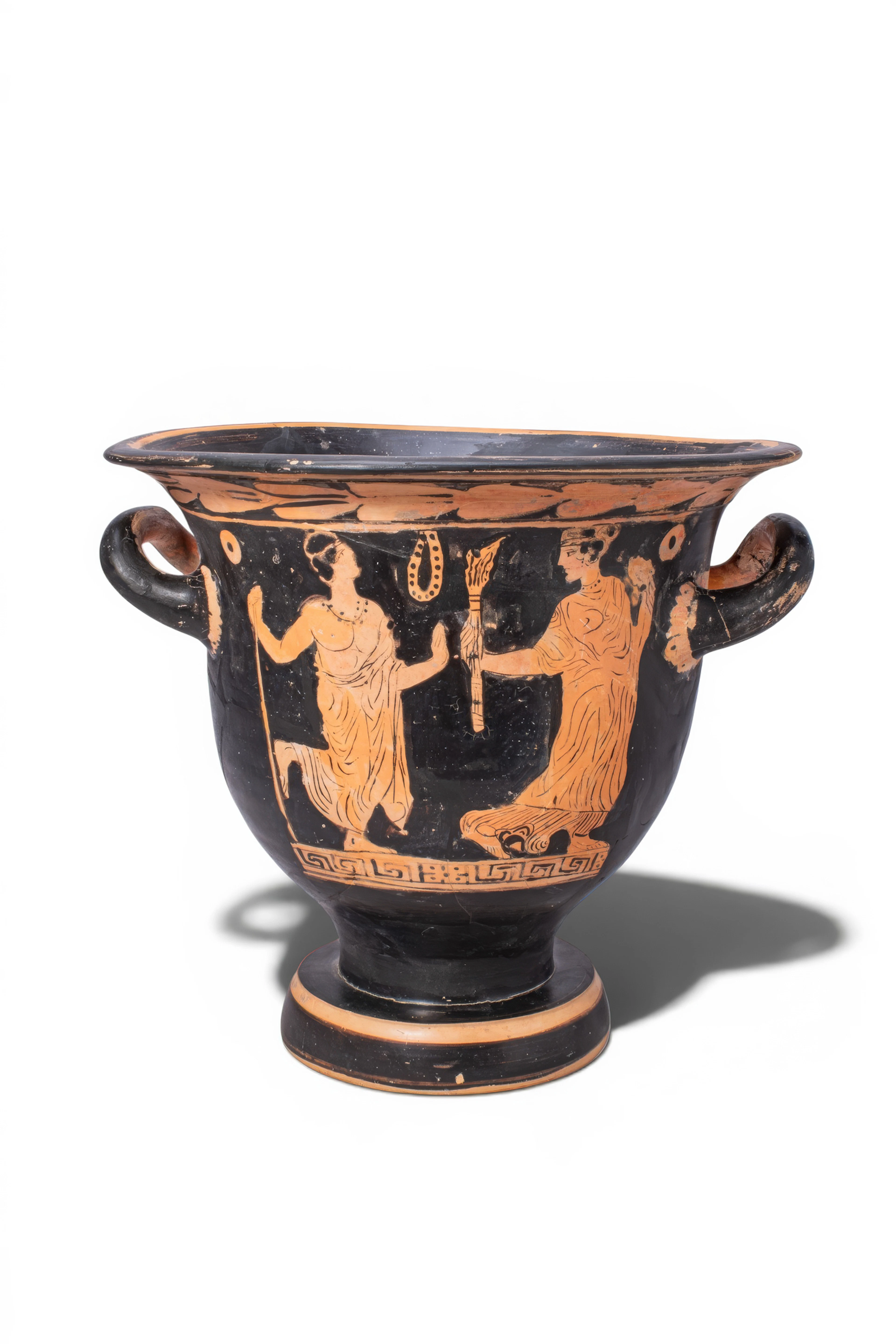
APULIAN RED-FIGURE BELL KRATER WITH KOMASTOS AND MAENAD - TL TESTED
06/21/2026
$3,443.96
Est: $2,640.96
OCT 31 | 4:00 PM


OCT 23 | 8:00 AM

OCT 27 | 4:00 PM
Bring your auction to collectors worldwide!
Get listed nowBy subscribing, you are agreeing to the privacy policy. Unsubscribe anytime.
Barnebys HQ
Brahegatan 10
BOX 5038
114 37 Stockholm
