



NOV 7 | 5:00 PM

All auctions / Ancient Art / KUNICHIKA


Artist: Toyohara Kunichika 豊原国周 (1835–1900) Title: Katō Kiyomasa (加藤清正) — Ichikawa Danjūrō IX (1838–1903) in one of his defining roles Series: Ichikawa Danjūrō Engei Hyakuban 市川団十郎演芸百番 Date: Colophon dated February, Meiji 30 (1897) Publisher: Fukuda Kumajirō 福田熊次郎, Nihonbashi-ku, Hasegawa-chō 19, Tokyo Block carver: Nisei Horiei 二世彫栄 (Horiei II) Signature / seals: Signed Kunichika hitsu 國周筆 in a cartouche, with the artist's red ring seal Format: Ōban tate-e, approx. 36 × 24 cm, full sheet with margins Condition Excellent, and the point on which this sheet should be judged. The mica ground is exceptionally well preserved: tilt the print and the whole pale grey-green field breaks into a fine, even glitter right up to the black keyblock frame, with no rubbing, no flaking and no dulled patches — the first thing to go on prints of this series, and the first thing to look for. The impression is crisp throughout, holding the individual scales of the armour, the diaper of the indigo brocade, the separate hairs of the beard, and the burnished black of the topknot. Colours are strong and unfaded. Paper Very good. Full margins on all four sides, the sheet clean and flat, with an old Japanese backing sheet applied to the verso (urauchi) — a standard and entirely sympathetic Japanese treatment, and one reason the mica has survived as well as it has. Light, even warm toning across the sheet, consistent with an 1894 printing. Earthquake Kiyomasa Just before dawn on 5 September 1596 the Keichō earthquake struck the Kinai. Fushimi Castle — Hideyoshi's great pleasure-fortress on the hill the Japanese call Momoyama, "peach mountain" — was wrecked, its keep and towers coming down around the man who had unified Japan. Katō Kiyomasa (1562–1611), Hideyoshi's kinsman and one of his most ferocious field commanders, was at that moment under house arrest: Ishida Mitsunari had poisoned his lord's ear over Kiyomasa's conduct in the Korean campaigns, and he was forbidden the castle. He went anyway. In the version Japan loves, Kiyomasa was the first man through the gates, climbing through the collapsing halls to find Hideyoshi trapped and immobile, and carried him out on his back. Loyalty of that order could not be punished; the disgrace was lifted on the spot. Kawatake Mokuami built the episode into Zōho Momoyama Monogatari, premiered in Tokyo in 1869 and expanded in 1873, and the play is known to every kabuki-goer simply as Jishin Katō — Earthquake Kiyomasa. It entered the Shin Kabuki Jūhachiban, the "new eighteen" that Danjūrō IX assembled as his own house repertory, and it remained one of his signature parts for the rest of his career. Kunichika shows him not in the rescue but in the moment before it: three-quarter length, filling the sheet, in full ō-yoroi with the great ōsode shoulder-guards spread like wings, the tasselled saihai of command gripped in his left hand, two swords at his hip. The head is turned sharply left and the eyes cut further left still — he is looking off-sheet at something we cannot see, brows driven down, mouth set hard under the enormous spade of beard. It is a portrait of a decision being taken. Perfectly Accurate, Entirely Untrue Here is what makes this particular sheet worth more than a second glance. Ichikawa Danjūrō IX was the great reformer of the Meiji stage, the driving force behind katsureki — "living history" — a movement that set out to purge kabuki of its comfortable anachronisms and put genuinely researched costume, armour and manners on the boards. Real periods, real scholarship, real armour. Zōho Momoyama Monogatari is generally counted among the works that opened the way for it. And the episode never happened. Kiyomasa's own letter, written two days after the earthquake to report it to his domain, says that Hideyoshi's household was unharmed, that his own Fushimi residence had escaped damage because it was not yet finished, and — with the flatness of a man not in the middle of a heroic rescue — that he was expecting a delivery of sesame from Kyoto. He was almost certainly not at Fushimi at all. The most celebrated act of loyalty in the Kiyomasa legend is a later invention. Kunichika, who had no stake in the argument, simply does what the stage did: he renders the fiction with total documentary conviction. Every lame of the cuirass is drawn and cut individually; the lacing, the brocade, the sword furniture, the fur crest bound with its indigo cord are all recorded as though from the object. The inset vignette above — a tiled roof rising out of blossom on a hillside, with blue hills behind — is not decoration either: it is Momoyama, the peach hill of the play's title, printed in the soft manner of a literati landscape and signed by a different hand entirely. A play about an earthquake, opening on a view of the castle in flower, before anything falls down. What "Deluxe" Actually Means Here The Engei hyakuban sheets were printed to a standard that had effectively disappeared from commercial ukiyo-e by the 1890s, and this impression carries the full apparatus. The ground is a mica field — powdered mica laid over a pale grey-green, catching light across the entire background rather than in a token strip. The blacks of the hair and the lacquered plates are burnished (tsuya-zuri) to a hard sheen against the matt colours. There is blind embossing in the white passages. The cartouches are set on separately printed pink panels with the peonies of the Ichikawa house drawn around the series title in miniature, botanically, in five colours. The carving is signed, which in the 1890s is itself a statement of ambition: the mark at lower right reads Nisei Watanabe Horiei — Watanabe Horiei II, the second-generation carver who cut the greater part of this series. Publishers did not name their horishi on ordinary work. Fukuda Kumajirō, who commissioned the series together with Gusokuya Kahei, was making a claim about the object, and the claim holds up under a loupe: the hair-lines at the temple and the individual whiskers of the beard are separated by the width of a knife-edge.
Estimate:$224.11
To the auctionView all items fromCatawikiorAncient Art
Estimate:
$224.11
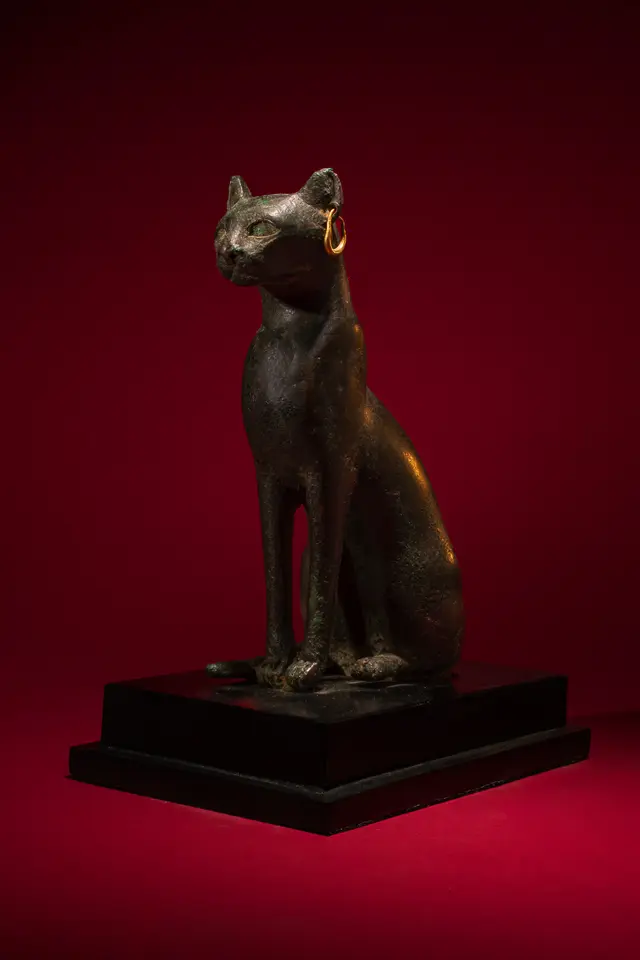
RARE EGYPTIAN BRONZE CAT STATUETTE WITH GOLD EARRINGS - LARGE SIZE
06/21/2026

$29,141.2
Est: $26,836.62
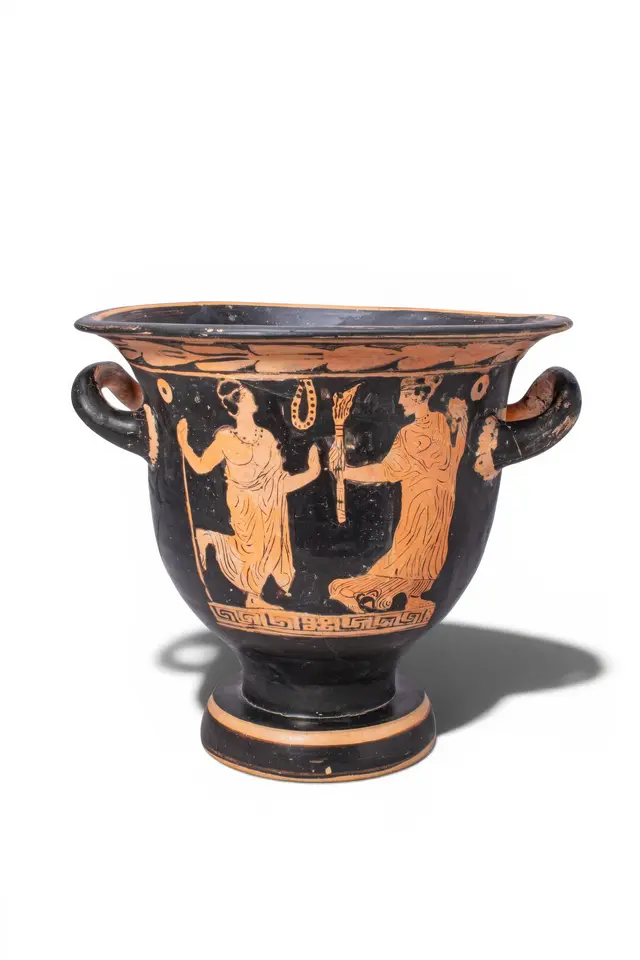
APULIAN RED-FIGURE BELL KRATER WITH KOMASTOS AND MAENAD - TL TESTED
06/21/2026
$3,443.96
Est: $2,640.96
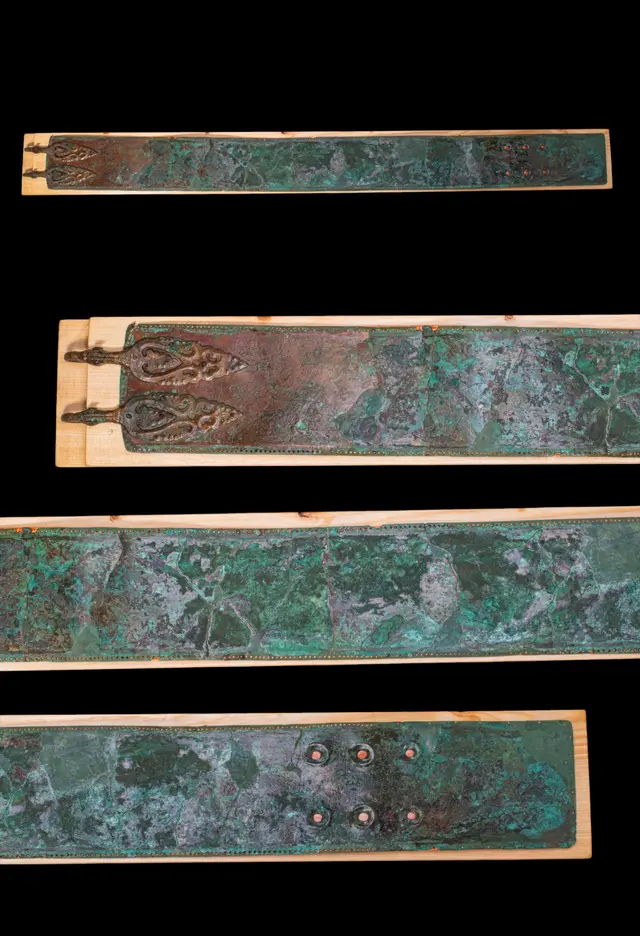
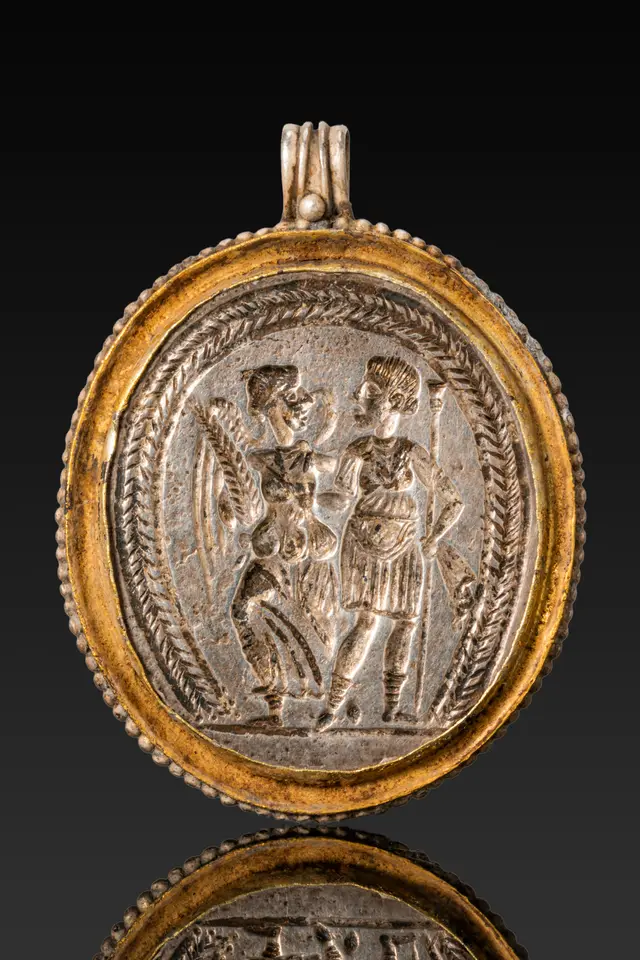
NOV 7 | 5:00 PM


NOV 12 | 10:00 AM


NOV 8 | 1:00 PM
Bring your auction to collectors worldwide!
Get listed nowBy subscribing, you are agreeing to the privacy policy. Unsubscribe anytime.
Barnebys HQ
Brahegatan 10
BOX 5038
114 37 Stockholm
