




OCT 8 | 3:00 PM

Bring your auction to collectors worldwide!
Get listed nowBy subscribing, you are agreeing to the privacy policy. Unsubscribe anytime.
Barnebys HQ
Brahegatan 10
BOX 5038
114 37 Stockholm
All auctions / Books, Maps & Manuscripts / Jean Fernel (Ioannis Fernelii) - Universa Medicina / Curatio Methodica - 1586

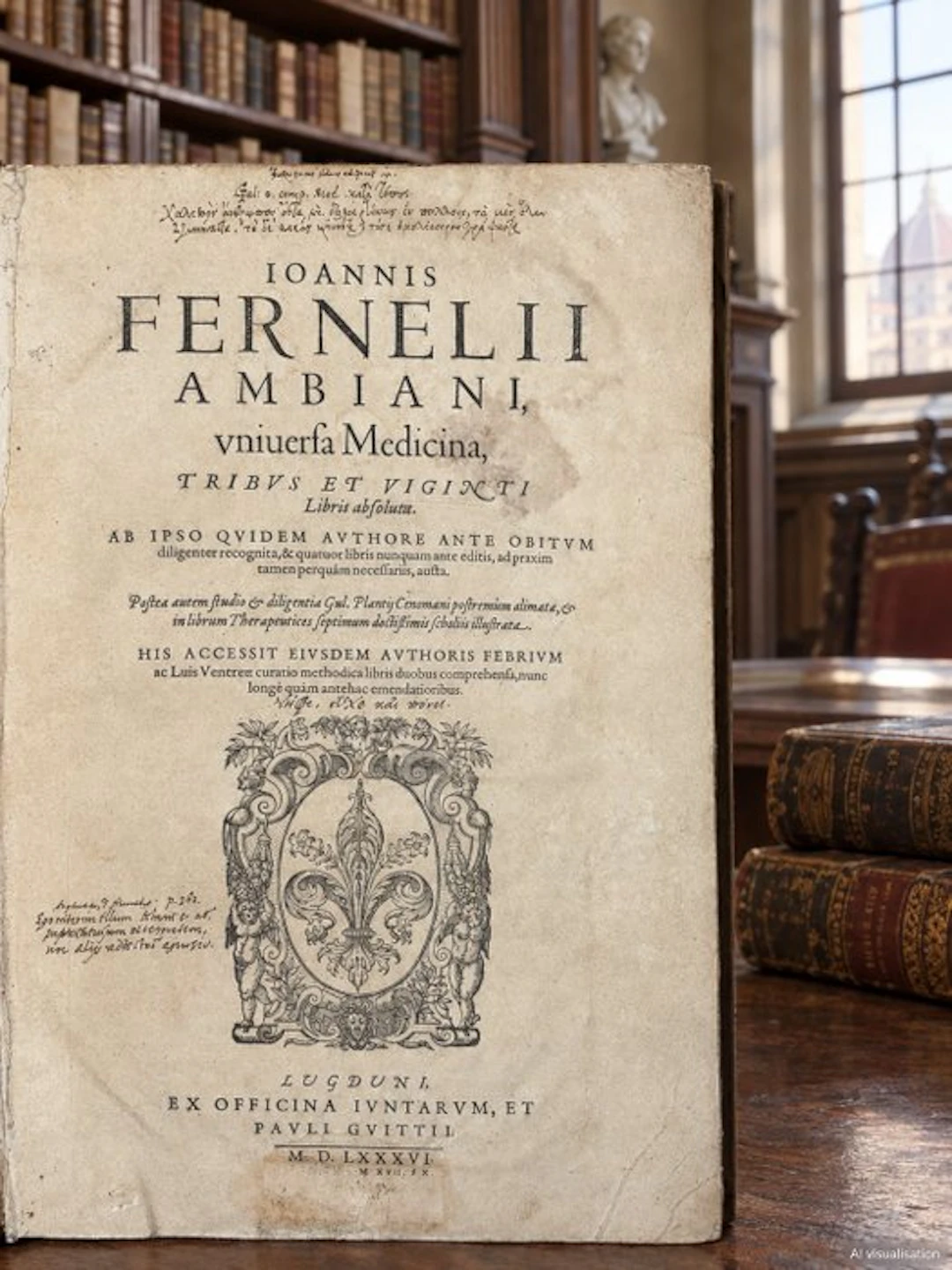
JEAN FERNEL Universa medicina and Febrium ac luis venereae curatio methodica Lyon, 1586 — Officina dei Giunti and Paul Guittius 1. The author: Jean Fernel Jean Fernel (1497–1558), identified on the title pages as Ioannes Fernelii Ambiani, was one of the most authoritative personalities in European medicine of the Renaissance. Born in Montdidier and trained in Paris, Fernel initially cultivated interests in mathematics, astronomy, and philosophy, before dedicating himself to medicine. In 1530 he earned his doctorate and in 1556 became personal physician to Henry II of France, thus entering directly into the milieu of the French court. His figure is particularly significant because he belongs to that generation of scholars who sought to reorganize ancient medical knowledge in light of Renaissance experience and clinical observation. Fernel remained deeply tied to the Hippocratic and Galenic tradition, but did not merely repeat their teachings passively. His work constitutes, in fact, a broad and organic systematization of medicine in the sixteenth century. Historiography regards him as one of the most important representatives of the so-called Renaissance Galenism. 2. The first work: Universa medicina The first title page depicted in the photographs bears the title: IOANNIS FERNELII AMBIANI, Universa Medicina, tribus et viginti libris absoluta. The work brings together in a systematic form the main branches of medicine according to Fernel’s thought. The text originally included the great sections on physiology, pathology, and therapeutics, organizing medical knowledge into a coherent and overall structure. It is particularly important that Fernel contributed to give medicine a conceptual framework in which the study of the healthy body, that of diseases, and that of therapeutic methods were considered parts of a single system. Physiology studies the functioning of the organism; Pathology deals with diseases and their causes; Therapeutice focuses on the means by which the physician can intervene. This conception represented a significant attempt to transform medicine into a discipline ordered by general principles, rather than a mere collection of recipes and observations. The French National Academy of Medicine also emphasizes that Fernel contributed to the diffusion of the terms “physiology” and “pathology” in their systematic medical meaning. 3. The second work: Febrium ac luis venereae curatio methodica The second photograph shows another title page, also dated Lugduni, 1586, bearing the title: Ioannis Fernelii Ambiani Febrium ac luis venereae curatio methodica libris duobus comprehensa. This part is devoted to two important problems of medicine of the time: fevers and the venereal disease, i.e., syphilis. The text thus represents a predominantly clinical and therapeutic deepening. It is not simply a repetition of Universa medicina, but a specific section in which the modalities of treating some of the most difficult and widespread diseases of modern Europe are methodically addressed. The text on fevers had already circulated in autonomous form: a broader version of Febrium curandarum methodus generalis had been published in 1577, while the tract on the venereal disease had had its own publication in 1579. Subsequently these texts were united in the editions of Fernel’s complete work. The presence of this second title page is therefore bibliographically significant: it shows how the 1586 edition was conceived as a large organic collection of Fernel’s medical writings, including specialized treatises. 4. The printer: i Giunti and Paul Guittius The typographic colophon in the photographs reads: Lugduni, ex officina Iuntarum, et Pauli Guittii, M.D.LXXXVI that is, Lyon, from the typography of the Giunti family and Paul Guittius, 1586. The presence of the Giunti is particularly important in the history of European printing. The Giunta family had developed one of the most important printing and bookselling enterprises of the modern era, with activities in Venice, Florence, and Lyon. Lyon, in the sixteenth century, was also one of the main European centers of production and distribution of books, especially scientific, medical, and humanistic works. The 1586 edition thus sits in a premier international editorial milieu. The catalog of the Biblioteca Braidense records for the 1586 edition the printer’s formula “Lugduni : ex officina Iuntarum, et Pauli Guittii,” confirming the data in your copies. 5. Guillaume Plancy and the transmission of the work A fundamental element already reported on the title page is the reference to Gulielmus Plantii Cenomani, namely Guillaume Plancy. Fernel had died in 1558, so the 1586 edition was naturally produced posthumously. Plancy played an essential role in the revision, organization, and editorial transmission of the French physician’s writings. The title page indeed declares that the work had subsequently been subjected, through the study and diligence of Guillaume Plancy, to a further revision and enriched with annotations, particularly in the seventh book of Therapeutice. This element helps to understand a fundamental aspect of sixteenth-century book culture: the work of a great author could continue to live and evolve through editors, curators, and commentators many decades after the author’s death. 6. The scientific significance of the work The value of Universa medicina does not lie solely in the amount of information it contains, but above all in the attempt to build a comprehensive vision of medicine. Fernel conceives the physician as a scholar who must first know the nature and functioning of the human body, understand diseases, and only then proceed to their treatment. In this sense the work perfectly testifies to the particular nature of Renaissance medicine: a discipline still strongly founded on the authority of the ancients, but at the same time traversed by new forms of observation, classification, and comparison with experience. Pathology, in particular, is remembered by modern studies for the importance attributed to the localization of diseases and clinical observations; Fernel also took an interest in anatomy and physiology with observations considered original for his time. 7. The historical context: Renaissance, the French court, and European medicine These works must be placed in the midst of the cultural revolution of the European Renaissance. Fernel worked in an era in which Europe was undergoing profound transformations: the spread of printing had radically changed the circulation of knowledge; the rediscovery of Greek and Latin texts fueled humanism; while anatomy, botany, pharmacology, and clinical medicine began to develop under new modalities. It is the same intellectual milieu in which figures such as Andreas Vesalius operated, whose De humani corporis fabrica was published in Basel in 1543, and later William Harvey, who in the seventeenth century would revolutionize the study of blood circulation. It is also interesting to note the chronological relationship between Fernel and Harvey: historical studies have shown that Harvey was a careful reader of Fernel and used his work in his own research on animal generation. Therefore Universa medicina belongs to that long transitional phase in which European medicine progressively moved from the ancient medical-philosophical tradition toward the science of modern medicine. 8. The question of the lue venerea Particularly interesting is the section devoted to the lue venerea. Syphilis represented one of the great health problems of Europe between the sixteenth and seventeenth centuries. Its appearance in continental Europe at the end of the fifteenth century had generated an extensive medical debate on the nature of the disease, its origin, and above all the therapeutic possibilities. Fernel’s treatise thus inserts itself into a matter of great social and health significance of the time. His approach belongs, naturally, to the medicine of the sixteenth century and must not be interpreted according to modern microbiological knowledge. Precisely for this reason the text is extremely interesting from a historical point of view: it allows us to observe how a learned Renaissance physician sought to understand and treat one of the most enigmatic pathologies of his time. 9. Impact and fortune of the work Fernel’s editorial fortune was immense. Universa medicina did not remain a work confined to the sixteenth century: it continued to be reprinted for over a century. The French National Academy of Medicine records 32 editions, with the last published in Geneva in 1680. Even in the seventeenth century, when new medical theories gradually began to challenge humoral medicine and the traditional Galenic system, Fernel’s work continued to be read, commented upon, and reprinted. This fact is particularly significant: it shows that Fernel was not only an important author in sixteenth-century France, but became an international reference for European medical culture. 10. Importance of the two illustrated copies The two photographs thus have particular interest because they visually document two complementary nuclei of the same great editorial construction. The first title page presents the general synthesis of fernellian medicine: Universa medicina whereas the second leads to a more clinical and therapeutic dimension: Febrium ac luis venereae curatio methodica. Their joint presence allows reading the work on two levels: on the one hand the general theory of the body, disease, and therapy; on the other the application of these principles to the concrete care of specific pathologies. From a material standpoint, the photographs also show interesting elements: the large printer’s mark with the lily, the composition in roman and italic type, the large format of the volume, and, in the first copy, numerous ancient handwritten annotations, testimony to the historical reading and use of the book. Conclusion Jean Fernel’s Universa medicina represents one of the most significant testimonies of Renaissance European learned medicine. Originally published in the mid-sixteenth century and subsequently expanded, corrected, and commented, it sought to bring physiology, pathology, and therapy within a single medical system. The Lyon edition of 1586, issued by the Officina dei Giunti and Paul Guittius, belongs to the mature phase of the author’s editorial fortune. The presence of Guillaume Plancy’s work also testifies to the complex operation of conservation and transmission of Fernel’s writings after his death. The connection with Henry II of France, with the Galenic tradition, with Vesalius’s anatomical medicine, and, subsequently, with the studies of William Harvey, places these volumes within one of the most important moments in the history of European science: the transition from medicine inherited from antiquity to the progressive formation of modern medicine. Collation and state of preservation: Universa Medicina: 62 pp; (657 pp) Curatio Methodica: 2 pp:63 pp last blank leaf entirely annotated with sixteenth-century manuscript text. Note tarred wormholes at the margins, light browning and minor imperfections but overall a rare and beautiful copy. Shipping express delivery in 24 working hours across Europe, for non-EU countries 48 working hours
Estimate:$506.35
To the auctionView all items fromCatawikiorBooks, Maps & Manuscripts
Estimate:
$506.35

OCT 8 | 3:00 PM

OCT 17 | 10:00 PM


OCT 8 | 3:00 PM
Bring your auction to collectors worldwide!
Get listed now