



All auctions / Arts & Graphics / Jean-Baptiste Greuze (1725-1805)

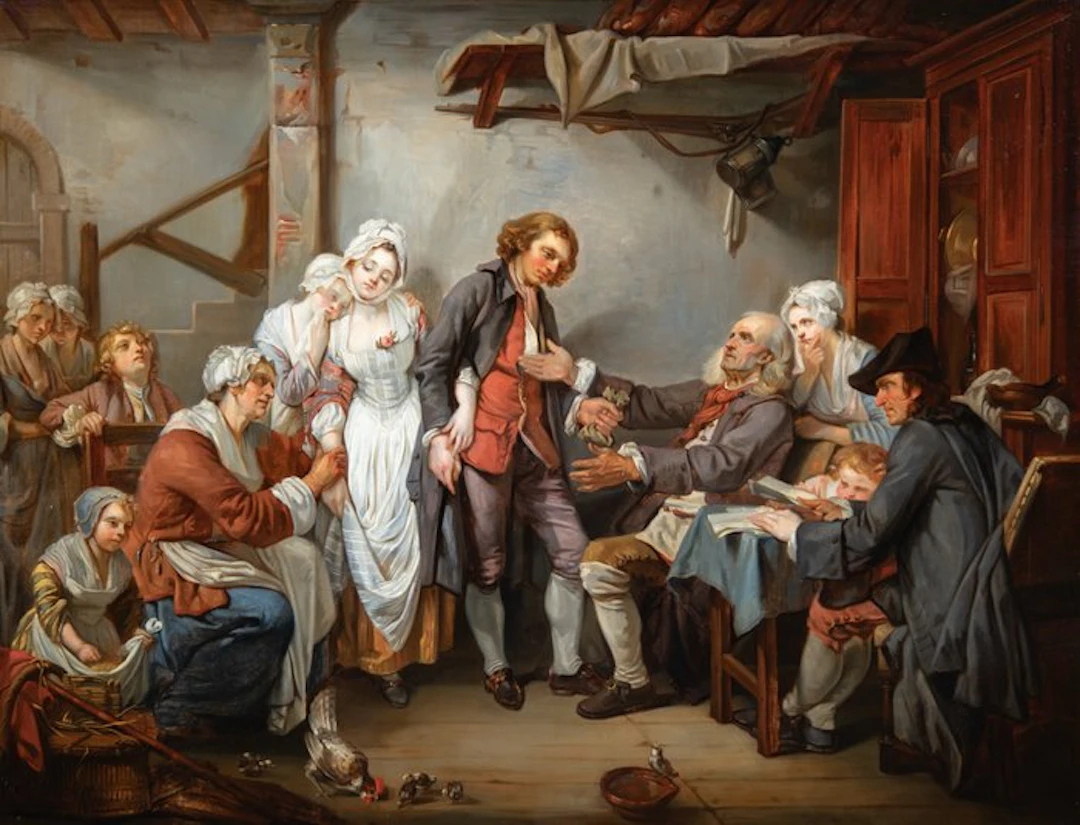
Artist: nineteenth-century follower of Jean-Baptiste Greuze (1725-1805) Title: L’Accordée de village Dating: probably mid-nineteenth century Technique: oil on canvas Dimensions: 90.5 x 119.5 cm Dimensions with frame: 110 x 137 cm Frame: gilded grand Rococo frame Rear: oval trade stamp of Haro Fils, Paris, with mention of the silver medal at the 1849 exhibition Delivered with Art Historical Research Report Jean-Baptiste Greuze and the compositional model Jean-Baptiste Greuze, born in Tournus in 1725 and died in Paris in 1805, is among the leading representatives of the narrative genre scene in eighteenth-century French painting. After training in Lyon and Paris, he gained fame from the Salon of 1755 with domestic scenes in which gesture, facial expression and interpersonal relations carry the action. His paintings connect daily life with themes such as education, parental responsibility and familial solidarity. This painting follows L’Accordée de village, the work Greuze presented at the Paris Salon in 1761 and which is now housed in the Louvre. The original measures 92 x 117 cm. The current copy approaches that original size. The scene depicts the moment when the father hands over the dowry to his future son-in-law. The extensive discussion by Denis Diderot testifies to the attention the work attracted at its first presentation. Object description In a rural interior, a family has gathered around a young couple. The groom stands opposite the seated father, who addresses him with a telling gesture. The money pouch in the young man’s hand refers to the transfer of the dowry. On the left stands the bride in light clothing, with lowered gaze and an arm along that of her future husband. Her mother holds her, while a sister rests her head on her shoulder. To the right sits the notary, dressed in a dark cloak and wearing a black hat, at a table with the papers of the marriage contract. Other family members and children follow the event. The stairs, the column, the wooden sideboard and the elevated storage space define the simple interior. In the foreground are a hen with chicks, a feeding dish and household objects. The copy preserves the full group of figures and the orientation of Greuze’s composition. Composition and painting method The figures form a continuous group around the encounter between the father and the groom. Glances and hand gestures link the characters and guide attention to the central act. The bride’s light clothing provides a bright accent among the warm reddish-brown and subdued gray clothing parts. On the right, the dark cloak of the notary adds weight to the composition, while the stairs on the left and the elevated storage space above frame the group spatially. The execution focuses on a recognizable rendering of the whole scene, with particular attention to faces, hands, folds of clothing and interior details. The nearly original size preserves the scale and narrative coherence of the example. Stylistic and art-historical context L’Accordée de village fuses a rural family scene with the severity of a morally charged tale. The financial arrangement surrounding the marriage is made visible by the dowry and the presence of the notary, but the emotional relationships between family members determine the character of the scene. Greuze gives daily life the weight of a history painting. The composition was also disseminated through prints, including an engraving by Jean Jacques Flipart from 1770. The current painted copy belongs to the later continuation of this famous image. It reproduces a specific composition of Greuze; the designation “navolger naar Greuze” (copy after Greuze) here refers to the dependency on this exemplar. Haro stamp and historical documentation The reverse bears the oval trade stamp of the Parisian firm Haro Fils, with the trade name Au Génie des Arts and the address Rue des Petits-Augustins 18. The text mentions the supply of fine painter’s pigments, the restoration of paintings, and a new system for prepared canvases intended to resist moisture. The inscription “Exposition de 1849, Médaille d’Argent” refers to the supplier’s material award. In the official jury report of the Paris agricultural and industrial products exhibition of 1849, Étienne-François Haro was awarded a silver medal for his prepared painting canvases. The jury praised their pliability, sturdiness and intended moisture resistance; his varnish was also favorably rated. The official catalog of the London Great Exhibition of 1851 mentions Haro at the address number 18 that appears on the stamp. This documentation supports the dating of the canvas to the mid-nineteenth century in its material context. The year 1849 concerns the medal and does not establish a separate painting date. No documentation of a prize or exhibition participation for this copy exists. Technique, condition and frame Oil on canvas. Localized thin painting. Under UV light there are a few very minor retouchings visible. The painting was cleaned in 2026 and given a new final layer of varnish. The work is housed in a gilded grand Rococo frame. Total dimensions with frame: 110 x 137 cm. Conclusion A nineteenth-century painted copy after Greuze’s L’Accordée de village, executed at almost the original size and preserving the full composition. The Haro stamp provides a concrete link to the historical material provenance. The silver medal of 1849 mentioned therein is corroborated in the original jury report. The painting is presumably dated to around the middle of the nineteenth century. The work "L'Accordée de village" is housed in a gilded grand antique wooden frame with plaster decorations Total dimensions: 110x137 cm Medium dimensions: 90.5x119.5 cm All shipping in professional packaging via DHL For all shipments, a surcharge for packaging material applies, which is already included in the listed shipping price. The customer is responsible for any import duties and additional costs that may apply when delivering abroad. Shipping artworks always carries certain risks. Although shipping is possible, we recommend collecting the artwork in person when this option is available. If shipping is chosen, it is entirely at the buyer’s risk. Picking up offers the certainty that the work is received undamaged and in optimal condition. After purchase, you can easily schedule a pick-up appointment at our workshop and studio, where it will be prepared safely and carefully for you. Transport Quote request via our website (Service-transport) or via Catawiki support When purchasing this artwork you have the option to have it delivered with or without the frame. The frame, richly decorated and matching the work, is offered free of charge so you can hang the painting immediately. While we take the utmost care with professional packaging and shipping, there is a small risk of damage to the frame or glass during transport. Any damage to the frame or glass that does not affect the artwork itself is not accepted as valid grounds for a claim or cancellation. We recommend collecting the work or arranging your own transport, as frame damage, especially to the plaster ornaments, will not be compensated. We strive to deliver your artwork safely and in optimal condition, paying careful attention to packaging and shipping procedures. For questions or special requests you can always contact Catawiki customer service. From the moment your purchase is confirmed, we treat each shipment as an individual project. Each painting is carefully packed with high-quality, professional shipping materials and we select the most suitable carrier based on destination, transit time and handling requirements. We track every package closely until delivery is completed. Because no two artworks are the same, we often create customized, handmade shipping crates or boxes tailored to the size, frame and fragility of the painting, as well as the distance and transport conditions to your address. This guarantees the best possible protection throughout the journey. To support a smooth international shipping process, we prepare the proper paperwork and shipping documentation, including customs codes and export-related information if needed. In some cases we proactively contact you to confirm that your package has arrived safely, that the painting is in good condition and to answer any questions you may have. We usually call the phone number provided to Catawiki, and this call will be in English. If preferred, you can also reach us by email or via the Catawiki chat.
Estimate:$5,056.72
To the auctionView all items fromCatawikiorArts & Graphics
Estimate:
$5,056.72
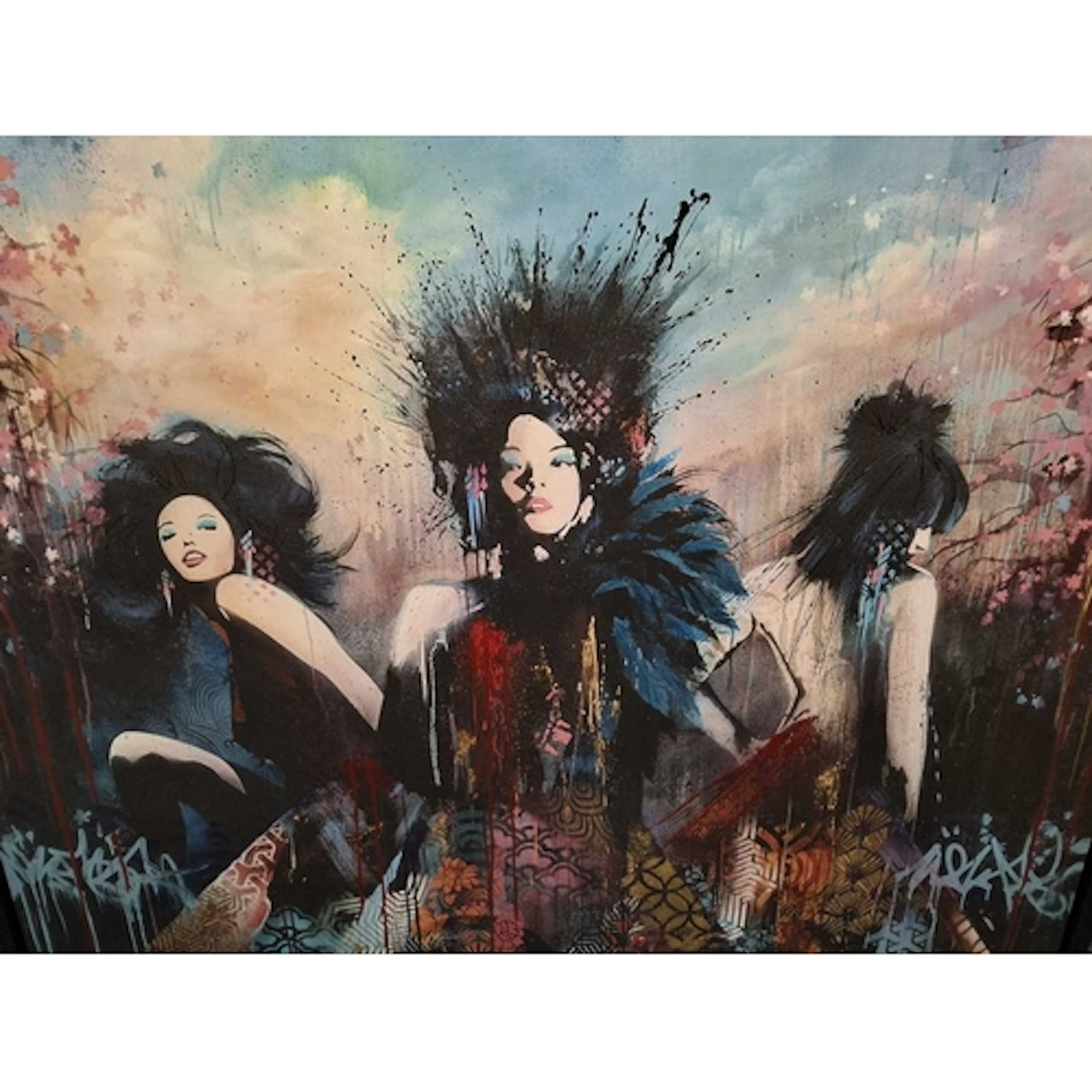
'TRINITY' A LARGE LIMITED EDITION BOX CANVAS, a striking, la...
09/07/2026

$94.81
Est: $135.13




OCT 27 | 4:00 PM
Bring your auction to collectors worldwide!
Get listed nowBy subscribing, you are agreeing to the privacy policy. Unsubscribe anytime.
Barnebys HQ
Brahegatan 10
BOX 5038
114 37 Stockholm
