

OCT 8 | 3:00 PM

Bring your auction to collectors worldwide!
Get listed nowBy subscribing, you are agreeing to the privacy policy. Unsubscribe anytime.
Barnebys HQ
Brahegatan 10
BOX 5038
114 37 Stockholm
All auctions / Miscellaneous / Hilaire (Hil.) Vanbiervliet (1890 - 1981) - Dorp in de sneeuw

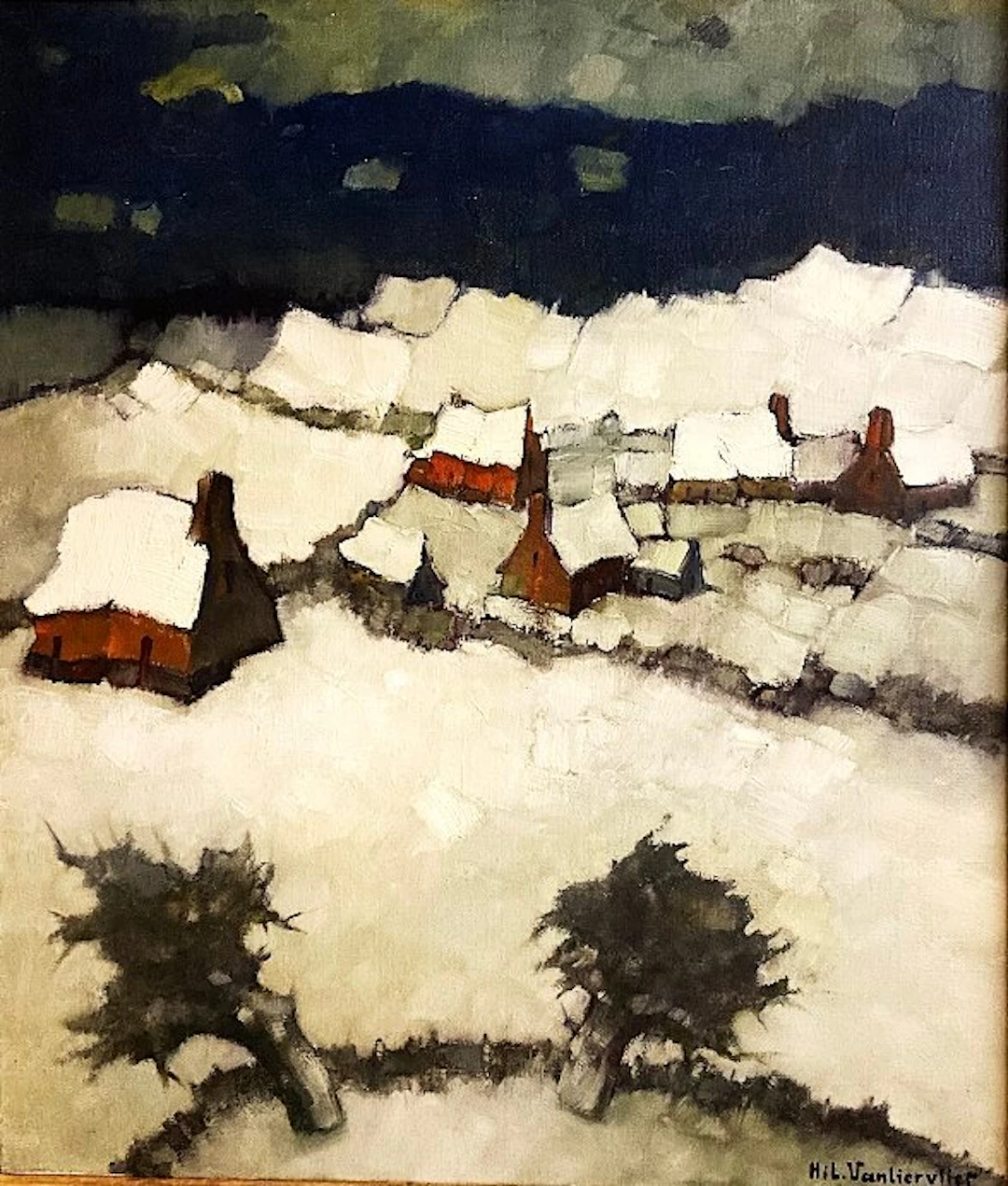
This is a beautiful painting by the Flemish artist Hilaire Vanbiervliet. It is in perfect condition and painted on a nice size (60x70 cm). His works belong to Flemish expressionism. The winter scene exudes an breathtaking stillness. The village seems as if painted from a hill, in the midst of the Flemish Ardennes, which greatly enhances the panorama of the landscape. Notable is the deep blue sky behind the snow clouds. The two striking pollarded willows in front are typical of his style and add extra depth. These appear in the same form regularly in other of his works. A painting for genuine lovers of the genre and this painter. About Hilaire Vanbiervliet (source: the website hilaire-vanbiervliet(dot)com) Hilaire Vanbiervliet was born on October 29, 1890, in Kortrijk, Belgium. From his fourteenth year he attended evening classes at the Municipal Academy. The teachers were Emmanuel Viérin, Edouard Messeyne and Albert Caullet. He won eight first prizes, five times the city medal, and the Grand Prix d’Honneur of the state for painting. In 1909 and 1910 he won the golden medal twice in the National Competition for Art and Decoration. He was surrounded there by Albert Saverijs, Frans Masereel, Jules Boulez, Albert Claeys and Evarist de Buck. From 1909 he first took decorative arts courses at the Royal Academy, then life painting and painting at the Higher Institute Ghent under the guidance of Jan Delvin and Georges Minne, up to 1914, the beginning of the First World War. Forced to go to the front, he had to give up his artistic training. The war deeply troubled and disoriented the ambitious young artist, and in 1918, at the age of 28, he decided to return for a few months to Ghent to recover. After becoming independent, he first ventured into the Impressionist movement, but the superficiality of Pointillism no longer satisfied him. He later called that period a waste of time. The young Vanbiervliet felt a strong attraction to religious themes. This genre freed him from the Pointillist process. In this way, he became an active member of the Pelgrims, a religious painters’ group from Antwerp, in 1921, with whom he regularly exhibited and achieved great successes. It was at the same time that his first landscapes appeared. They sensitively reflected the Flanders of his youth, his miserable dwellings and his labor-distorted farmers. His vision and personal style drew attention during his early exhibitions. Without joining the experimentalists, Vanbiervliet remained true to himself and created a very personal genre, whose content is characterized by social inspiration in a natural environment. The evolution toward a completely personal view of the Flemish landscape is not only due to his own attitude and philosophy, but is also influenced and inspired by two attractive places where he often came to paint and to meet his friends and family: Tiegem and Normandy. There he discovered a panoramic view and endless horizons that seemed to fit a dynamic atmosphere. There he also discovered the green slopes where the shining plots rolled in an abstract composition. Thus his vision of the landscape grows, where all elements: trees, fields and houses lie over one another with an expressionist force. The country houses: “Maene Min” and “Zonneweelde,” on the Tiegemkam and owned by the Colardijn brothers, were the two observation posts from which he looked for years and did so at a rate of five times per week, viewing the world panoramically. In 1932 Vanbiervliet had the idea to found a provincial association for visual arts with his friends Firmin and Lieven Colardyn; All three formed the Kortrijk modernist group of painters. They founded the West Flemish Art Group, later renamed West Flemish Art Circle. This is how he felt its essence most deeply. Another residence that added several components to this vision and to these typical landscapes is the beautiful Normandy, where, since his marriage in 1919, he spent several weeks a year exploring the region with his canvas and his brush. Later, his houses and trees became a synthesis of what he had often contemplated and enjoyed, both in Flanders and in Normandy. The climate, the cloudy sky and the diffuse light projected onto the two landscapes by a hazy sun offer many similarities. Originally he processed shading in his compositions to arrive at an acceptable result of what he saw, without being exuberant. Large elements in the foreground are often backlit. The focus then falls on a small part, the place of concentration, which lies behind or next to the dominant elements. Each canvas is drenched in mystical quiet, an atmosphere of vague intimacy, a melancholic poetry, a kind of religious experiment of suppressed pleasure in the face of this grandeur, this imposing miracle of life that arrives every day to dominate our human smallness. Later, around the sixties, these subdued colors gradually evolved into ardent lyricism. In every landscape we felt the presence of a fierce sun, a kind of enthusiastic optimism for the grandeur that nature offers us. We can attribute this to the evolution of mentality and the maturity of the soul of a happy man, of an artist grateful for all the beauty life offers. The same warmth is found in his snowy landscapes as well, something otherworldly that pierces reality and where the helpless small person finds a safe haven. Vanbiervliet did not paint the winter field, nor the storms bending the bare branches of trees; nor did he paint suffering figures. On the contrary, he painted winters that are gentle for the poor, those who draw the most attention in his works: sturdy beings, but tired and worn, with bent backs, slumped shoulders, whose legs look as if they are made of wood. They drag themselves to other tasks with heavy hooves. Their skeletal faces are tired from life and express indifference under ill-fitting hats. The women, under their long skirts and heavy shawls, walk hunched over, stumbling under the heavy burden of a hard life. It shows us both the strong woman who cannot afford to give up and the farmer who lives by the rhythm of the land and the seasons and becomes a machine that endures her painful existence. Often we also see the child in a miserable surroundings, the shrunken model of these great beings, dependent on and clinging to the adult in such a way that it forms a unitary block of misfortune. Hilaire Vanbiervliet aims to be far from aggressive. On the contrary, he is very sensitive to tormented faces and wants to show them to the well-to-do. He does not judge anything in his work and does not ask for mercy. It testifies to a period not far behind us and brings these images as food for thought; from these elements we discover a religious painter. The deeply rooted religious conviction of Hilaire Vanbiervliet pervades all his work. It is not only in the pure and Biblical religious theme, where the figure of Christ plays a major role throughout his career, that we find this conviction, but also in his secular subjects, his miserable characters and his expressionist heads. It is difficult to place Vanbiervliet into one school or another; he is unique in his style, vision and diversity. A delicate mysticism, a dream hangs over his landscapes and his religious figures; the figures and heads reflect the character of a tempered expressionist painter, who can express the typical element of inner emotion directly with force and volume. Beyond this imaginary and capricious world, the painter evokes demonic characters, nightmares to symbolize situations in society or human behavior and thereby draw attention. All this reflects his strong personality and extensive technical background, earning him recognition from the press and the public. Between the time when he, as a beginner, earned five medals at the Kortrijk Academy, and the period spent in Ghent obtaining the State Medal and, on the other hand, the great French decoration he received on Sunday, May 6, 1973, for his oeuvre, from Marcel Achard, chairman of the jury, a lifetime passed. In 1956 he was selected for the circular exhibition “Art Flamand” in the former Belgian Congo. Besides numerous individual exhibitions across Flanders, he was also selected for group exhibitions in Paris, Lille, Arras, Tourcoing, Béthune, Eindhoven and Bad Godesberg. The honor due to him was paid in 1970 on his 80th birthday by the city of Kortrijk. In honor of the painter, an exhibition was organized in the Fumoir of the Stadsschouwburg. Various government agencies have, over the years, expressed their approval and appreciation by purchasing one or more of his paintings. These include the Belgian Provincial Museum of Modern Art and the cities of Kortrijk, Bruges, Harelbeke, Zottegem and Roeselare. Hilaire Vanbiervliet died 40 years ago on November 8, 1981. Hilaire Vanbiervliet was an extremely productive artist throughout his long life; many paintings are now dispersed, mainly in Belgium, but also in France, especially in Normandy, where part of his family lives and has illuminated his work. He remained artistically active until the end of his life and true to his creative vision: “Art without spiritual depth is too material to be true art.”
Estimate:$253.17
To the auctionView all items fromCatawikiorMiscellaneous
Estimate:
$253.17
OCT 8 | 3:00 PM


OCT 8 | 3:00 PM

Bring your auction to collectors worldwide!
Get listed now$833.22