



OCT 8 | 3:00 PM

Bring your auction to collectors worldwide!
Get listed nowBy subscribing, you are agreeing to the privacy policy. Unsubscribe anytime.
Barnebys HQ
Brahegatan 10
BOX 5038
114 37 Stockholm
All auctions / Books, Maps & Manuscripts / G. Nanni - Antiquitatum Variarum Autres - 1560

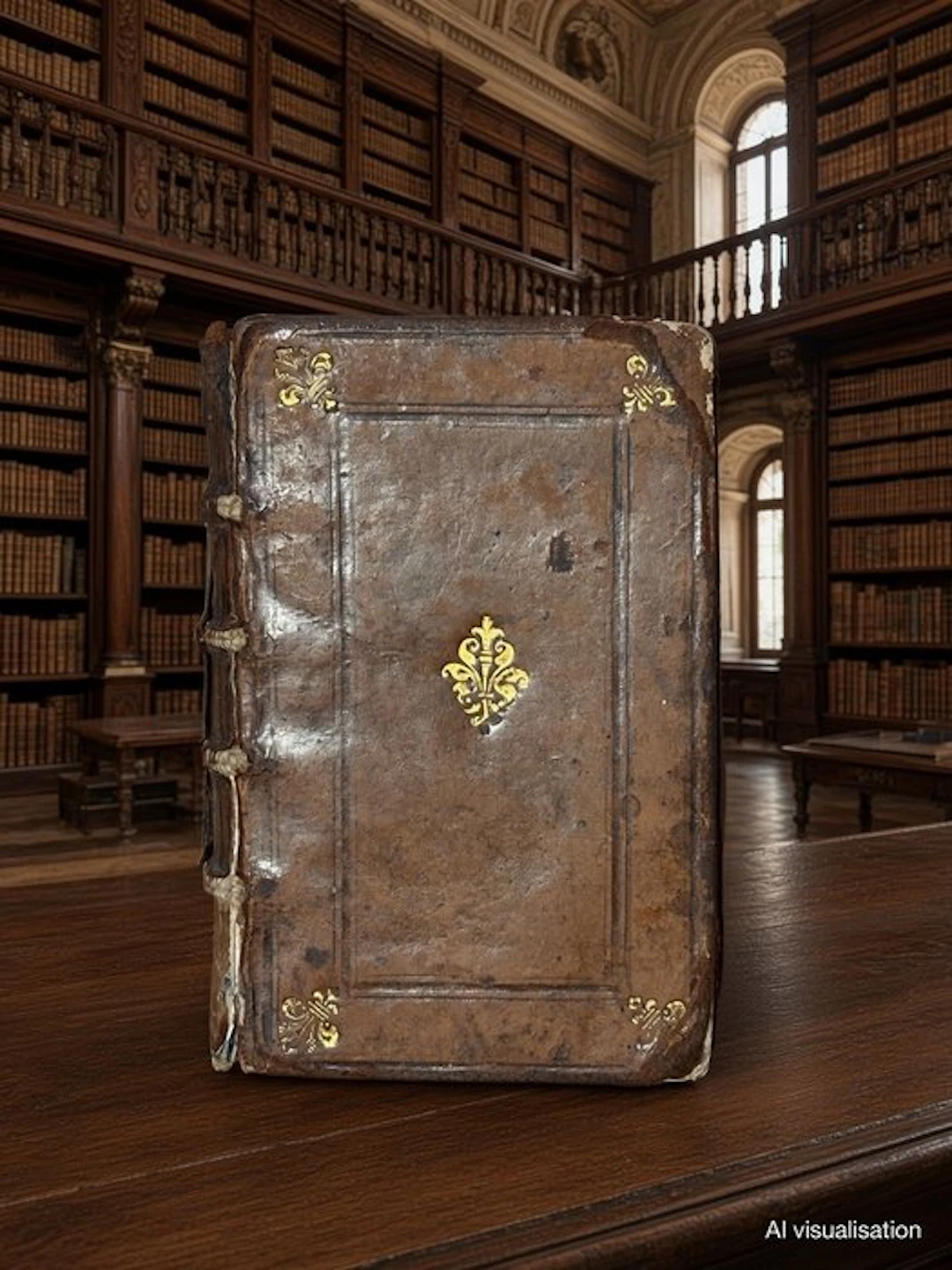
The author (or rather, the authors) This is not the work of a single writer, but a collection of ancient and pseudo-ancient texts devoted to antiquities. The catalog at the beginning lists, among others: Myrsilus of Lesbos (De origine Italiae & Tyrrhenorum) Marco Porcio Catone (Originum) Archilocus (De temporibus) Beroso of Babylon (Antiquitatum) Manetho (De regibus Aegyptiorum) Quintus Fabius Pictor, Sempronius, Solinus, Pomponius Mela, Pomponius Leto, Fenestella and others. Many of these “fragments” are not authentic. The collection largely derives from falsifications elaborated at the end of the fifteenth century by Giovanni Nanni (better known as Annio da Viterbo, 1432-1502), a Dominican scholar-forger who invented entire corpora of ancient authors to glorify Etruscan and Italic origins and to rival Grecian and biblical traditions. The printer The 1560 edition bears the imprint of the heirs of Sébastien Gryphe (Sebastian Gryphius, 1493/94–1556), one of the most important humanist printers of the sixteenth century. Born in Reutlingen, Gryphe trained in Germany and in Venice before settling in Lyon, becoming the city’s most prolific publisher. He printed over 1,300 editions, privileging classical, humanist, and scholastic texts. He was a friend and printer of François Rabelais and published numerous works by Erasmus. Upon his death (1556) the workshop passed to his illegitimate son Antoine Gryphe, who continued to use the famous griffin printer’s mark with the Ciceroan motto Virtute duce, comite fortuna (“With virtue as guide and fortune as companion”). The 1560 edition falls squarely into this phase of continuity under the formula “Apud Haered. Seb. Gryphii.” Historical context and connections The work sits squarely in the height of Renaissance antiquarian culture, in an era when Europe sought in remote origins the legitimation of its nations and dynasties. Annio da Viterbo had published his forgeries in 1498 (Commentaria super opera diversorum auctorum de antiquitatibus). Despite criticisms (already Erasmus and later the seventeenth-century scholars showed its spurious nature), these texts circulated widely throughout the sixteenth century because they answered a political and cultural need: to give Italy (and especially Etruria) a glorious past independent of Greece and Rome. The collection also includes authentic or semi-authentic texts (Pomponius Mela on geography, Fenestella on Roman magistrates, Pomponius Leto on urban antiquities), placed in a mosaic that mixed truth and falsehood. Lyon, in 1560, was still one of Europe’s book capitals, at a moment of religious tension (the French Wars of Religion were looming) and of intense cultural exchange with Italy and the Netherlands. People and episodes linked: Annio da Viterbo and the papal court of Alexander VI Borgia, who had supported his “discoveries.” The Italian humanists (Pomponius Leto and the Roman Academy) who rekindled interest in Roman antiquities. The great Lyonese printing era, which acted as a bridge between Italy and Northern Europe. Meaning of the work Antiquitatum Variarum Autores represents a typical product of sixteenth-century antiquarian curiosity: a small pocket volume (in-16°) intended for scholars and cultivated readers who wished to have at hand the “sources” on the origins of peoples, ancient geography, and Roman institutions. Even though we now know that much of the material is spurious, at the time these pages fed national stories, princely genealogies, and reflections on the past. They also constitute a valuable witness to how, between the Quattrocento and the Cinquecento, historical memory was constructed (and sometimes invented). Conclusion Printed in Lyon in 1560 by the heirs of one of Europe’s greatest humanist printers, Antiquitatum Variarum Autores is emblematic of the Renaissance: a crossroads between philology, erudite forgery, antiquarian passion, and the printing industry. It still today holds the charm of a era that, in its attempt to rediscover the ancient, ended up reinventing it. Collation and state of preservation 1pp, (928pp) Excellent state of preservation, binding in armorials with contemporaneous gilt borders, a specimen of great collector’s rarity Shipping express delivery in 24h working days across Europe and 48 working days for non-EU countries
Estimate:$450.09
To the auctionView all items fromCatawikiorBooks, Maps & Manuscripts
Estimate:
$450.09
OCT 8 | 3:00 PM

OCT 17 | 10:00 PM

Bring your auction to collectors worldwide!
Get listed now$350.62



OCT 8 | 3:00 PM