


Bring your auction to collectors worldwide!
Get listed nowBy subscribing, you are agreeing to the privacy policy. Unsubscribe anytime.
Barnebys HQ
Brahegatan 10
BOX 5038
114 37 Stockholm
All auctions / Books, Maps & Manuscripts / Freminville Original Watercolor of a fish, the Galápagos hogfish

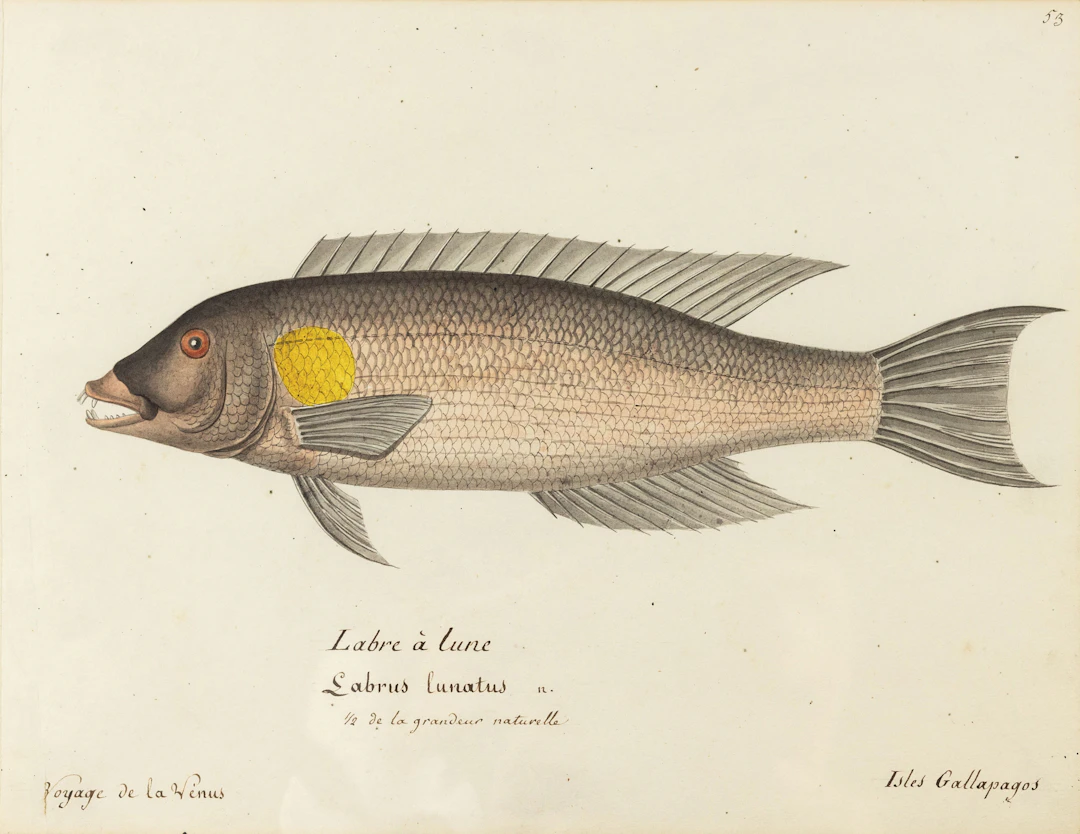
De FREMINVILLE, Christophe Paulin de la Poix (French, 1787-1848). Labre a lune Labrus lunatus 1/2 de la grandeur naturelle Voyage de la Venus Isles Gallapagos. [Fish species 1/2 lifesize Voyage on the Venus Galapagos Islands]. Likeliest identity is Bodianus eclancheri, the harlequin wrasse or Galápagos hogfish. Watercolor, graphite, and ink on paper. Inscribed ‘Labre a lune Labrus lunatus n./ 1/2 de la grandeur naturelle’ at center, ‘Voyage de la Venus’ lower left, and ‘Isles Gallapagos’ lower right. Numbered ‘53’ upper right. Ca. 1839 to 1847. 12" x 17 1/2" sheet. “Labre à lune, Labrus lunatus” is a Fréminville manuscript name, the “moon wrasse,” for that clean yellow disc behind the head. The likeliest identity is Bodianus eclancheri, the harlequin wrasse or Galápagos hogfish. Valenciennes described it in 1846, and the species epithet honors Léclancher, the Vénus’s own surgeon, which ties the drawing directly to this voyage’s collections. Adults range from uniform dark gray or brown to bright orange or white, with a highly irregular and variable pattern of blotching, and essentially every individual is uniquely colored. A single crisp yellow patch on an otherwise gray fish is entirely within that range, and it explains why a nineteenth-century naturalist meeting one specimen might reasonably think he had something new. This species is found in the Galápagos among rocky reefs in the cooler western waters around Isabela and Fernandina, a lineage originating in the Peru-Chile province rather than the tropics. Two watercolors of fish from the Voyage of the Venus, at the intersection of French naval science and early Galápagos natural history. Ichthyology images from the Voyage de Venus mission to the Galápagos are significant because they are among the very earliest scientific samplings of Galápagos reef fishes, essentially contemporaneous with Darwin’s. The frigate Vénus left Brest, France, in late 1836 under the command of Abel Aubert Dupetit-Thouars and returned in June 1839. On board were the hydrographer Urbain Dortet de Tessan, the doctor-naturalist Adolphe Simon Neboux, and the surgeon Charles René Augustin Léclancher. Despite what we know of the voyage today, their mission was not scientific; it was commercial. The voyage aimed to protect and expand French whaling in the Pacific and gather intelligence on commercial opportunities in Russian Kamchatka, Mexico, and California. The Venus reached the Galápagos from Payta in June 1838 and stayed about three weeks. Dupetit-Thouars visited Floreana on June 22, 1838, and Nicholas Lawson took him to the struggling penal colony there; Lawson had told Darwin three years earlier that he could identify which island a tortoise came from by its shell. The Vénus sailed for the Marquesas on July 15.[1] While the Beagle had been in the archipelago in late 1835, Leonard Jenyns’s account of Darwin’s fishes did not appear until 1840 to 1842. Then, in 1846, Achille Valenciennes published the ichthyology in the expedition’s Atlas de Zoologie (Zoological Atlas).[2] Fréminville was not on the Vénus. He sailed from 1818 to 1827 on the Rhône, the Néréide, the Bonite, and the Adour, in the Baltic, off West Africa, and to both Americas, repeatedly and unsuccessfully petitioning for command of a voyage of discovery around the world. He then retired to Brest and devoted himself entirely to natural history and archaeology until his death there on January 12, 1848. These drawings are almost certainly studio work, made in Brest from specimens, notes, or field sketches that came home with the Vénus. This fits a broader pattern in his surviving corpus, which includes sheets labeled for expeditions he never joined, including d’Entrecasteaux’s voyage, the Héroïne, and Vanikoro. His watercolors are best understood as a private, unpublished visual encyclopedia assembled by an ambitious naturalist working from mission field notes or base sketches. Fréminville was simultaneously a naval officer, Celtomane, Freemason, romantic, and pioneering archaeologist of Lower Brittany.
Estimate:$3,000
To the auctionView all items fromArader GalleriesorBooks, Maps & Manuscripts
Estimate:
$3,000


Bring your auction to collectors worldwide!
Get listed now

OBUYOSHI ARAKIS "THEATER OF LOVE" I FÖRSTA UPPLAGAN, 2011.
09/28/2026
$45.02
Est: $40.26