


NOV 8 | 1:00 PM

All auctions / Miscellaneous / Domenico Fedeli

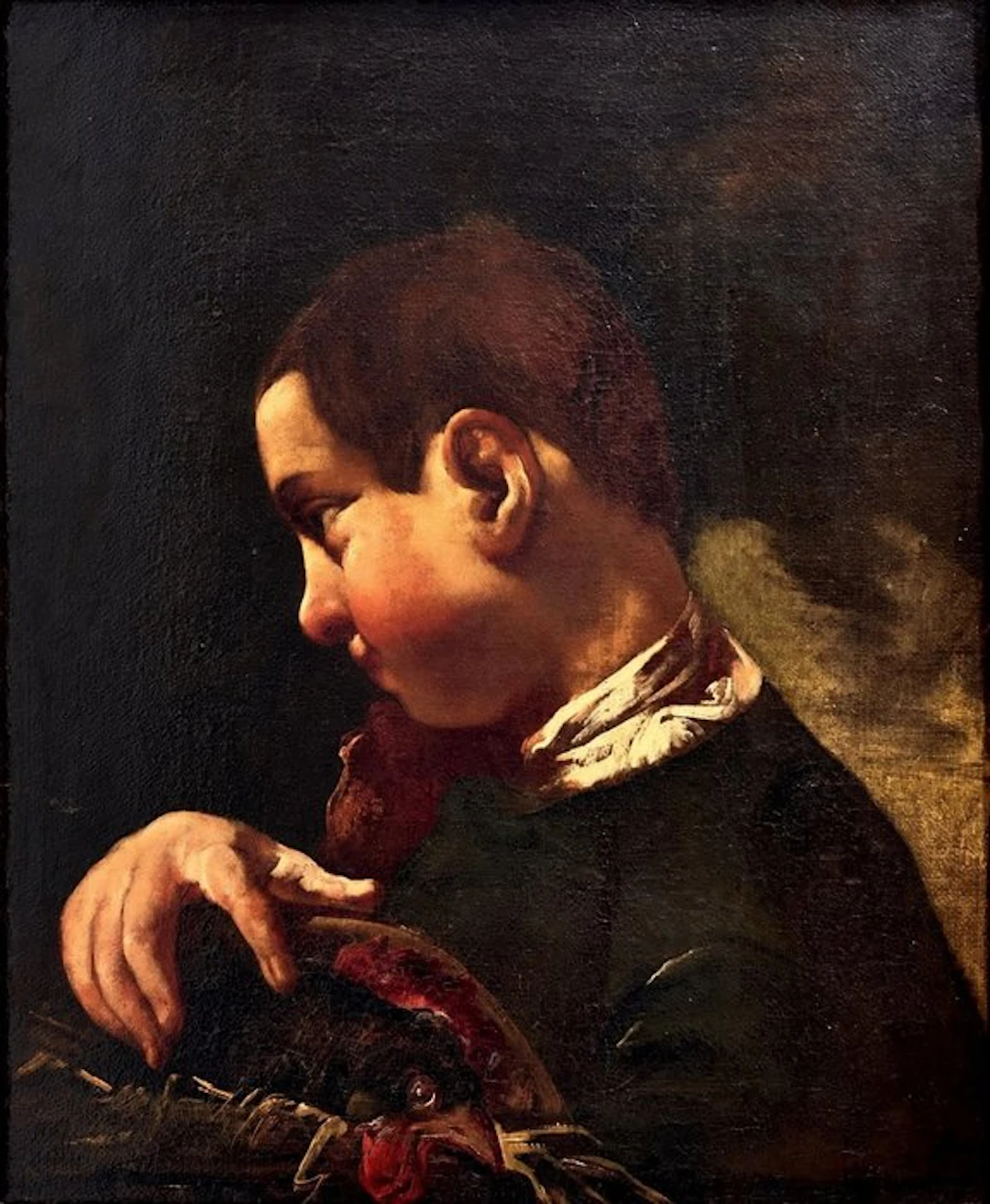
Domenico Fedeli, called the Maggiotto (attested also as Magiotto or Majotto; Venice, 1712 – Venice, April 16, 1794) “Young Man with a Rooster” dated between 1740 and 1750 Oil on canvas Description of the work The painting depicts a young man half-length, in profile to the left, caught in a moment of composed concentration. The head is slightly inclined and the gaze is directed toward the rooster, on which the hand rests with a measured gesture. The composition is built through a decisive chiaroscuro: the figure emerges from a dark brown-black indistinct background, while a warm, concentrated light falls on the forehead, the profile of the face, the cheek, the ear, the collar and the hand. The face is modeled through gradual transitions from shadow to light. The full cheek, the clearly defined nose and the lowered eye give the protagonist a contemplative, intimate character. The hand constitutes the second important luminous focal point of the composition and introduces, together with the presence of the animal, a narrative component typical of genre painting. The palette is restrained and dominated by browns, earth tones, blacks and deep reds, enlivened by the illuminated areas of the skin and the white of the collar. Historical-artistic framing The work belongs to the Venetian pictorial culture of the mid-18th century and presents characteristics coherent with the production of Domenico Fedeli called the Maggiotto, a painter who trained in the studio of Giovanni Battista Piazzetta. Biographical documentation testifies to the long relationship with Piazzetta and identifies in Maggiotto’s early maturity, between 1740 and 1754, a phase of faithful adherence to the maestro’s lexicon, with particular attention to half-figures, genre subjects and concentrated chiaroscuro. In this phase Maggiotto assimilates the plasticity of Piazzetta’s figures, the emergence of figures from dark backgrounds and the preference for young people and isolated popular characters, often translating these models into a more narrative and everyday dimension. Reasons for attribution The proposal of the name Domenico Maggiotto rests on the convergence of several elements. The protagonist’s typology — broad head, full face, stout cheek, lowered eye, robust neck — appears consistent with the artist’s repertoire of youthful half-figures. Equally significant is the lighting design: the light selects the face, ear, collar and hand, leaving the rest of the figure progressively absorbed into the background. A particularly pertinent comparison is offered by Young Man with Medal in the National Gallery of Parma, a Maggiotto work dated 1740-1750. The Parma painting measures 46 x 40 cm, a nearly coincident format with the 47 x 38 cm of the work examined here, and belongs to the same culture of youthful half-figures derived from Piazzetta’s prototypes. The closeness of format does not by itself constitute proof of autograph authenticity, but it reinforces the relevance of the typological and chronological comparison. The presence of the rooster also introduces a fully compatible genre component with Maggiotto’s activity, as he produced numerous everyday, pastoral and half-figure subjects. In the painting, the construction of the hand, the definition of the ear, the chiaroscuro transition on the knuck e and the warm, earthy palette are the aspects that most strongly support the attribution. Conclusions In light of the stylistic, compositional and iconographic characteristics observable in the photographic documentation, the painting is proposed as a work by Domenico Fedeli called the Maggiotto, plausibly attributable to his early maturity phase, around 1740-1755, still strongly tied to the Piazzetta tradition. This expert report constitutes a historical-artistic proposal based on photographs. Direct examination of the painting’s surface and the back of the canvas, together with any UV, IR and radiographic investigations, is advisable to verify the condition, restorations and technical data and to further consolidate the attribution. The estimate is formulated in relation to the attribution proposal, the dimensions, the visible quality and the subject’s typology. It should be understood as an indicative market guide and may vary according to direct examination, conservation status, provenance, any specialist opinions and the sale context. Essential references E. Merkel, "Fedeli, Domenico, called the Maggiotto", Dizionario Biografico degli Italiani, vol. 45, Istituto dell'Enciclopedia Italiana, 1995. Complesso Monumentale della Pilotta, Galleria Nazionale di Parma, Domenico Fedeli called the Maggiotto, Young Man with Medal, 1740-1750. E. Merkel, Domenico Fedeli called the Maggiotto, in G.B. Piazzetta. Il suo tempo, la sua scuola, Venice, 1983, pp. F. Del Torre, "Per un catalogo di D. Maggiotto", Atti dell'Istituto Veneto di Scienze, Lettere ed Arti, CXLVI, pp. 87-112. Studio Arte Milano Historical-artistic Expertise BIOGRAPHY Domenico Maggiotto was the son of the boatman Sebastiano. He trained in the workshop of Giovanni Battista Piazzetta from the age of 10, becoming one of his best students[1]. Works dated between 1730 and 1750 reflect Piazzetta’s artistic expression, always depicting figures, such as the Boy with the Flute (1745) at Ca’ Rezzonico in Venice. The plasticity of the forms and the effects of chiaroscuro are the common and recurring elements in works from this period. On April 23, 1738 he married Elena Zuliani, with whom he had sons Francesco (who also became a painter adopting his father’s nickname as a surname) and Giuseppe Giovanni. The wife died on June 16, 1777. After 1754 he moved from the Santa Ternita area to the parish of San Giovanni in Bragora where he and his son Francesco were registered in the Confraternity of San Giovanni Battista and where Giovanni, the son, is said to have married. For this church he painted the canvas (lost) The Virgin, the Eternal, some cherubs and two angels and he restored Cima da Conegliano’s Baptism of Christ. This intervention drew much criticism, although numerous were the commissions for restoring works of art. From 1750 he joined the College of Painters and by 1756 became a member of the Venetian Academy of Painting and Sculpture, by invitation of the Tiepolo, where he held administrative posts and also served as master. At the death of his master, Maggiotto, morally unsettled by the loss of artistic guidance, developed a tendency that translates into art as an impersonal eclecticism. If in the altarpiece of Saint Nicholas the Bishop, Saint Leonard and Blessed Archangel Canetoli (1754) for the church of San Salvador, already sketched by Piazzetta, he forcibly repeats the maestro’s intonations albeit under the influence of Gaspare Diziani, in very clear tones he presents the altarpiece Jesus Child Appears to Saints Urban Pope, Anthony and Francis of Paola (1758-9) in the parish church of San Bartolomeo at Valnogaredo and the Miracle of Saint Spyridon for the Venetian Pietà; he also produced two Stations of the Cross, III and XII (1755), for Santa Maria del Giglio. He was nevertheless somewhat reluctant to undertake religious works, preferring genre painting. Shortly thereafter in Allegory of the Academy (circa 1762-63), now in the Galleries, he reveals a more academic tendency with significant influences of classicizing Roman taste. His artistic life can thus be divided into three distinct periods: the youth under Piazzetta’s school, the middle period during his maturity with an inability to pursue a personal artistic line, and the third, in old age, with a revival of youthful models in an Arcadian key. Oil on canvas in an authentic late 18th-century gold-to-mecca frame - measure: 60 x 52 cm Canvas: 47 x 38 cm (re-stretched) In good preservation with normal signs of aging, the frame also shows signs of wear. Work re-stretched Ideal for collecting and investment Note on the frame The work is presented within an important carved and gilded wooden frame from the 18th century, characterized by rich ornamentation with vegetal and decorative motifs running along the entire profile. The gilded surface shows abrasions, small losses and widespread traces of wear, consistent with age and with the natural handling of the artifact, which preserves an agreeable antique patina. The frame appears to be of good workmanship and particularly appropriate to the historical character of the painting. - The frame currently included is provided with the sale of the work as a courtesy. Any transport damage related solely to the frame cannot be the object of refund or dispute. Photographic note: Some images of the work were produced professionally with artificial lighting (studio spotlight) to better highlight the painting’s characteristics, material, chroma and conservation state. Colors and brightness may therefore vary slightly from viewing the work in natural or ambient light. With legally proven provenance - Expertise Professional packaging and insured shipping
Estimate:$4,490.59
To the auctionView all items fromCatawikiorMiscellaneous
Estimate:
$4,490.59
NOV 8 | 1:00 PM


OCT 31 | 4:00 PM

OCT 23 | 8:00 AM
Bring your auction to collectors worldwide!
Get listed nowBy subscribing, you are agreeing to the privacy policy. Unsubscribe anytime.
Barnebys HQ
Brahegatan 10
BOX 5038
114 37 Stockholm
