


NOV 8 | 1:00 PM

All auctions / Miscellaneous / Benedetto Musso (1835–1883), Attributed to - L’Annunciazione

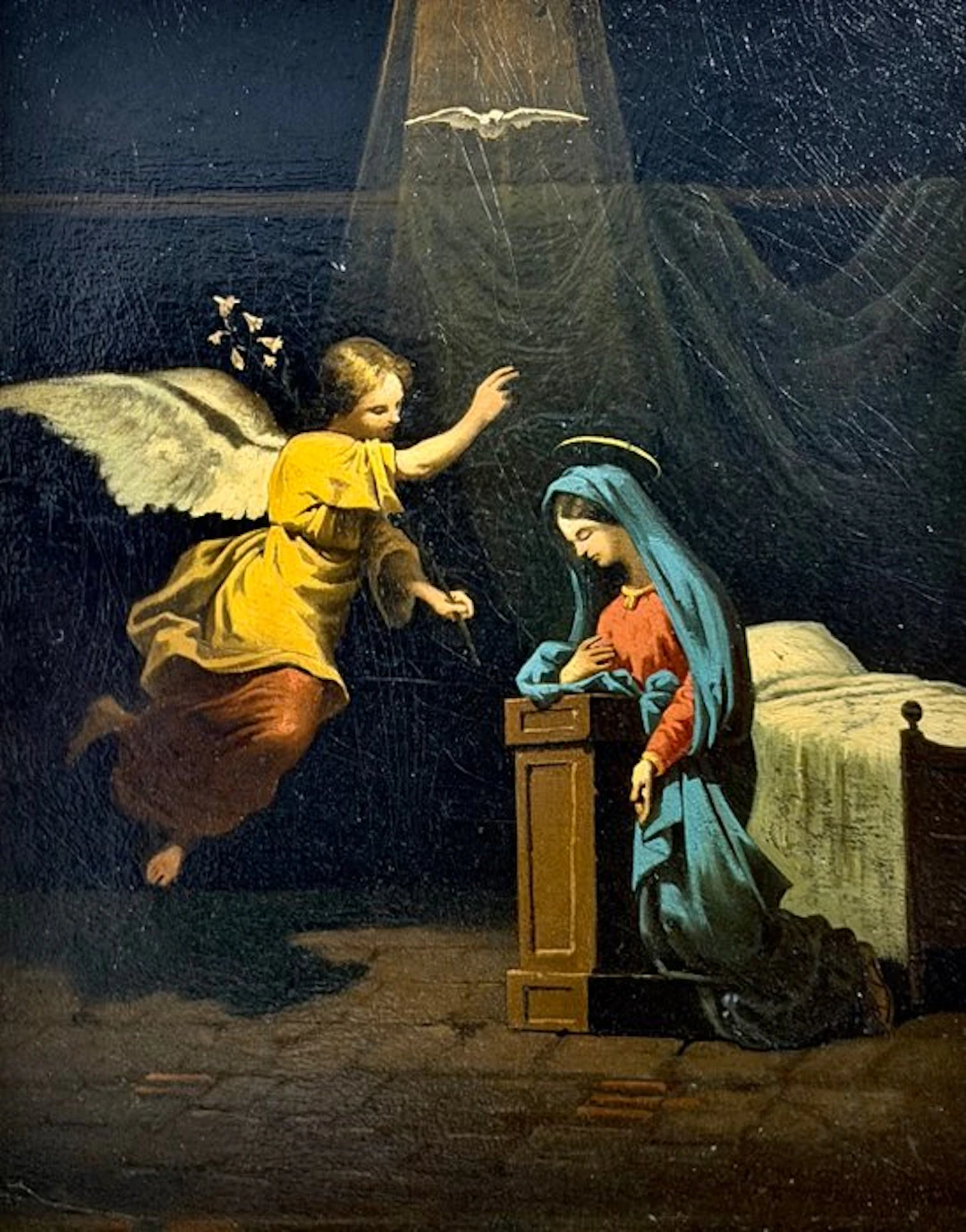
Benedetto Musso (Laigueglia, 1835 – 1883) “ The Annunciation ” Oil on cardboard 1850/1860 Dimensions: 43 x 37 cm in an accompanying frame 30 x 24 cm painting *** AN EXCEPTIONAL COLLECTOR’S OPPORTUNITY – NO RESERVE PRICE Magnolia Arte is pleased to present, in a completely exceptional manner and without any reserve price, this interesting work attributed to Benedetto Musso (1835–1883), offering collectors a particularly attractive opportunity. A painting of notable historical and artistic charm, expression of 19th-century Italian painting, which combines execution quality, compositional elegance, and collectible value. The absence of a reserve price represents a privileged chance to acquire a work of potential interest even from an investment perspective, under conditions determined solely by competition among bidders. An opportunity not to be overlooked for collectors, enthusiasts, and investors attentive to the market of antique and nineteenth-century art. The work depicts the moment of the Annunciation, one of the most significant episodes in Christian iconography, drawn from the Gospel of Luke (1, 26–38). The composition presents a gathered and intensely spiritual setting, in which the supernatural dimension manifests through the appearance of the Archangel Gabriel to the Virgin Mary, kneeling in a minimal domestic environment. The angel, shown flying on the left, wears a luminous yellow-gold tunic and a brown-reddish drapery. The raised right arm accompanies the gesture of the divine announcement, while the other hand supports a slender vegetal element, attributable to the traditional symbolism of the Annunciation. The Virgin, placed on the right, is depicted in an attitude of deep humility and contemplation. The head slightly inclined, the hand brought to the chest, and the lowered gaze express her acceptance of the divine will. Particularly interesting is the chromatic treatment of the Marian vestments, in which the red of the tunic contrasts with the intense blue of the mantle, according to a well-established iconographic tradition. At the top of the composition lies the dove of the Holy Spirit, bathed in a descending beam of light, an element that gives the scene a precise theological meaning. The setting, characterized by the bed in the background, dark drapery, and few architectural elements, emphasizes the intimate nature of the episode and allows the figures to emerge through a calibrated chiaroscuro contrast. 3. Stylistic analysis and attribution The painting shows characteristics attributable to the Italian figurative culture of the nineteenth century, with particular reference to academically oriented religious painting. The construction of the figures, the defined drawing, the distribution of drapery, and the use of relatively saturated colors highlight a painting sensitivity tied to the figurative tradition preceding it, reinterpreted through an nineteenth-century language. The composition preserves evident echoes of devotional painting from the Seicento (17th century) and the Settecento (18th century), especially in the selective lighting of the figures and the theatrical staging of the angelic appearance. The work could have been conceived as an autonomous devotional painting or as an nineteenth-century interpretation of an iconographic model preceding it. Artist biographical note Benedetto Musso was born in Laigueglia in 1835 and died in the same town in 1883. Initially trained under his father Giuseppe, he continued his studies at the Accademia Ligustica di Belle Arti di Genova, where he studied under Giuseppe Isola. His early production reflected his academic formation, showing interest in historic, literary, and religious painting. Subsequently, he approached the naturalistic researches of the Ligurian Scuola Grigia, distinguishing himself by an attention to light and tonal values. He participated in the exhibitions of the Società Promotrice di Belle Arti di Genova from 1864 to 1882.  It is particularly significant, for comparison with the examined painting, that the Catalogo generale dei Beni Culturali documents religious works by Musso, including the Sacro Cuore di Maria of 1865 and Cristo e la Samaritana. These precedents confirm that sacred painting indeed fell within his production. Condition report Preliminary examination: Support: The work is executed on cardboard. Paint surface: A widespread and fine network of cracks is visible, particularly noticeable in the dark background fields and in the drapery. There are also slight abrasions and surface marks compatible with the aging of the work. General conditions: signs of time and defects consistent with the period of the work With certificate of sale and legitimate provenance Note regarding the frame: The frame is provided free of charge as a courtesy, and therefore does not contribute to determining the economic value of the work. Given its nature, age, and particular delicacy, during transport there may be small breaks, detachments, abrasions, or losses of material. Any damage to the frame during shipping cannot therefore be a basis for dispute, refund, or compensation, as the sale concerns solely the painting.
Estimate:$561.66
To the auctionView all items fromCatawikiorMiscellaneous
Estimate:
$561.66

NOV 8 | 1:00 PM


OCT 31 | 4:00 PM


OCT 27 | 4:00 PM
Bring your auction to collectors worldwide!
Get listed nowBy subscribing, you are agreeing to the privacy policy. Unsubscribe anytime.
Barnebys HQ
Brahegatan 10
BOX 5038
114 37 Stockholm
