




All auctions / Ancient Art / Ancient Roman, Empire Bronze Seated Jupiter (Zeus) Bronze Sculpture - 9 cm


Seated Jupiter — Exceptional Roman bronze statuette Roman Empire — 1st century AD Sculptural representation of Jupiter (Zeus), supreme deity of the Roman pantheon, seated. * Culture: Roman. * Period: 1st century AD (proposed dating). * Identification: Seated Jupiter, iconographic attribution. * Material: Bronze with green, brown, and ochre patina. * Technique: Bronze casting, with finely refined modeling and anatomical definition. * Dimensions: 8 cm high × 5 cm wide × 3 cm deep. * Presentation: Mounted on a modern methacrylate stand. Description of the work Magnificent Roman-style bronze statuette, attributed to the 1st century AD, probably representing Jupiter, father of the gods, ruler of the heavens, and supreme authority of the Roman pantheon. The deity is shown seated, with a bare torso, legs extended forward, and arms arranged in a composition of great naturalness and balance. His pose conveys a sense of calm authority, characteristic of classical representations of Zeus-Jupiter. One of the sculpture’s most outstanding features is the extraordinary workmanship of the head, which displays refined casting and remarkable attention to facial detail. The abundant, carefully modeled hair is arranged in wavy locks that frame the forehead and surround the head. Almond-shaped eyes, pronounced brows, a straight nose, and a grave, majestic expression give the face an intense personality. Particularly noteworthy is the long, powerful beard, divided into deeply worked, undulating locks that descend from the cheeks and spread across the upper chest. Its elaborate arrangement, with overlapping volumes and curved tips, is one of the piece’s finest artistic features. The modeling of the torso likewise reveals a careful understanding of male anatomy. The shoulders are broad and powerful, with defined pectoral muscles, a narrow waist, and a convincing depiction of the abdominal muscles. The arms are arranged dynamically, with particular attention to the muscles and joints. One hand is clenched, with a small opening that may originally have allowed it to hold an attribute now missing, possibly a scepter or another object associated with the deity. The lower part of the figure shows a cloth arranged around the hips, rendered with subtly raised folds. The bent legs, projecting forward, display vigorous anatomy, with carefully defined and individually rendered knees, calves, and feet. The rear view reveals the modeling of the shoulders, back muscles, line of the spine, and contours of the lumbar region, demonstrating the attention paid to the work’s three-dimensional execution. Artistic quality and casting The quality of the casting is one of the statuette’s principal attractions. It is especially remarkable that, in a sculpture barely eight centimeters high, the facial features, complex arrangement of the beard, hair, anatomical details, and limbs have been rendered with such precision. The treatment of the volumes creates an interesting interplay of light and shadow, particularly visible on the face, the beard locks, the chest, and the body’s musculature. The surface retains an attractive patina in green and earthy tones, with areas of dark brown and reflections from the metal, enhancing the depth of the reliefs and adding chromatic richness to the whole. Historical context During the Roman imperial period, Jupiter was the principal deity of the state religion, associated with sovereign power, justice, protection, and divine order. His iconography derives from the great Greek sculptural models of Zeus, generally depicted as a mature man of powerful physique, with abundant hair and a long beard. In seated representations, Jupiter could be shown holding a scepter and a thunderbolt, attributes of his authority over gods and men. Small bronze statuettes of deities were widespread in the Roman world, both in domestic and religious settings, and could form part of small household shrines or lararia. Artistic assessment An interesting example of small-scale figurative sculpture in the classical tradition, whose main distinction lies in its richly modeled surfaces, the expressiveness of the head, and the exceptional attention paid to the hair and beard. The balanced composition, the body’s anatomical strength, and the care lavished on details, on both the front and back, give this piece a remarkable sculptural presence, especially notable given its small size. An appealing representation of seated Jupiter, attributed to the 1st century AD, of notable artistic quality, finely executed in bronze, and rich in iconographic detail. ONLY THE FIGURE IS INCLUDED IN THE LOT; THE IMAGE IS FOR ILLUSTRATIVE PURPOSES
Estimate:$5,486.36
To the auctionView all items fromCatawikiorAncient Art
Estimate:
$5,486.36
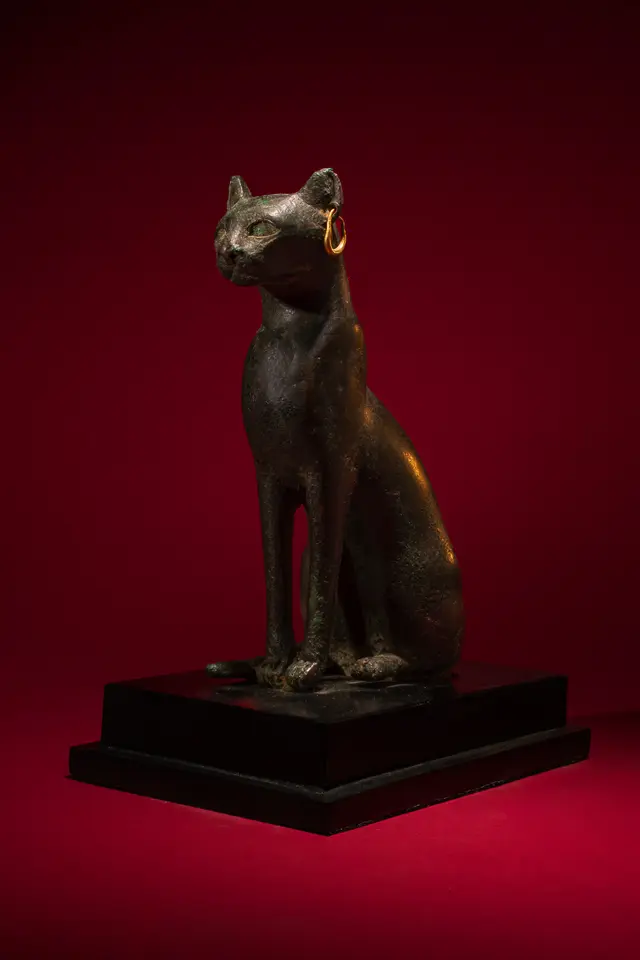
RARE EGYPTIAN BRONZE CAT STATUETTE WITH GOLD EARRINGS - LARGE SIZE
06/21/2026

$29,141.20
Est: $26,836.62
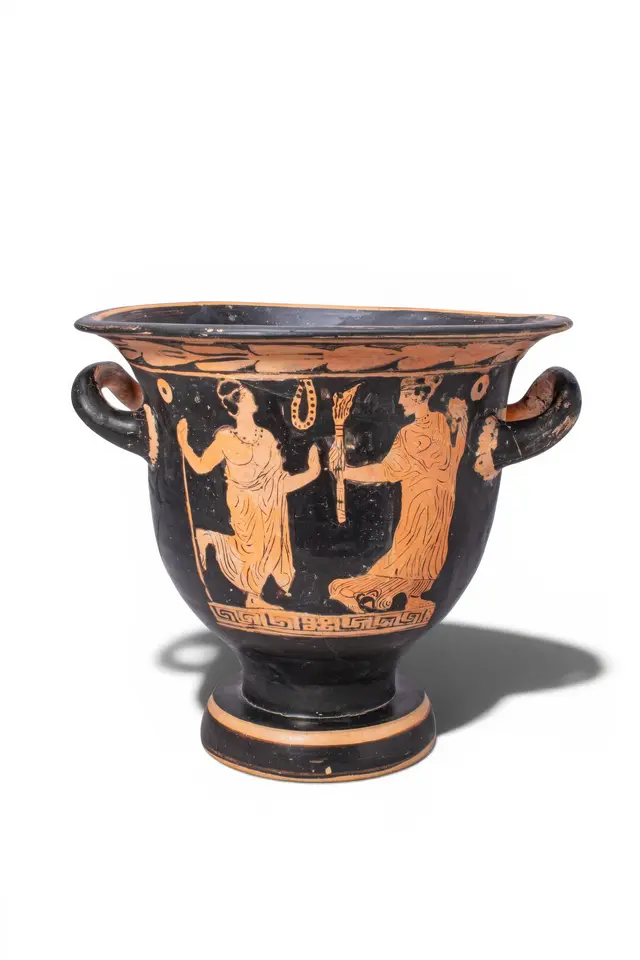
APULIAN RED-FIGURE BELL KRATER WITH KOMASTOS AND MAENAD - TL TESTED
06/21/2026
$3,443.96
Est: $2,640.96


NOV 28 | 4:00 PM


NOV 27 | 3:00 PM
Bring your auction to collectors worldwide!
Get listed nowBy subscribing, you are agreeing to the privacy policy. Unsubscribe anytime.
Barnebys HQ
Brahegatan 10
BOX 5038
114 37 Stockholm
