






NOV 8 | 1:00 PM

All auctions / Ethnographic / Acropora florida – White Branching Stony Coral Intricate...

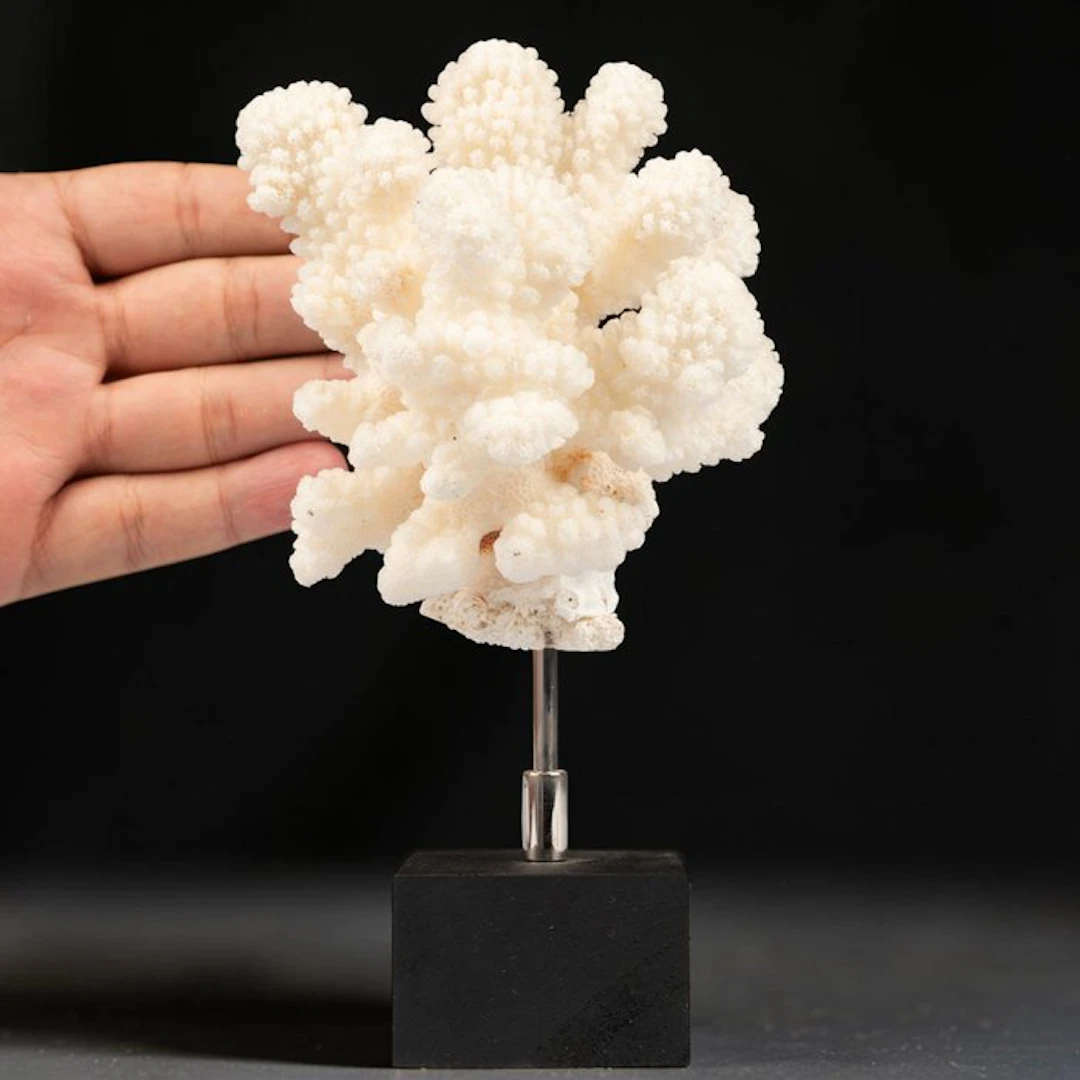
Acropora florida – The architecture of a coral colony Specimen of Acropora florida, a hard coral belonging to the Acroporidae family, characterized by a compact branched structure and numerous rounded ends. The skeleton, ivory-white in color, preserves a complex three-dimensional architecture, made up of branches that extend in different directions and overlap to form a colony with an almost arboreal appearance. The peculiarity of this specimen is the surface of the branches, entirely covered with tiny calcareous structures that give the coral a granular appearance. Observed up close, numerous small corallites can be distinguished, the skeletal cavities inside which the individual polyps of the colony lived. Each polyp contributed to the construction of the common skeleton, depositing calcium carbonate and taking part in the progressive growth of the entire structure. In Acropora, the corallites are not distributed randomly. Their arrangement is linked to the organization of the colony and to the growth patterns of the branches. In particular, the distinction between axial and radial corallites represents an important characteristic for identifying species of the genus. In living colonies, the polyps located in the growth zones contribute to the elongation of the branches, while those distributed laterally participate in the development and maintenance of the structure. Acropora florida is a species from the Indo-Pacific region, associated with tropical coral reef environments. Its colonies can develop robust, relatively short and closely spaced branches, with rounded tips and irregular surfaces. Morphology can vary according to environmental conditions, including light, water movement, and available space for growth. Like many other reef-building corals, Acropora florida lives in association with photosynthetic dinoflagellates present in its tissues. This symbiosis contributes to the colony’s energy needs and favors the deposition of calcium carbonate. Over time, the accumulation of skeletal material produced by the corals participates in forming the structures of coral reefs. The photographed specimen shows numerous well-developed ramifications, with an articulated distribution of branches and their terminations. The cream-white coloration allows the surface texture of the skeleton to be observed with particular clarity. In the lower zone, the basal portion of the colony is visible, from which the branched structure develops.
Estimate:$4.48
To the auctionView all items fromCatawikiorEthnographic
Estimate:
$4.48
NOV 8 | 1:00 PM


OCT 31 | 4:00 PM


OCT 27 | 4:00 PM
Bring your auction to collectors worldwide!
Get listed nowBy subscribing, you are agreeing to the privacy policy. Unsubscribe anytime.
Barnebys HQ
Brahegatan 10
BOX 5038
114 37 Stockholm
