


NOV 8 | 1:00 PM

All auctions / Ethnographic / A wooden sculpture - Prampram - Ghana

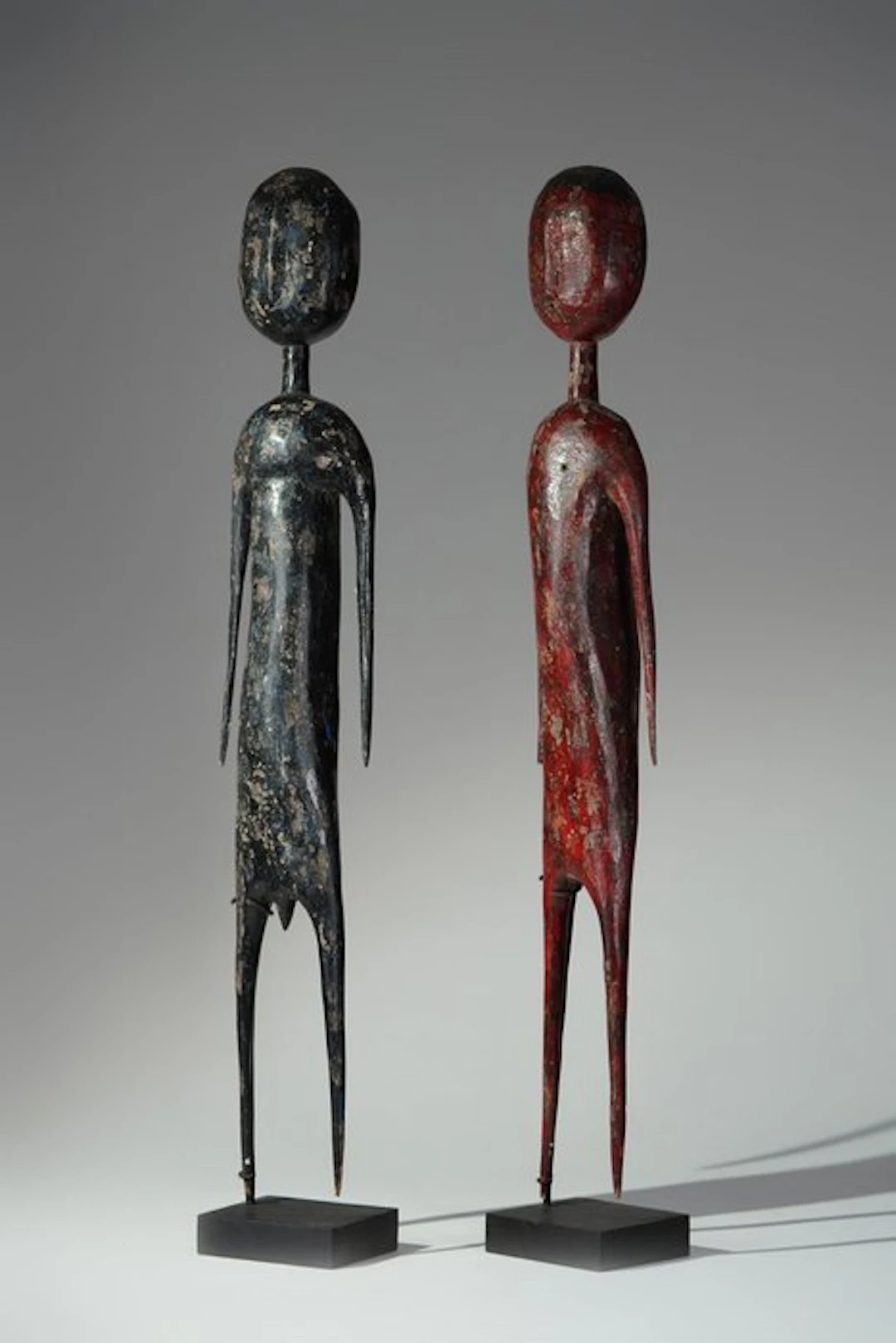
Pair of Figures from Prampram – Two Anthropomorphic Wooden Sculptures Origin: Prampram, Greater Accra Region, Southern Ghana Cultural Context: Prampram, within the cultural context of the Ga-Adangme (Dangme) people Material: Wood, carved, black and reddish-brown paint, surfaces worn in places Dating: Uncertain Provenance: Prampram Region, Ghana, according to traditional provenance information Description This ensemble, consisting of two slender, anthropomorphic wooden figures, is characterized by a consistently abstract formal language and remarkable compositional unity. Both sculptures follow an almost identical design principle: An oval, largely featureless head rises above an elongated, narrow body, clearly separated from the torso by a thin, cylindrical neck. The shoulders are softly rounded and flow into long, slender arms that hang parallel to the body. The legs appear as strongly elongated, downward-tapering appendages, their pointed ends further emphasizing the pronounced verticality of the composition. The left figure has a dark, almost black surface with bluish reflections in places and numerous light signs of wear. The right figure, in contrast, is characterized by an intense reddish-brown paint finish, whose partially glossy surface also reveals clear signs of use and irregularities. Both heads largely forgo anatomical details. Only faint vertical ridges and depressions structure their surfaces and offer a minimal suggestion of human physiognomy. The bodies are sculpted without pronounced chest or abdominal modeling. In the lower region, both figures exhibit small sculpted protrusions that could possibly be interpreted as male sexual characteristics. However, their identification remains uncertain due to the simplified rendering. The figures stand on separate modern display pedestals. Their almost mirror-image posture and the contrasting surface colors create a dynamic interplay between formal harmony and individual differentiation. Art Historical Analysis The coastal region around Prampram in present-day southern Ghana belongs to the historical settlement area of the Dangme people, who, together with the Ga, form a significant cultural and linguistic group within southeastern Ghana. The artistic traditions of this region developed within the interplay of local religious beliefs, familial and social organizational structures, and historical exchange relationships with neighboring populations. Besides figurative wood carvings, ritual objects, shrine furnishings, and items associated with protective beliefs, spiritual powers, and the veneration of supernatural beings are particularly well-known. The figures presented here differ markedly from naturalistic forms of representation. Their aesthetic effect is based on a significant reduction of anatomical details in favor of a clear, vertically oriented silhouette. This formal language can be compared with various anthropomorphic sculpture traditions of southern Ghana and neighboring Togo, although a direct stylistic or functional equivalence should not be inferred. The strongly elongated limbs, slender necks, and largely undifferentiated faces, in particular, point to a deliberate concentration of the human form on a few basic formal elements. The attribution to the Prampram region should be understood as a traditional geographical reference. A more precise classification within a specific local workshop tradition or a documented ritual object type is not possible based on the photograph. Symbolism and Iconography The iconographic peculiarity of the pair of figures lies in their pronounced formal parallelism and the simultaneous juxtaposition of two different surface colors. Black and red form a strong visual contrast that emphasizes the figures' connection without negating their individual appearance. In various West African religious and artistic traditions, colors can possess symbolic meanings and, for example, refer to specific spiritual powers, social categories, or ritual states. However, a direct transfer of such meanings to the sculptures in question would not be justified without a documented cultural context. It is conceivable that the different coloring was intended to make a complementary relationship between the two figures visible. It could also have served to distinguish between two people or spiritual beings. The paired arrangement opens up further possibilities. In numerous West African societies, concepts of duality, kinship, partnership, and social complementarity hold particular significance. The ensemble could therefore embody a symbolic community of two figures whose relationship is more important than their individual anatomical features. However, whether they actually represent an originally related pair cannot be deduced solely from stylistic similarity. The largely featureless heads also warrant special attention. Their closed, oval shape deprives the figures of a distinct personal identity and lends them a transpersonal appearance. This reduction could point to the representation of general human or spiritual principles, but remains an art historical interpretation. Ritual Function and Cultural Context In the religious life of Ga Dangme societies, traditional deities, local guardian spirits, ancestor worship, and the relationship between the visible and invisible worlds have historically played a significant role. Certain material objects can serve in this context as components of shrines, as symbols of spiritual presence, or as aids to ritual acts. For the two wooden figures in question, such a use is possible, but not proven. Their slender, elongated design and the lack of a base on the original figures could indicate that they were once embedded in another material, attached to a structure, or placed within a ritual ensemble. The tapered legs would, in principle, allow for such a use. Whether the figures were originally presented as a pair or only later combined into an ensemble remains unclear. Likewise, no specific cultic treatment can be deduced from the visible surface changes. The abrasions and paint loss could have resulted from prolonged handling, storage, or natural aging processes. The interpretation as ancestral figures, protective figures, or ritual representatives should therefore be understood as a possibility, not as a confirmed function. Art Historical Assessment The particular artistic quality of this pair of figures lies in the consistent reduction of the human body to an almost symbolic form. The elongated legs, slender arms, and heads clearly set off from the torso create an exceptionally stretched silhouette, the effect of which is further enhanced by the absence of ornamental details. The two sculptures appear less as individual portraits than as concentrated sculptural expressions of human presence. Their artistic strength lies in the balanced relationship between rounded and linear elements: the oval heads and softly modeled shoulders stand in striking contrast to the strictly vertical limbs. The different treatment of the surfaces is particularly impressive. The dark figure has a restrained, almost monochromatic appearance, while the red sculpture, through its intense color, unfolds a stronger visual presence. Together they form a composition in which repetition and variation become essential design elements. Subject to their cultural attribution, the ensemble can be appreciated as a remarkable example of abstract anthropomorphic wooden sculpture from the coastal region of southern Ghana. Its art historical significance lies primarily in its distinctive formal language and the striking combination of sculptural simplicity, color contrast, and potential symbolic duality. Literature For further scholarly contextualization, ethnographic and art historical studies on the Ga Dangme societies, their religious traditions, and the material culture of southern Ghana should be consulted. A verified literature reference directly related to this type of figure is not currently available. Copyright and Scientific Documentation Some of the information and photographs have been generated with the assistance of artificial intelligence and are based on published sources in ethnography, archaeology, and art history. Original texts and photographs may be protected by copyright. All rights held by the respective copyright holders are reserved. Inv. No. MAZ31810 Informant: Tagué Height: 98 cm / 98 cm Weight: 3 kg / 3,1 kg (incl. stand)
Estimate:$1,008.21
To the auctionView all items fromCatawikiorEthnographic
Estimate:
$1,008.21
NOV 8 | 1:00 PM


OCT 31 | 4:00 PM


OCT 27 | 4:00 PM
Bring your auction to collectors worldwide!
Get listed nowBy subscribing, you are agreeing to the privacy policy. Unsubscribe anytime.
Barnebys HQ
Brahegatan 10
BOX 5038
114 37 Stockholm
