


OCT 17 | 10:00 PM

All auctions / Ethnographic / A wooden sculpture - Moba - Togo (No reserve price)

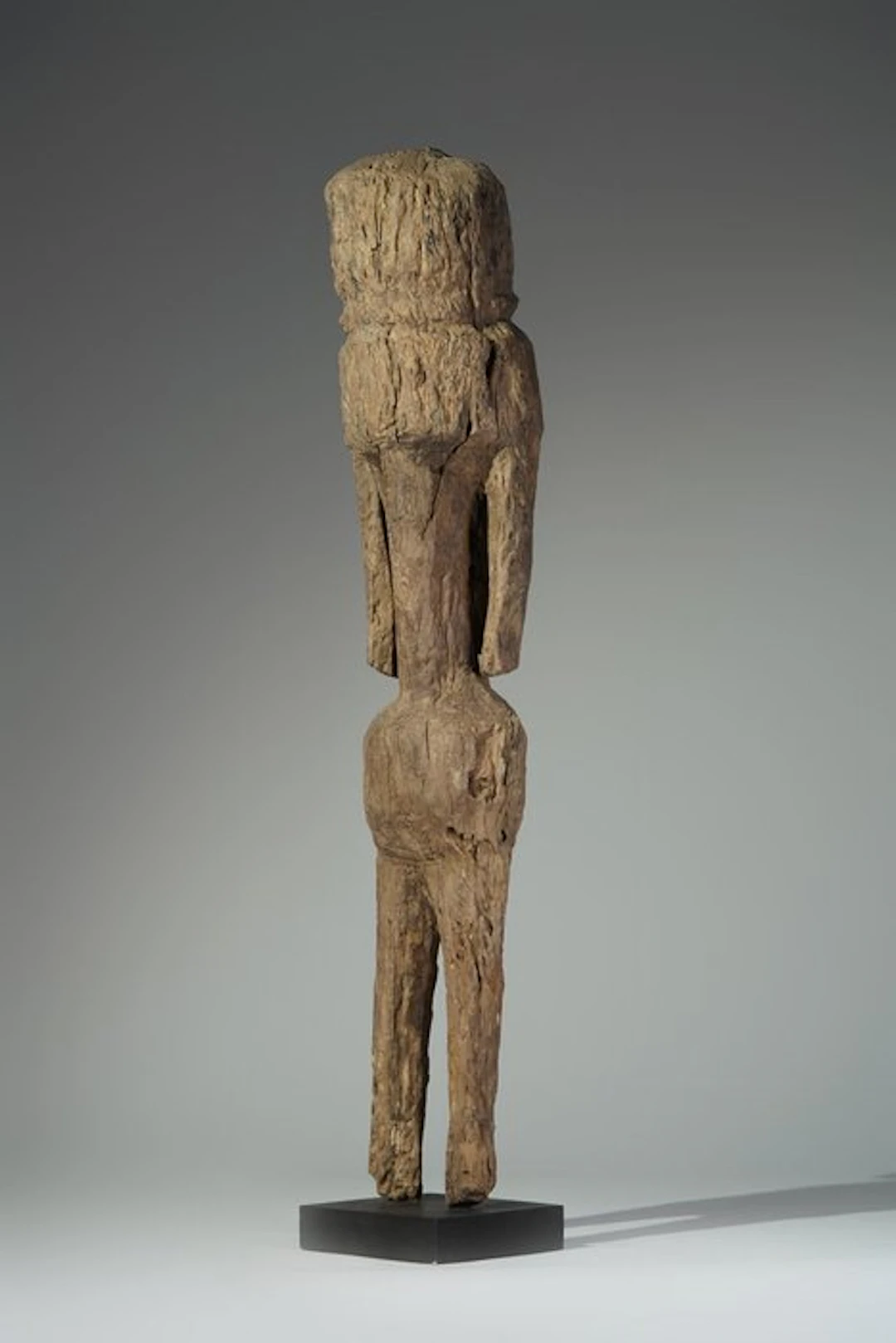
Moba sculpture, Dapaong region, Togo Wood, light brown to grayish-ochre in color. A wooden sculpture, Moba, depicts a standing human figure with a slender, highly elongated silhouette, whose anatomy is reduced to a few essential forms. The massive, almost cylindrical head lacks clearly discernible facial features; a horizontal constriction separates it from a widened torso, extended by two straight arms extending down on either side of the torso. The torso tapers sharply before joining a rounded pelvis, followed by two long, separate legs without clearly defined feet. This construction highlights the contrasts between the mass of the head and pelvis and the slenderness of the limbs. The wood, ranging in color from light brown to grayish ochre, retains a few dark patches and features a deeply eroded surface marked by longitudinal cracks, cavities, and areas of material loss that make certain details difficult to interpret. From a historical and anthropological perspective, the object belongs to a category of figures known as tchitcheri, documented among the Moba people of northern Togo and northeastern Ghana: placed on personal, family, or community altars, they are used in protective rituals and, depending on their category, may represent ancestors, thereby maintaining a ritual link between the living and previous generations. Moba sculpture differs from many neighboring West African traditions in its rejection of elaborate surface ornamentation. Scarifications, jewelry, clothing, and detailed hairstyles are generally absent from the most characteristic tchitcheri. Instead, the sculptor focuses on proportions, silhouette, and the tension between a few basic forms. Within the Moba corpus, differences in scale and sculptural refinement may correspond to differences in function and status. Ethnographic research distinguishes several categories of tchitcheri, notably personal figures and larger ancestral figures associated with family compounds. Without precise measurements or field documentation, however, it would be premature to attribute this sculpture with certainty to a specific ritual category. Stylistically, the work falls at the austere end of the Moba sculptural spectrum. Its significance lies precisely in the absence of decorative embellishments. The sculptor has transformed the human figure into an elementary symbol: head, body, arms, and legs—sufficient to establish a human presence while avoiding any individual identity. Selected Literature Kreamer, Christine Mullen. “Moba Shrine Figures.” African Arts, Vol. 20, No. 2, 1987. Kreamer, Christine Mullen. “The Moba and Their Tchitcheri Shrine Figures.” In African Arts. Kerchache, Jacques; Paudrat, Jean-Louis; Stephan, Lucien. L’Art africain. Paris, 1988. Roy, Christopher D. Art of the Upper Volta Rivers. Meudon, 1987. Some of the information and photos are generated by artificial intelligence and is based on published sources from the fields of ethnography, archaeology, and art history documents. All information and photos are protected by copyright. Inv. No. MAZ29289 Informant Ouro
Estimate:$420.16
To the auctionView all items fromCatawikiorEthnographic
Estimate:
$420.16
OCT 17 | 10:00 PM


Bring your auction to collectors worldwide!
Get listed nowBy subscribing, you are agreeing to the privacy policy. Unsubscribe anytime.
Barnebys HQ
Brahegatan 10
BOX 5038
114 37 Stockholm
