


NOV 8 | 1:00 PM

All auctions / Ethnographic / A bronze sculpture - Vere - Nigeria (No reserve price)

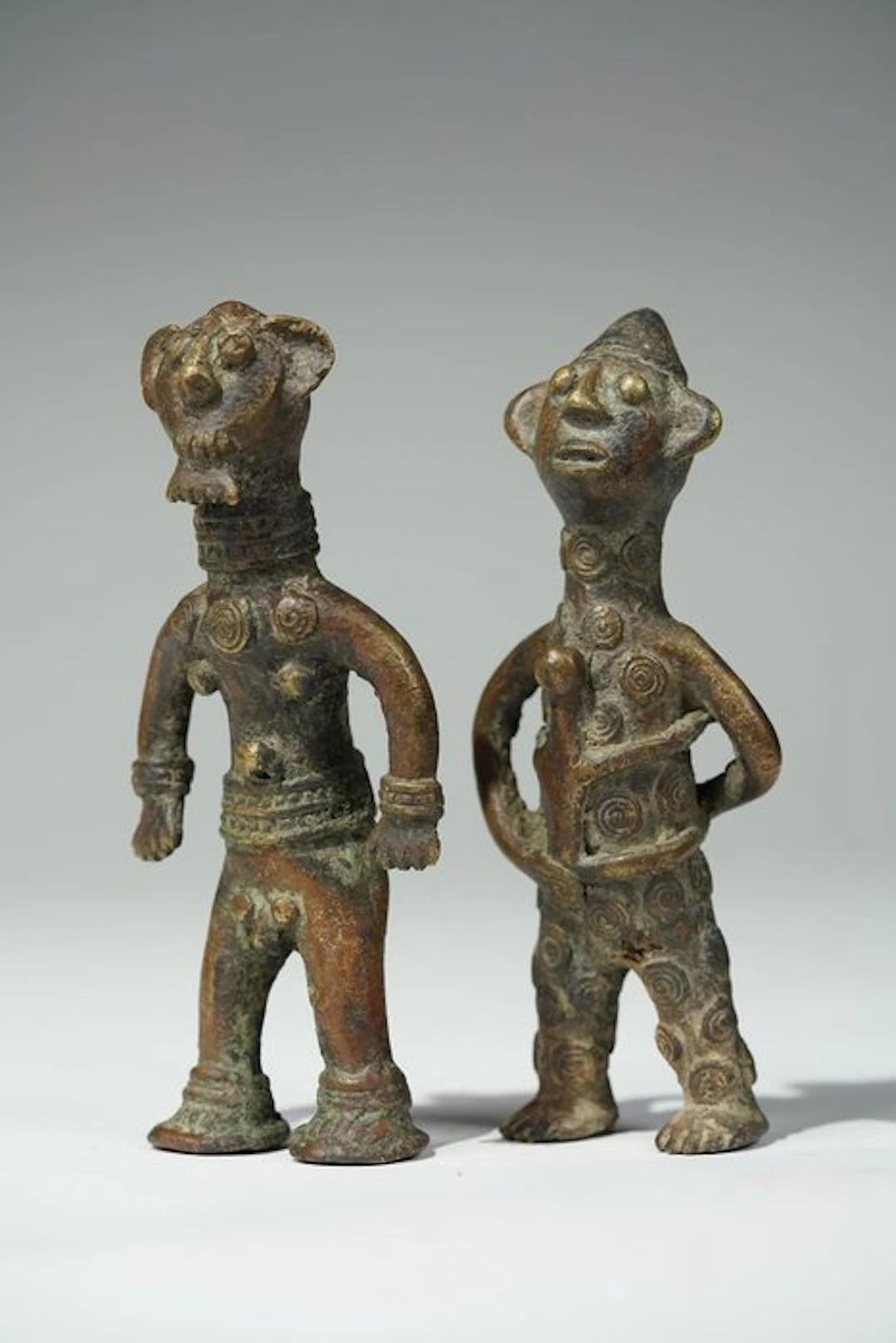
Vere Sculpture of Two Anthropomorphic Figures Origin: Jimeta collection area, Nigeria Material: Brown-black bronze with golden highlights, greenish patches, and earthy deposits. Description The figure on the left is male, as indicated by the depiction of the genitals. It stands facing forward on broad, flared feet; its legs are short, its arms arched, and its hands clenched. Its raised head has zoomorphic or hybrid features: large, lateral ears, bulging eyes, a protruding snout, and an appendage under the chin. It would, however, be unwise to identify the specific animal depicted. Rings encircle the neck, wrists, waist, and ankles, while spiral discs adorn the chest. The second figure appears to be female due to her breasts and the shape of her pelvis. She wears a conical hairstyle or headdress; her hemispherical eyes, triangular nose, protruding ears, and slightly parted mouth accentuate her expression. The arms wrap around the body and meet at the abdominal region. Spirals cover the neck, chest, abdomen, and legs: they may evoke jewelry, scarification, elements of clothing, or signs of rank, though no single interpretation can be definitively established. Both objects feature a brown-black patina, golden highlights, greenish patches, and earthy deposits. Historical and Artistic Analysis The Vere were renowned for their work in brass and other copper alloys. Their output included ornaments, bells, ceremonial hoes, daggers, initiation insignia, and human figures made of wood, clay, or metal. Recent research indicates, however, that anthropomorphic sculptures played a less central role among the Vere than among the neighboring Mumuye or Chamba. The corpus preserved today comes mainly from collections made in the early 20th century and then in the 1960s, when this metallurgical activity began to decline. The two statuettes share the same aesthetic of frontal orientation, stability, and ornate decoration, but they are not strictly identical: rather, they form a visual complementarity. The first combines a male body with an animal-like head; the second emphasizes femininity, the hairstyle, and spiral motifs. The thick relief and the proliferation of spirals are reminiscent of Verre's relatively late works, which became heavier and more lavishly decorated as metal became more readily available. This comparison, however, is not sufficient to date the objects: an attribution to the mid- or second half of the 20th century remains hypothetical. Scientifically Based Description Lost-wax casting is the most likely manufacturing technique: a wax model was encased in a refractory mold, then the wax was removed and replaced with molten metal. This technique is historically documented among the Verre foundrymen, but its use on these two pieces has yet to be confirmed. An X-ray would reveal internal cores, porosity, and any welds or repairs. X-ray fluorescence (XRF) analysis would measure the proportions of copper, zinc, tin, and lead to determine whether the metal is brass, bronze, or a mixed alloy. Microscopic examination would also help distinguish between the original patina, deposits resulting from use, restorations, and any artificial aging. Green corrosion merely indicates the presence of copper; it does not, on its own, constitute proof of age. Ritual Function It would be unwise to automatically identify these statuettes as an "ancestral" or marital "couple." Certain Verre figures, primarily made of wood, were carried by women or young people during public performances and rituals related to male initiation; a female figure, in particular, could symbolize the future wife of an initiate. However, this information cannot be mechanically applied to the metal figures. Copper alloys were more widely used in adornment, the display of wealth, initiations, and certain specialized cults. For this set, several functions therefore remain possible: objects of prestige, images of complementary genders, protective talismans, altar figures, ceremonial accessories, or works later paired together. Gender differentiation and the abundance of adornments may evoke fertility, marriage, or social complementarity, but no specific function can be asserted without field provenance, a vernacular name, and a collection narrative. Selected Bibliography Chappel, Tim, Richard Fardon, and Klaus Piepel. "Surviving Works: Context in Verre Arts." *Vestiges: Traces of Record*, vol. 7, no. 1, 2021. Berns, Marla C., Richard Fardon, and Sidney Littlefield Kasfir, eds. *Central Nigeria Unmasked: Arts of the Benue River Valley*. Los Angeles, Fowler Museum at UCLA, 2011. Brincard, Marie-Thérèse, ed. The Art of Metal in Africa. New York, African-American Institute, 1982; notably Arnold Rubin, "Bronzes of Northeastern Nigeria." Meek, C. K. *Tribal Studies in Northern Nigeria*, vol. 2. London: Kegan Paul, Trench, Trübner, 1931. Kirk-Greene, A. H. M. *Adamawa Past and Present: An Historical Approach to the Development of a Northern Cameroons Province*. London: International African Institute/Oxford University Press, 1958. The publications mentioned serve for comparative art historical classification. They do not establish the specific cultural attribution, dating, or original use of the sculpture in question. Copyright and Scientific Documentation Some of the information and photographs have been generated with the assistance of artificial intelligence and are based on published sources in ethnography, archaeology, and art history. Original texts and photographs may be protected by copyright. All rights held by the respective copyright holders are reserved. Inv. No. MAZ32962 Informant: Amadou Dogo Height: 17 cm / 16 cm Weight: 470 g / 430 g Sold without TL test. Catawiki's experts perform a virtual review based on the information, photographs, provenance and supporting documentation provided during the submission process. Acceptance of a traditional or ancient African art object for auction does not constitute independent authentication or certification by Catawiki, nor does it mean that Catawiki's expert has physically or scientifically authenticated, patina-analyzed, or dated the object. Under our Terms and Traditional African Art Submission Guidelines, the seller remains responsible for the accuracy, legality, provenance and authenticity of the object and the information provided.
Estimate:$504.1
To the auctionView all items fromCatawikiorEthnographic
Estimate:
$504.1
NOV 8 | 1:00 PM


OCT 31 | 4:00 PM


OCT 27 | 4:00 PM
Bring your auction to collectors worldwide!
Get listed nowBy subscribing, you are agreeing to the privacy policy. Unsubscribe anytime.
Barnebys HQ
Brahegatan 10
BOX 5038
114 37 Stockholm
