



All auctions / Vehicles / 1998 RUF Project Dragon

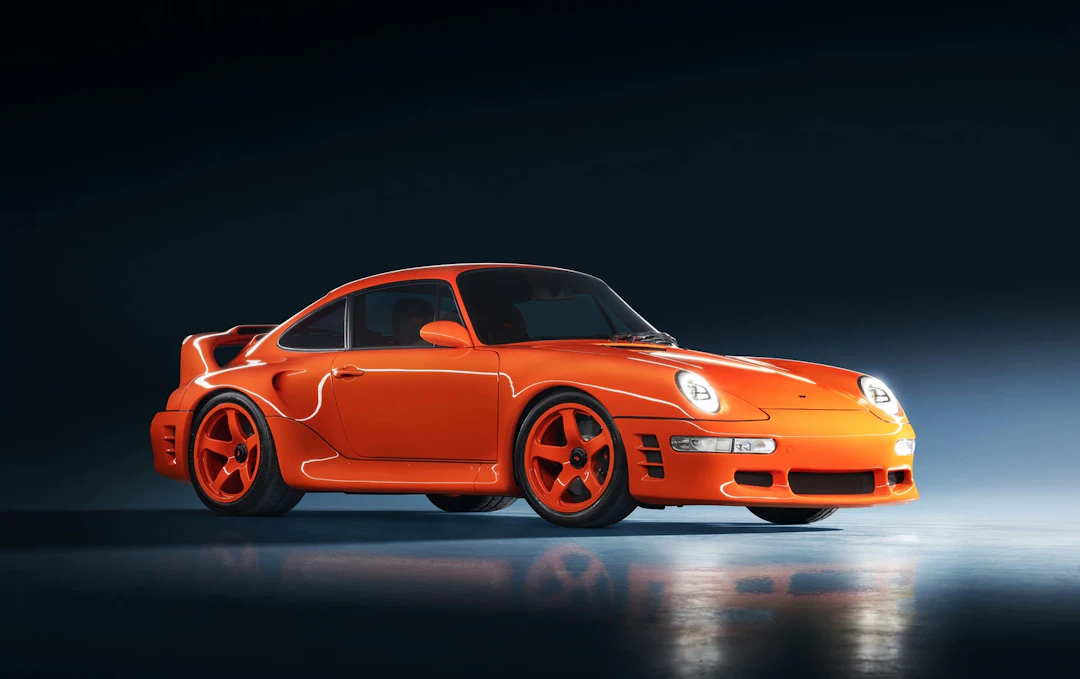
RUF established its reputation by taking the basic architecture of the Porsche 911 and pursuing its possibilities far beyond the limits imposed by series production. The car that brought RUF worldwide attention was the 1987 CTR “Yellowbird,” which famously reached 211 mph during Road & Track’s high-speed testing at Ehra-Lessien. Yet the CTR’s significance went beyond its headline speed. It established the template that would define RUF’s most ambitious road cars: immense performance, relatively restrained dimensions, and engineering developed around function rather than spectacle. When RUF turned its attention to the 993 generation, the result was the CTR2, introduced in 1996 as the company’s next great high-performance flagship. Beginning with a narrow-body 993 shell, RUF transformed the car comprehensively, revising the bodywork for improved aerodynamics and cooling, incorporating its Integrated Roll Cage, and developing the distinctive rear aerofoil whose internal ducting fed both the induction and intercooling systems. Beneath it sat an extensively developed, air-cooled 3.6-liter flat-six fitted with twin turbochargers and producing 520 hp in its initial specification. Period testing confirmed just how formidable the result was. In March 1997, Germany’s Auto Motor und Sport recorded 0–100 km/h (0–62 mph) in 3.6 seconds, 0–160 km/h (0–99 mph) in 7.6 seconds, and the standing kilometer in just 20.8 seconds. Those figures put the CTR2 firmly among the quickest road cars of its era and underscored just how much performance RUF had extracted from the air-cooled 993 platform. Development did not stop there. The CTR2 Sport represented a more aggressive evolution of the concept, with road-going versions producing approximately 580 hp, while competition derivatives demonstrated still greater potential. In 1997, two CTR2 Sport-based cars were prepared for the Pikes Peak International Hill Climb, where output rose to more than 700 hp. More recently, advances in carbon fiber construction, suspension, braking, engine management, and computer-aided design offered possibilities unavailable when the CTR2 Sport was created. Rather than reproduce the earlier car, RUF elected to preserve the character of the original while applying contemporary engineering and manufacturing techniques. The resulting one-off became known as Project Dragon. At the heart of Project Dragon was an unused W09 body-in-white that had remained with RUF since the CTR2 era. According to the car’s commissioner, a noted Porsche and RUF collector, Alois Ruf sold him the shell as “his very last one,” providing an extraordinary – and unrepeatable – starting point for one of the firm’s most ambitious air-cooled one-offs. The idea had been in the collector’s mind for decades. “This is the car I wanted to build back in 1997/98 when the CTR2 Sport was introduced,” he recalled, adding that “the technology did not exist yet then.” Over the ensuing years, he owned “many CTR2s, standard and Sport,” describing the model as his “very favorite RUF” and one he considers among the most beautiful interpretations of the 911. “I always had my original dream in mind,” he explained. “Alois continued to improve upon the development and then I could afford it, he was willing, and it all came together.” His brief was not to simply recreate a CTR2 Sport. Certain elements, however, were non-negotiable. The new car “had to retain the unique rear clamshell and bi-wing” as well as the original’s “very wide-body stance.” At the same time, he wanted to eliminate the door extrusions of the period CTR2 Sport and make the rear-quarter ducts “both functional and better looking.” Central to realizing that vision was British designer Tony Hatter, whose career at Porsche included responsibility for the exterior design of the 993-generation 911. Hatter’s design process for Project Dragon included sketches and computer modeling in CAD, followed by the production of molds and manufacture of new components. Nearly three decades after helping shape the 993 itself, Hatter was revisiting its basic form in a project largely freed from the constraints of series production. Although unmistakably descended from the CTR2 Sport, Project Dragon received substantially new bodywork. RUF constructed the outer shell entirely from carbon fiber and utilized the company’s Integrated Roll Cage. The front bumper and fenders were redesigned as a cohesive assembly, while the revised rear quarters incorporated the functional ducting specifically requested by the commissioner. The dramatic rear spoiler likewise served considerably more than a stylistic purpose. As on the original CTR2, separate airflow paths were incorporated into the rear bodywork, with the lower intake supplying induction air to the engine and the upper passage directing cooling air to the charge-air system. Thus, one of the defining features the collector insisted upon retaining remained functional rather than merely decorative. The chassis was brought up to date with Bilstein PSS10 suspension, carbon ceramic brakes, and 18" RUF center-lock wheels, designed and created just for this project by OZ Racing at a cost of nearly €100,000. Power came from a “special CTR2 engine,” characterized as a reinterpretation of the original air-cooled engine. Retaining twin turbochargers, it incorporated specially developed pressure pipes intended to optimize airflow and further increase performance. Output was confirmed on the dyno at 621 hp at 6,500 rpm and 834 Nm (615 lbs./ft.) of torque at 5,000 rpm, delivered to the rear wheels only. The personalization extended equally to the car’s appearance. “Orange is my favorite car color,” the collector explained, adding, “I always do one-off paints for my bespoke commissions with RUF.” Working with Estonia Ruf and her team, a series of samples were developed using Porsche’s Blutorange (Blood Orange) and Continental Orange as starting points. The eventual Dragon Fire Orange was created, he recalled, “by taking Blut and adding black and few other tweaks to darken the hue.” Rather than limit the color to the exterior, RUF carried it throughout the automobile, including the wheels, seat shells, embroidery, and specially finished instruments. Their orange backgrounds were contrasted by RUF’s signature green numerals and markings, producing one of the cockpit’s most distinctive details. The interior specification was equally personal. “The interior was also all me,” the collector noted. RUF fitted its distinctive “lollipop” seats in black semi-aniline leather, but the center sections were trimmed in new-old-stock 1970s Porsche velour, material he identifies as having originally appeared on the 914 GT. Its black ground and fine orange striping were repeated on the door panels, while the seat backs were finished in Dragon Fire Orange and the headrests embroidered with contrasting RUF logos. A RUF-embossed gear knob, black-anodized aluminum pedals, and further body-color detailing completed the cockpit. RUF also substantially reworked the rear compartment, integrating a bespoke luggage box into the rear bench area and trimming the parcel shelf in semi-aniline leather with prominent orange “DRAGON” embroidery. A RUF Classic Radio, upgraded sound system with a subwoofer beneath the passenger seat, and LED lighting added contemporary amenities without disturbing the deliberately period-conscious atmosphere. The scale of the undertaking is perhaps best demonstrated by the factory paperwork. RUF’s order identifies the automobile as a “RUF CTR2 Sport ‘Dragon’” and, more tellingly, as a “Special one of model,” individually listing the design work, CAD development, production of molds and new parts, carbon body, special engine, suspension, brakes, wheels, and bespoke interior appointments. There was also historical precedent for such an intensely collaborative undertaking. The original CTR2 Sport itself had developed in part through the efforts of American enthusiast and competition driver Steve Beddor, whose discussions with Alois Ruf helped lead to the creation of the more aggressive Sport variant. Delivered new in March 2024, Project Dragon displayed just 759 miles at the time of cataloguing and presents in virtually new condition throughout. It is accompanied by a RUF build book documenting the car’s construction and features, along with manuals, service records, paint and fabric samples, a car cover, tool kit, air compressor, and first aid kit. Project Dragon is ultimately the realization of an idea nearly as old as the CTR2 Sport itself. Conceived by a collector who had dreamed of building such a car since the CTR2 Sport was new, shaped by years of experience with multiple CTR2s, and constructed around what Alois Ruf represented as his final available W09 body-in-white, it could only have come together under exceptional circumstances. With Tony Hatter returning to the 993 form he had helped shape and RUF applying nearly three decades of further development to one of its most celebrated air-cooled models, Project Dragon stands as a singular meeting of RUF history, personal vision, and contemporary engineering. car
Estimate:$8,000,000
To the auctionView all items fromGooding Christie'sorVehicles
Estimate:
$8,000,000
A COLLECTION OF TWELVE VINTAGE CAR CLUB BADGES including Bri...
09/29/2026

$265.26
Est: $66.97




OCT 27 | 4:00 PM
Bring your auction to collectors worldwide!
Get listed nowBy subscribing, you are agreeing to the privacy policy. Unsubscribe anytime.
Barnebys HQ
Brahegatan 10
BOX 5038
114 37 Stockholm
