





NOV 8 | 1:00 PM

All auctions / Coins & Banknotes / 1792 Half Disme. LM-1, Judd-7, Pollock-7. Rarity-4. MS-65 (NGC).

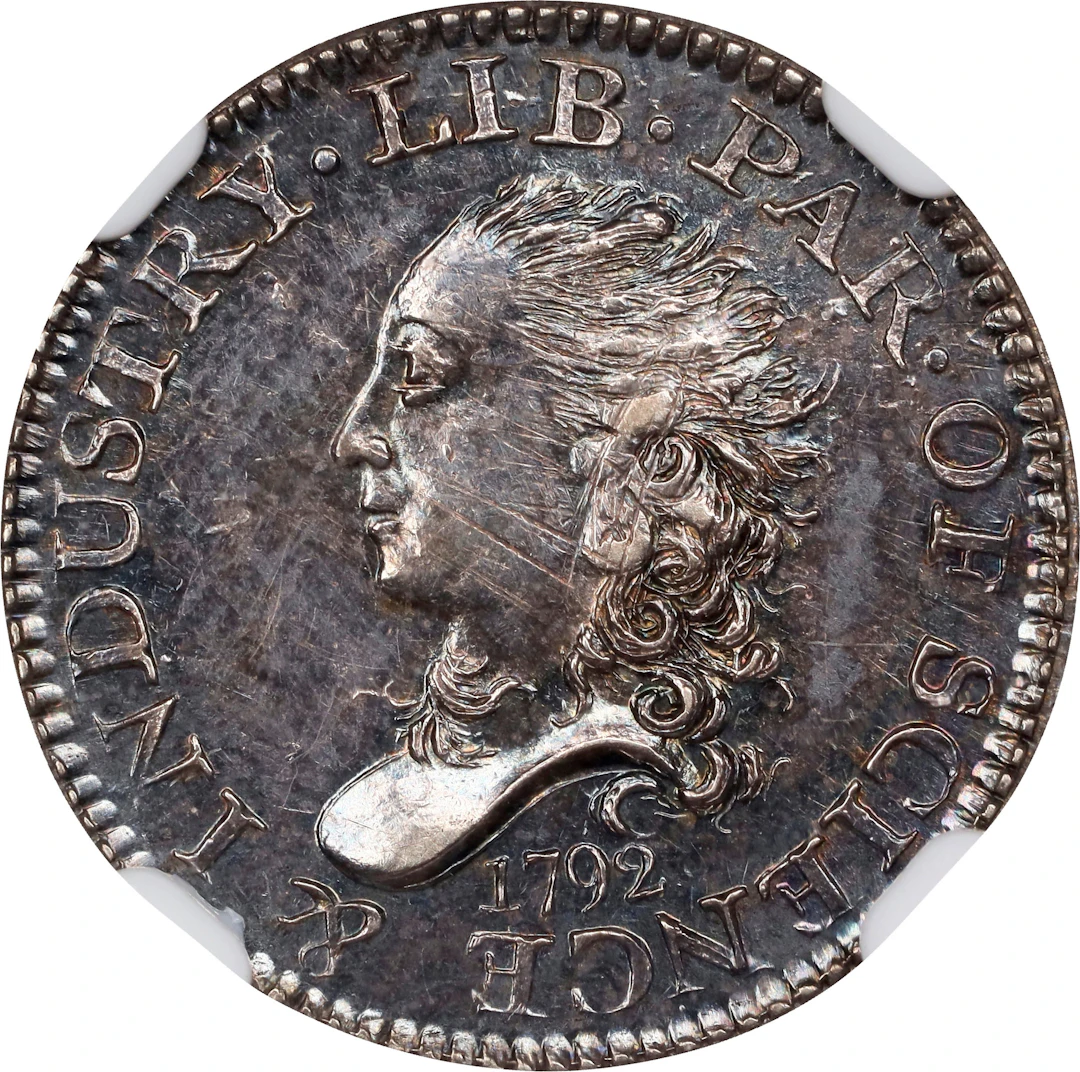
Historic 1792 Half Disme The Famous Garrett Specimen NGC MS-65 1792 Half Disme. LM-1, Judd-7, Pollock-7. Rarity-4. MS-65 (NGC). Smith-Orosz-Augsburger Coin 65-2. Die Sate 1-A, with no damage to the reverse die. Obv: A bust of Liberty with short, curly hair faces left, the date 1792 in small digits immediately below the curved truncation of the bust. The legend LIB. PAR. OF SCIENCE & INDUSTRY is around the border, an abbreviation of "Liberty, parent of science and industry." Rev: A small eagle with spread wings faces to the left with the denomination HALF DISME and a single star below. The legend UNI. STATES OF AMERICA encircles most of the reverse periphery. All 1792 half dimes except for the unique copper impression (Judd-8) are struck in silver with a diagonally reeded edge, and a single set of dies was used to complete the entire mintage of approximately 1,500 pieces. The coins were struck with medallic alignment. This is one of the most famous, and currently also one of the finest certified examples of the scarce and historically significant 1792 half disme. The strike is uncommonly well executed for a type that often displays blunt central definition and/or incomplete denticulation around the borders. On the obverse of this coin, all focal design elements are sharp except for a few of the highest curls of Liberty's hair. The strike at central reverse is more typical for the type, the eagle's breast, inner left wing and left leg missing all but a trace of feather detail, although we stress that all other features on this side are sharply rendered. Centering is also superior for the issue, the obverse trivial aligned to 7:30, but with complete, nearly uniform border denticulation framing this side of the coin. The reverse impression is more significantly off center to 10:30, and while the denticulation is still complete, it is noticeably thinner at upper left than elsewhere, thin area of smooth field outside the denticles from 12:30 to 6:30. The impressive features of this coin are fully appreciable given the superior level of preservation at the desirable Gem Mint State grade level as assigned by NGC. Free of wear, the surfaces retain full frosty to modestly semi-prooflike luster that is most intense in direct lighting. Several crisscrossing adjustment marks within Liberty's portrait at central obverse are as made and serve as useful provenance markers alongside a minor scratch on the reverse angling down from the back of the eagle's head along the top of its left wing and a faint hairline in the upper field on this side, curving below the letters in the word OF. The entire coin is draped in rich steely olive-charcoal gray that lightens a bit in and around the central reverse, both sides with soft underlying champagne-pink and powder blue undertones appreciable with the aid of direct lighting. Following passage of the Mint Act of April 2, 1792, the Treasury Department made arrangements to set up a mint. Although there had been private mints in America dating back to the days of the Massachusetts Bay Colony, this was to be the first federal institution. Dr. David Rittenhouse, an eminent scientist and craftsman, was named director. By mid-July of the same year a press was on hand and stored in the shop of John Harper at the corner of Sixth and Cherry streets, not far from where the Mint would be erected. That awaited the laying of a foundation stone on July 31 and work after that time, including rehabilitation of a large existing structure and the building of new ones. At the time Philadelphia was the seat of the federal government and it was only logical that the Mint be located there. The Federal City, as it was first known, was in the planning stage. It was not until 1800 that the government was moved there, by that time known as Washington City or simply Washington. On October 15, 1792, George Washington received a report from Secretary of State Thomas Jefferson noting that there has been a small beginning in the coinage of the half dismes, and included this milestone in his Annual Address to Congress that November. Struck from $75 of silver bullion deposited by Jefferson, the coins were produced in the cellar of John Harper's shop several blocks from where the first United States Mint was still being readied. Jefferson took delivery of 1,500 half dismes on July 13, 1792, his last day in Philadelphia that summer, and it appears he spent them on his trip back to Monticello, largely as tips for the servants he encountered along the way. At Chester, Christiana, Elkton, Bushtown, Baltimore, Elkridge, Bladensburg, Georgetown, Elkrun Church, and Orange, Jefferson recorded tips to servants all in neat multiples of five cents. While the quartered pistareen (also worth 5 cents) was the coin of the realm in the Chesapeake colonies, they were also difficult to carry in quantities for one simple reason: they were pointy and inconvenient (this is why folks in the Ohio Valley called them "sharp money"). The very first payment of precisely $0.05 Jefferson recorded in his Memorandum Book after receiving the half dismes took place in Virginia on July 19, 1792. The recipient was recorded as, simply, "a child." It's a moment anyone can imagine - dropping a bright shiny new coin in a tiny hand. Over the next 24 hours, Jefferson delivered two more half dismes into the hands of children he encountered. These were not pattern coins. They were spending money that Jefferson, then a man approaching 50, was enjoying handing out on his long trip home. One wonders if the upcoming arrival of his first grandchild was turning him into a softy. Thomas Jefferson Randolph was born on September 12, 1792, just two months later. Although 1,500 pieces is generally regarded as the entire mintage for this issue, research published by Pete Smith, Dr. Joel Orosz and Leonard Augsburger in their excellent reference 1792: Birth of a Nation's Coinage (2017) confirms a second striking period in October 1792. The authors believe that the 1,500 coins from the July strike were made on Harper's press while the October striking utilized the Mint press. A third striking period is also discussed, the dies having been removed from the press after the second striking period to create an interruption in coinage. Exactly how much time elapsed between the second and third striking periods is unknown. The uncommonly well centered, universally bold to sharp strike of this coin and Die State 1-A attribution confirm it as one of the earliest impressions from the first striking period in July 1792. The Smith-Orosz-Augsburger study concluded that this die state accounts for approximately 57.7% of 1792 half dismes extant in all grades, and 41.2% of the Mint State survivors. As with their less widely recognized counterparts from the second striking period, these earlier pieces were widely distributed beginning with Jefferson, and many did yeoman's work in circulation for many years, as evidenced by the fact that most survivors irrespective of striking period or die state are in low grades and often damaged. Indeed, many have been found throughout the Eastern Seaboard, including heavily worn examples found in New Jersey as well as Washington's and Jefferson's home state of Virginia. Ever since the very beginnings of American numismatics, the 1792 half dismes with their direct connections to the nation's Founding Fathers have been among the most coveted of all federally issued coins regardless of condition. Steeped in history, this Mint State example of one of the most significant American issues would make an impressive addition to any advanced collection. Provenance: Property from an Alabama Family. Earlier ex Henry Chapman's sale of June 1914, lot 1692; James W. Ellsworth, March 1923, via Wayte Raymond; John Work Garrett, to The Johns Hopkins University, by gift, 1942; our (Bowers and Ruddy's) sale of the Garrett Collection for The Johns Hopkins University, Part IV, March 1981, lot 2351; Superior's Jascha Heifetz Collection sale, October 1989, lot 891; Superior's The Father Flanagan's Boys Home Sale, May 1990, lot 3350; our (Stack's) sale of October 1995, lot 267; our (Bowers and Merena's) Rarities Sale of August 2004, lot 1383; our (Bowers and Merena's) Rarities Sale of August 2009, lot 677; Rare Coin Wholesalers (Steven L. Contursi); offered on eBay, September 2012-January 2013; offered by U.S. Rare Coin Investments (Tom Pilitowski), 2015, reported sold May 22, 2015; offered on eBay, June 2015; Rare Coin Wholesalers (Steven L. Contursi), August-November 2015; offered on eBay March-May 2016. NGC Census: 1; 0 finer. The corresponding PCGS Population is 0/5 (including the Specimen-67 coin; MS-68 finest). PCGS# 11020. NGC ID: 22ZS. Click here for certification details from NGC.
Estimate:$1
To the auctionView all items fromStack's BowersorCoins & Banknotes
Estimate:
$1
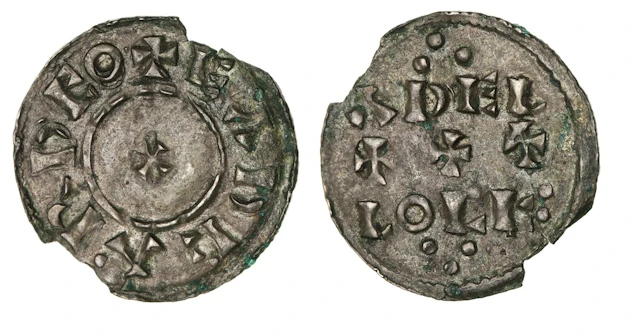
Eadgar (959-975), 'Two Line' Type, Penny, "With and From God", Æthelwulf
10/08/2026
$1,124.11
Est: $662.02
NOV 8 | 1:00 PM


OCT 31 | 4:00 PM

OCT 27 | 4:00 PM
Bring your auction to collectors worldwide!
Get listed nowBy subscribing, you are agreeing to the privacy policy. Unsubscribe anytime.
Barnebys HQ
Brahegatan 10
BOX 5038
114 37 Stockholm
