



Bring your auction to collectors worldwide!
Get listed nowBy subscribing, you are agreeing to the privacy policy. Unsubscribe anytime.
Barnebys HQ
Brahegatan 10
BOX 5038
114 37 Stockholm
All auctions / Ethnographic / 11th C. Indian Marble Stele - Gauri on the Godha

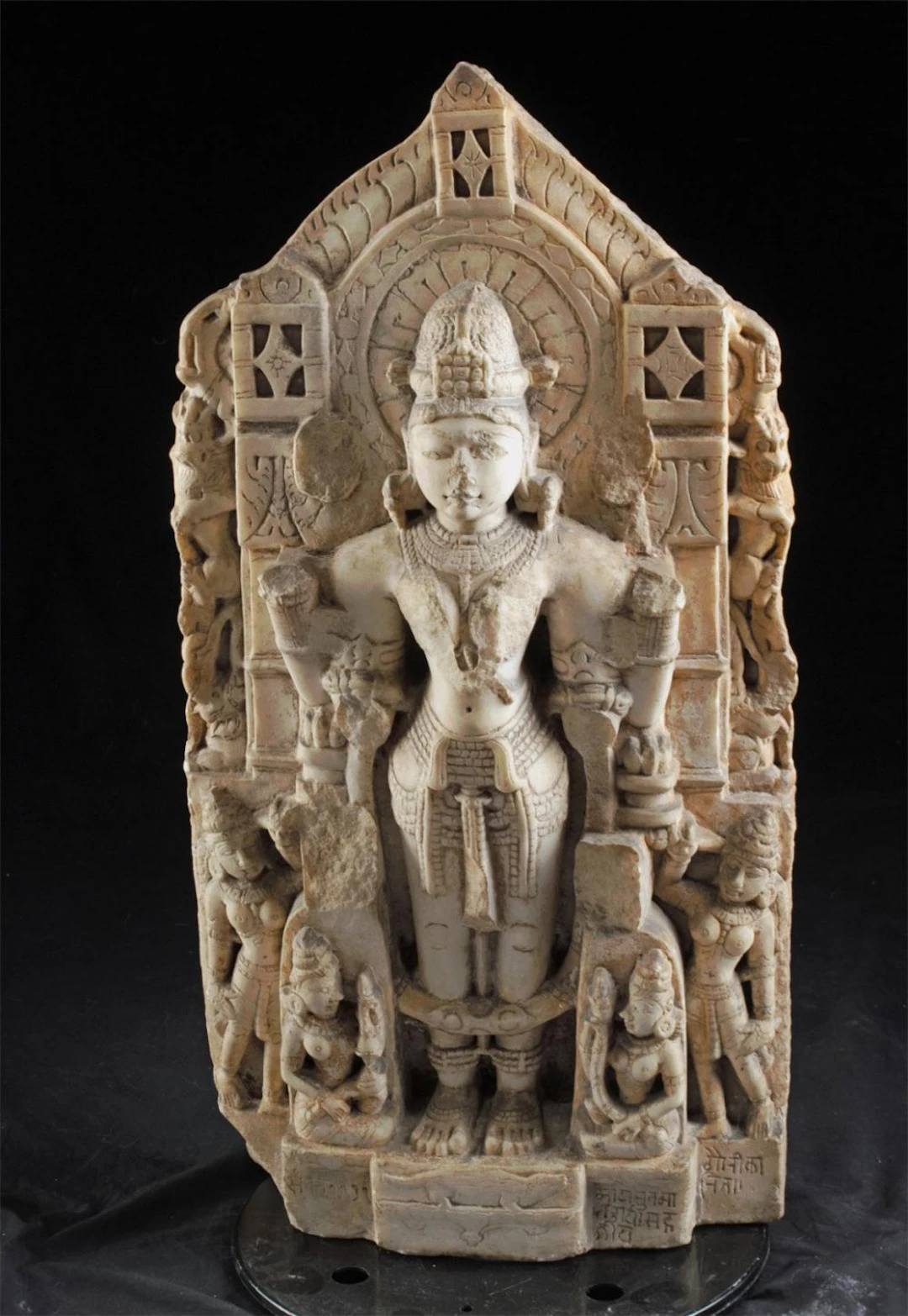
South Asia, India (Rajasthan or Gujarat), Solanki (Chaulukya) or Paramara period, ca. 11th to 12th century CE. A white marble stele houses the goddess Gauri inside a miniature shrine, her plaited crown climbing into the arch overhead and a stout, blunt muzzled animal couched at her feet. She stands samabhanga, four armed, rigidly frontal and evenly weighted upon a plain rectangular plinth. The jatamukuta is built of coiled and braided hair bound in jeweled courses and closed with a stepped finial, a Shaiva headdress rather than the smooth conical crown of the Vaishnava pantheon, and makara headed pendants swing at her ears. A wide beaded collar rings the throat, a long chain descends past the navel, and a girdle of many strands loops in shallow festoons across the hips above a lower garment whose central cascade falls in crisp vertical pleats toward the shins. Heavy ringed anklets close the figure at the ground. Around her the sculptor raised architecture: a lobed arch springing from pilastered pavilions pierced with jali windows, a foliate crest, and above that the tiered finial of a shrine tower, so that the goddess is not merely carved but installed. Two pairs of women attend her, the taller flexed in tribhanga at the outer margins, the smaller kneeling near her feet in attitudes of offering. Four plain rectangular masses flank her legs, perhaps the agnikundas that ring the earliest known image of this type on the east wall of Cave 23 at Ellora. The base blocks carry short incised inscriptions in Nagari, cut in a hand distinctly later than the sculpture. Size: 13.8" W x 25.5" H x 5.1" D (35.1 cm W x 64.8 cm H x 13.0 cm D) The animal at her feet is the godha, the Indian monitor lizard named as Gauri's vahana in the Agnipurana, compressed by eleventh century western Indian convention into the stout, blunt muzzled form that older literature often labels a mongoose. The identification is not in doubt. It is fixed by the epithet godhikavahini, she who rides the godha, and by the formula godhasana bhavet gauri, Parvati becomes Gauri when she performs her penance standing upon the godha. Only the resemblance is deceptive, and it is deceptive by design. Sculptors of the seventh through tenth centuries drew the creature as it lives, long and low and slipping out of the folds of a hillside. From the late tenth century the length collapses and the body swells into the thick necked animal seen here, a shift Elora Tribedy reads as deliberate rather than inept: the mongoose, nakula, is the attribute of Kubera and the guardian of household wealth, and by the eleventh century Gauri had moved from mountain ascetic to mistress of the domestic shrine, petitioned for the steady increase of the house. The vahana thickened as its mistress settled down, and the borrowed silhouette was the point. There is a longer arc beneath the animal's ankles. For most of recorded Indian history the godha was meat, hunted with spades and dogs and smoked out of its burrow after a summer thunderstorm, its flesh praised in the Jatakas and the medical compendia and eaten chiefly by forest dwelling and semi nomadic communities while the upper strata kept a taboo against it. Its passage onto the pedestal of the great goddess records a sanctification, an animal of the margins raised into the sacred and then, in these later western Indian images, domesticated into a plump emblem of prosperity. Gauri herself is Parvati at her most luminous, daughter of Himavat, who withdrew into the hills to perform tapas, first to win Shiva as a husband and then, in one strand of the tradition, to burn the darkness from her own skin and emerge fair, which is precisely what her name means... white, shining, brilliant. Indian folklore insists that a monitor's jaws, once shut, cannot be prised apart, and the reptile beneath her likely reads as a figure for the tenacity of her austerities, unpersuadable and in no hurry. A chromatic wit attends the pairing as well, since the yellow monitor, Varanus flavescens, is known as svarna-godhika, the golden lizard, so the shining goddess arrives upon a shining mount. By the fifteenth century the Rupamandana, composed by the architect Mandana under the patronage of Maharana Kumbha of Mewar, prescribes for her the rosary and the lotus with the gestures of reassurance and of boon giving, and recommends that Gauri upon the godha be worshipped in the household shrine for lasting prosperity. This stele, scaled for a domestic or subsidiary shrine yet framed with the full apparatus of a temple, sits squarely inside that instruction. Material and framing place her in western India. Marble of this whiteness was quarried at Makrana in Nagaur and at Arasur near Ambaji, and the lobed arch with its jali windowed pavilions belongs to the Solanki (Chaulukya) workshops of Gujarat and the neighboring ateliers of Marwar and Mewar, with the Paramara studios of Malwa close by in idiom. The compressed godha of exactly this type recurs among the fifteen forms of Parvati carved into the walls of the Rani ki Vav at Patan, the eleventh century stepwell raised as a memorial to Bhimadeva I, and again on the Parvati images from Hinglajgarh in Mandsaur district, where the animal is sometimes shown tangled in lotus stalks. Gauri's cult was formidable across this ground, sustained by Brahmanical and Jain patronage alike, the eleventh century Nirvanakalika and the thirteenth century Pratishthasaroddhara both praising her as godhavahanam and godhagata. It has not diminished. Every spring Rajasthan still fills its streets for Gangaur, the festival that carries her name. Item # 202511
Estimate:$3,500
To the auctionView all items fromArtemis Fine ArtsorEthnographic
Estimate:
$3,500



Bring your auction to collectors worldwide!
Get listed now